
Paid media in the United States is no longer a single-channel game. The advertiser who only knows how to bid on a few keywords in Search is leaving money on the table while a competitor across town in Dallas or Miami is running a coordinated machine across Search, Shopping, Display, YouTube, and Microsoft Ads. This guide is the operating manual for that machine. It is written for US advertisers who want a full-funnel system in 2026, with real USD budget ranges, seasonal bidding logic around Black Friday, Cyber Monday, and Amazon Prime Day, and a clear path to reach both the general US market and the large US Hispanic audience that most accounts under-serve.
At Orbis we have spent more than fifteen years building paid media programs, and the pattern that separates winners from the rest is rarely the bid strategy of the week. It is structure, measurement discipline, and the willingness to treat each channel as a role player on a team rather than a standalone hero. As a Google Partner with a 4.9-star rating across 58 reviews and more than 500 clients served, we have watched the same mistakes repeat across industries: budgets concentrated in the wrong funnel stage, conversion tracking that quietly breaks, and seasonal moments that arrive faster than the account is ready for. This guide exists to keep you out of those traps.
If you want the short version: build a clear funnel, instrument it honestly, fund the stage that is actually your bottleneck, and pressure-test everything against the US calendar. The long version follows. For a deeper look at how we run these programs end to end, see our paid media services.
The Full-Funnel Mental Model for US Paid Media
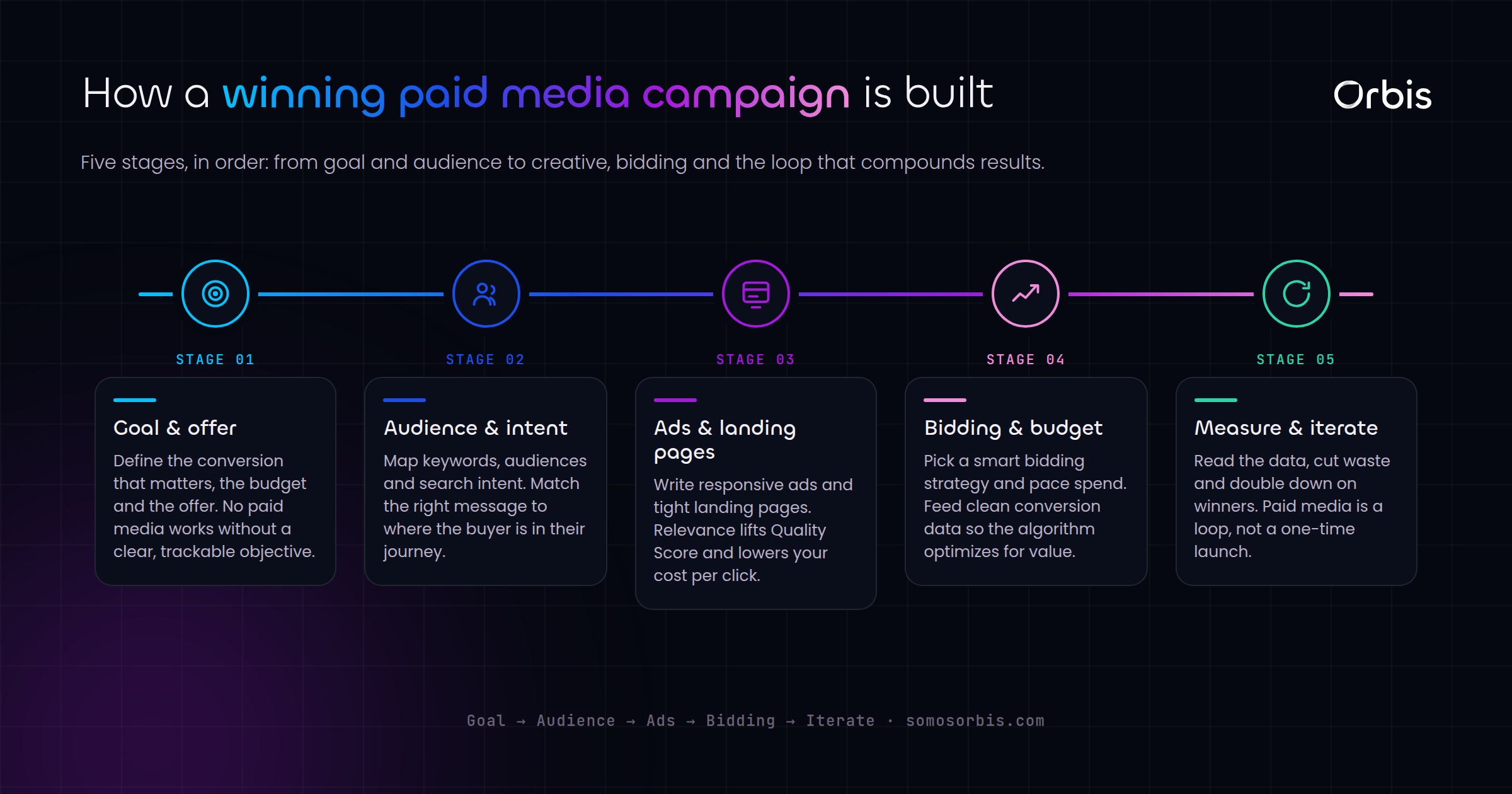
Every dollar you spend on paid media in the US falls into one of three jobs: create demand, capture demand, or convert and retain it. Most accounts that struggle are over-invested in capture and under-invested in the other two. They bid aggressively on bottom-of-funnel keywords, then wonder why volume plateaus and cost per acquisition creeps up every quarter. The fix is to think in stages and assign each channel a role.
Top of Funnel: Demand Creation
This is where you reach people who do not yet know they need you. In the US, that means YouTube for video storytelling, Display for visual reach, and broad Performance Max or Demand Gen campaigns for efficient prospecting. The goal here is not a same-day sale. It is to enter the consideration set of buyers in markets like Los Angeles, Chicago, and Houston before they ever type your category into a search bar. A healthy US account typically allocates 20 to 30 percent of total budget here, more if you sell a considered purchase with a long sales cycle.
Middle of Funnel: Demand Capture
This is the engine room: Google Search, Google Shopping, and Microsoft Ads. When someone in Miami searches "commercial HVAC repair near me" or a shopper in New York compares running shoes, you want to be there with the right message and the right price. This stage usually earns 50 to 60 percent of budget because intent is highest and the path to revenue is shortest. The discipline here is precision, not volume for its own sake.
Bottom of Funnel: Conversion and Retention
Remarketing across Display and YouTube, plus dynamic Shopping remarketing, closes the loop. A US shopper who abandoned a cart on a Tuesday is a very different prospect from a cold audience, and the bid, creative, and offer should reflect that. This stage is small in spend, often 15 to 25 percent, but it carries the best return on ad spend in almost every account we audit.
The reason structure matters so much is documentation. When each campaign has one clear job, you can read the account like a dashboard and know exactly which lever to pull. This is the Business Assurance principle of Documented Processes applied to media: a paid account that anyone on the team can understand and operate is an asset, while one that lives only in the head of a single specialist is a liability.
Google Search Ads: The Core of US Demand Capture
Search is where intent is purest, and for most US advertisers it remains the largest single line item. The fundamentals have not changed, but the execution bar has risen. Broad match plus smart bidding now works far better than it did a few years ago, provided your conversion tracking is clean and your account structure feeds the algorithm good signals.
Start with tight thematic ad groups, even inside broad match campaigns. A plumbing company serving the Dallas metro should separate "emergency plumbing," "water heater installation," and "drain cleaning" so that ad copy and landing pages match the query. Responsive search ads should carry at least eight to ten distinct headlines that vary by benefit, proof, and call to action, plus pinned brand and offer headlines where compliance or messaging requires control.
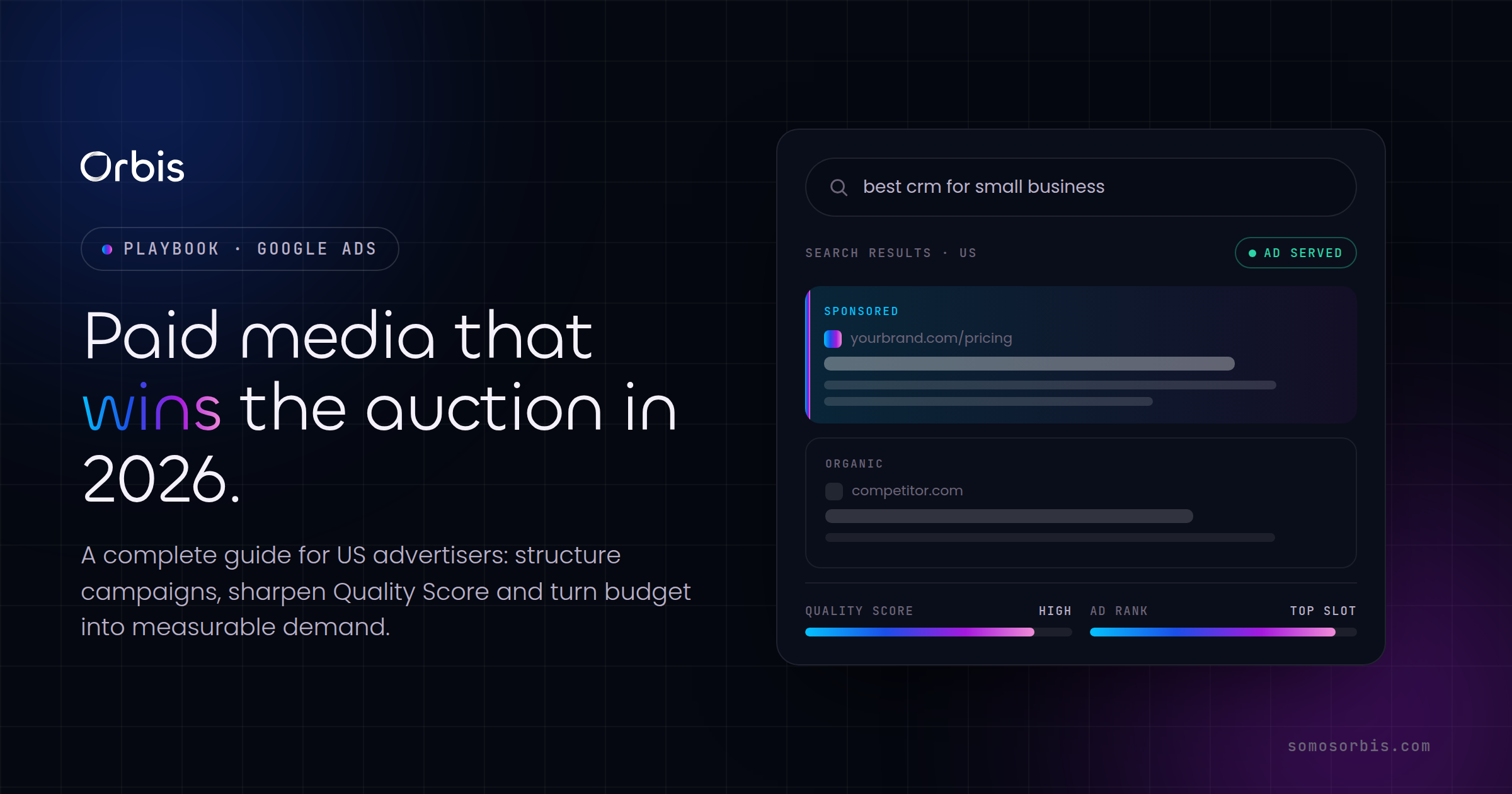
The single highest-leverage metric in Search is Quality Score, because it compounds. Higher Quality Score lowers your cost per click and improves ad rank simultaneously, which means you pay less and show more. We go deep on the levers that move it in our companion piece on Quality Score for US Search advertisers, and it is worth reading before you scale spend.
Bidding Strategy in USD Terms
For a new US Search campaign with limited data, start on Maximize Conversions to gather signal, then graduate to Target CPA or Target ROAS once you have at least 30 conversions in a 30-day window. Set your initial Target CPA slightly above your true breakeven, then tighten it weekly. A common mistake is setting a target so aggressive that the algorithm starves the campaign of impressions. In a competitive US vertical, a $45 Target CPA when your real economics support $70 will simply turn the campaign off.
Budgeting Search for a US Account
- Local service business (single metro): $3,000 to $8,000 per month in Search is enough to dominate a mid-sized market like Charlotte or Tampa.
- Regional or multi-city brand: $10,000 to $40,000 per month, segmented by market so New York and a smaller market are not forced to share a single budget.
- National ecommerce or lead gen: $50,000 and up, with Search as the capture layer beneath a broader full-funnel program.
If you want this layer built and managed with the rigor it deserves, our Google Search Ads service handles structure, bidding, and continuous optimization.
Google Shopping: Winning the US Retail Click
For any US business that sells physical products, Shopping is often the highest-ROAS channel in the account. It works differently from Search because there are no keywords to bid on directly. Instead, Google reads your product feed and matches it to queries. That means the feed is your campaign, and feed quality is the difference between a profitable program and a money pit.
The titles in your feed do the heavy lifting. A title like "Nike Air Zoom Pegasus 41 Men's Running Shoe Black Size 10" will be matched and clicked far more often than "Pegasus 41." Front-load the brand, product type, and the attributes US shoppers actually search: size, color, gender, material, and key specs. Your product type and Google product category fields should be fully populated, because they help the algorithm understand context that the title alone cannot convey.
We treat feed work as ongoing engineering, not a one-time setup, and the full methodology lives in our guide to Shopping feed optimization for US retail. The short version: optimize titles, fix disapprovals weekly, add custom labels for margin and seasonality so you can bid differently on high-margin items, and never let your feed go stale during peak season.
Performance Max and Standard Shopping Together
In 2026, most US retailers run Performance Max for Shopping inventory because it pulls in Display, YouTube, and Discover placements automatically. The risk is that Performance Max can lean on brand traffic and remarketing to flatter its reported ROAS. The discipline is to feed it good asset groups, exclude brand terms where you can, and watch new-customer acquisition as a separate metric. Standard Shopping still earns a place when you need granular control over specific product lines or want clean data for a particular category.
Shopping Budgets and Seasonality
Shopping budgets should be elastic, not fixed. The whole point of retail media is to spend more when demand is high and conversion rates climb. A US apparel retailer might run $15,000 per month in Shopping for most of the year and then triple it across November, because the same dollar simply buys more revenue when the market is in buying mode. We will cover the seasonal mechanics in detail below. To have this channel built and managed against your margins, see our Google Shopping service.
Display and Remarketing: The US Funnel's Connective Tissue
Display gets a bad reputation because it is easy to do badly. Cheap impressions, irrelevant placements, and weak creative produce the classic "we spent a lot and got nothing" result. Done well, Display is the connective tissue that keeps your brand in front of US prospects between the moment they discover you and the moment they buy.
The highest-value Display work is remarketing. Segment your audiences by intent: all visitors, product viewers, cart abandoners, and past purchasers each deserve a different message and bid. A cart abandoner in Houston who saw your product yesterday should get an offer-driven creative, while a top-of-funnel visitor gets a brand and value message. Layering recency matters too: someone who visited in the last 48 hours is worth far more than someone from 30 days ago.
For prospecting, custom intent and custom segments let you reach US users based on the searches they have recently performed and the sites they visit, which is far more precise than blanket interest targeting. Our full playbook on building these audiences sits in our guide to Display and remarketing across the US funnel, including the frequency caps and exclusion lists that keep you from annoying your best prospects.
A note on US privacy norms: with stronger consumer privacy expectations now standard across the country, lean into first-party data, server-side tracking, and consent-aware measurement. Building your remarketing on a durable first-party foundation is not just compliant by design, it is more resilient as third-party signals continue to degrade.
YouTube Ads: Demand Creation at Scale for US Brands
YouTube is where US paid media programs go to build demand rather than just harvest it. It is the second-largest search engine in the country and a primary discovery surface for everything from home improvement to B2B software. For brands that have never invested above the bottom of the funnel, YouTube is usually the fastest way to break a growth plateau.
The format you choose should match the job. Skippable in-stream ads carry your core story and are billed when someone watches or engages, which makes them efficient for reach. In-feed video ads capture users actively browsing. Demand Gen campaigns combine YouTube with Discover and Gmail to find lookalike audiences at the top of the funnel. The creative principle that holds across all of them: hook in the first five seconds, because that is what US viewers give you before the skip button.
This is also the channel where reaching the US Hispanic market pays off most directly. Bilingual EN/ES creative, or fully Spanish-language video for audiences in markets like Los Angeles, Miami, and Houston, consistently outperforms a single English asset shown to everyone. Do not just translate; adapt the cultural references and the offer. Our deeper treatment of formats, budgets, and creative testing is in our guide to YouTube Ads for US brands.
What to Budget for YouTube
YouTube needs enough budget to reach a meaningful audience or it produces noise instead of signal. As a floor, plan $3,000 to $5,000 per month per campaign to gather usable data, and treat the first 60 days as a learning investment. Measure it on assisted conversions and brand-search lift, not last-click, or you will undervalue exactly the work it is doing.
Microsoft Ads: The Overlooked Channel for US B2B
Microsoft Ads is the channel most US advertisers ignore, and that is precisely why it is valuable. The audience skews older, more affluent, and more professional, because it includes Bing, the default search on millions of corporate Windows machines and Microsoft Edge. For B2B advertisers in particular, this is where decision-makers in finance, healthcare, and enterprise IT are actually searching during the workday.
The mechanics are familiar to anyone who runs Google Search, which is the good news: you can import your Google campaigns directly and have a working Microsoft account in an afternoon. But importing is the start, not the finish. Cost per click is frequently 20 to 40 percent lower than Google for the same keywords, and competition is thinner, so the accounts that take the time to tailor bids and budgets rather than blindly mirroring Google see outsized returns. LinkedIn profile targeting layered onto Microsoft Search, by company, industry, and job function, is a capability Google simply cannot match for B2B.
We make the full case, including import settings and the B2B targeting stack, in our guide to Microsoft Ads for US B2B advertisers. For most B2B accounts we manage, allocating 10 to 20 percent of Search budget to Microsoft is found money.
Measurement and Conversion Tracking: The Foundation That Breaks Quietly
Everything above depends on one thing: knowing what actually worked. The most expensive failure in US paid media is not a bad bid strategy, it is conversion tracking that broke three weeks ago and nobody noticed. When the algorithm optimizes toward bad data, it spends faithfully toward the wrong outcome.
Build your measurement on a few non-negotiables:
- Server-side tracking so that ad blockers and browser privacy controls do not erase your conversions before they are counted.
- Enhanced conversions that pass hashed first-party data to recover conversions the browser would otherwise lose.
- Offline conversion import for any business with a sales cycle, so that a closed deal in your CRM teaches the algorithm which clicks actually became revenue, not just which became leads.
- Consent-aware configuration that respects US privacy expectations while still recovering as much modeled signal as the platform allows.
This is the Revenue Engineering principle in practice: the account is only as smart as the revenue data you feed it. We have rescued countless US accounts whose performance "problem" turned out to be a tracking problem, where the media was fine and the measurement was lying. Audit your tracking on a fixed schedule, because it will break, and the only question is whether you catch it in days or quarters.
Seasonal Bidding for the US Calendar
US paid media lives or dies by the calendar. The advertiser who treats November like March is either overpaying in the off-season or underspending when the market is handing out revenue. Here is how to plan the year.
Black Friday and Cyber Monday
The biggest retail moment of the US year is not a day, it is a season that now stretches from early November through Cyber Monday. Conversion rates climb and so does competition, which means your cost per click rises but your cost per acquisition can actually fall if you bid into the demand instead of away from it. The classic mistake is keeping a flat budget cap that throttles your campaigns at 2 PM on the highest-converting day of the year.
The playbook: raise Target ROAS goals slightly looser in the run-up to capture demand, lift budget caps well above normal so smart bidding is never constrained, and prepare creative and offers weeks in advance. We lay out the full week-by-week budget plan in our guide to holiday PPC budget planning for US Black Friday, including how to ramp spend in October so the algorithm enters peak season already trained.
Amazon Prime Day
Even if you do not sell on Amazon, Prime Day in July reshapes US shopping behavior for several days. Search volume and shopping intent spike across categories as consumers enter deal-hunting mode. Non-Amazon retailers can ride this wave with competitive offers and increased Shopping and Search budgets during the event, capturing shoppers who are comparison-shopping outside the Amazon ecosystem.
Back-to-School and Tax Season
Two more US-specific windows deserve calendar entries. Back-to-school, running from mid-July through early September, drives demand across apparel, electronics, and services, and reaches families across every major metro. Tax season, from January through April, is a major moment for financial services, software, and any business positioned around refunds or year-end spending. Plan budget elasticity into both.
The Off-Season Discipline
The flip side of spending into peaks is restraint in the troughs. Late January, the weeks after major holidays, and slow summer stretches in some verticals are when you tighten targets, harvest data, and test new creative cheaply. Trying to force volume when the market is not buying just inflates your cost per acquisition and trains your bidding algorithms on unrepresentative data.
Reaching the US Hispanic Market
One of the largest under-served opportunities in US paid media is the Hispanic market, which represents enormous purchasing power and is concentrated in exactly the high-value metros most advertisers already target: Los Angeles, Miami, Houston, Dallas, Chicago, and New York. The advertisers who win here do not treat Spanish as an afterthought translation. They build it into the strategy.
The practical moves are straightforward but rarely executed well:
- Bilingual EN/ES ad copy tested as distinct variants, not machine-translated duplicates, so the message lands culturally and not just literally.
- Spanish-language landing pages that match the ad, because sending a Spanish click to an English page kills the conversion you just paid for.
- Language and location signals used together, targeting Spanish-language users within high-density metros rather than relying on geography alone.
- Culturally adapted creative on YouTube and Display, where representation and relevance drive measurably higher engagement.
This is not a niche tactic. For many US categories, the Hispanic audience is the growth segment, and a competitor who speaks to them authentically will compound that advantage every year you do not.
Putting It All Together: A 90-Day US Paid Media Plan
Strategy without sequencing is just a wish list. Here is how we phase a new full-funnel program for a US advertiser over the first 90 days.
Days 1 to 30: Foundation
- Audit and rebuild conversion tracking with server-side and enhanced conversions before spending a dollar at scale.
- Launch the capture layer: a tightly structured Google Search account and, for retailers, a clean Shopping feed and campaign.
- Set conservative smart bidding to gather signal, and document the account structure so the whole team can read it.
Days 31 to 60: Expansion
- Add Display remarketing to close the loop on the traffic you are already buying.
- Launch Microsoft Ads by importing and then tailoring your Search campaigns, especially for B2B.
- Stand up YouTube demand creation, including bilingual creative if the Hispanic market is in your footprint.
Days 61 to 90: Optimization and Scale
- Graduate Search and Shopping to Target CPA or Target ROAS now that data has accumulated.
- Layer in offline conversion import so the algorithm optimizes toward revenue, not just leads.
- Build the seasonal calendar for the next two quarters, with budget elasticity mapped to Black Friday, Prime Day, back-to-school, and tax season.
By day 90 you no longer have a collection of campaigns. You have a system, with each channel playing its role, measurement you can trust, and a calendar that tells you when to lean in. That is the difference between buying clicks and engineering revenue.
Related Guides in This Series
This pillar is the map. Each of the guides below goes deep on one part of the territory, and together they form the complete US paid media playbook:
- Quality Score for US Search advertisers — the compounding metric that lowers your costs.
- Shopping feed optimization for US retail — turning your product feed into your best campaign.
- Display and remarketing across the US funnel — the connective tissue between discovery and purchase.
- YouTube Ads for US brands — demand creation and bilingual reach at scale.
- Microsoft Ads for US B2B advertisers — the overlooked channel with cheaper, higher-intent clicks.
- Holiday PPC budget planning for US Black Friday — the week-by-week seasonal money plan.
Build Your US Paid Media Machine With Orbis
A full-funnel paid media program is a lot to run well, and the advertisers who win are the ones who treat it as an engineered system rather than a series of campaigns. That is exactly what we build. With more than fifteen years of experience, Google Partner status, a 4.9-star rating across 58 reviews, and more than 500 clients, Orbis brings documented processes, revenue engineering, and compliance by design to every account we manage.
Whether you need the whole machine built from scratch or a specific channel fixed, we will meet you where you are. Start with a conversation about your goals and your numbers, and we will show you exactly where the next dollar belongs. Explore our paid media services and let us build the system that turns US ad spend into predictable, measurable revenue.