Influencer marketing in the United States stopped being a "nice to have" years ago. For brands selling into New York, Los Angeles, Chicago, Miami, Dallas, or Houston, creators are now a primary distribution channel that sits somewhere between paid media and word of mouth. But the difference between a campaign that moves units during Black Friday and one that quietly burns your budget comes down to process: how you find creators, how you vet them, how you brief them, what you pay in USD, and how you stay on the right side of disclosure rules. This guide walks through all of it, the same way we run it for clients at Orbis.
We are not going to inflate numbers or invent case studies. What follows are documented, repeatable steps you can run yourself or hand to a partner. The goal is simple: turn creator spend into measurable revenue instead of vanity reach.
Why influencer marketing works differently in the US
The US market is not one audience. It is dozens of overlapping ones, separated by region, language, platform habit, and seasonality. A creator who drives sales for a Miami-based DTC skincare brand on Instagram Reels may do nothing for a Dallas SaaS company that lives on LinkedIn and YouTube. Three structural realities shape every US influencer plan:
- The Hispanic market is enormous and bilingual. Tens of millions of US consumers move fluidly between English and Spanish. In markets like Los Angeles, Houston, Miami, and Chicago, bilingual EN/ES creators often outperform English-only talent because they signal cultural fluency, not just translation.
- Seasonality is intense and predictable. Black Friday and Cyber Monday, Amazon Prime Day, back-to-school, and tax season each create distinct buying windows. Creator content needs to be briefed and shot weeks ahead of these peaks, not during them.
- Disclosure is regulated, not optional. US advertising rules require creators to clearly disclose paid partnerships. Sloppy disclosure exposes both the creator and your brand. We treat this as a baseline compliance requirement, not an afterthought.
Get these three right and you have the foundation. Ignore them and even great creative underperforms.
How to find the right US creators
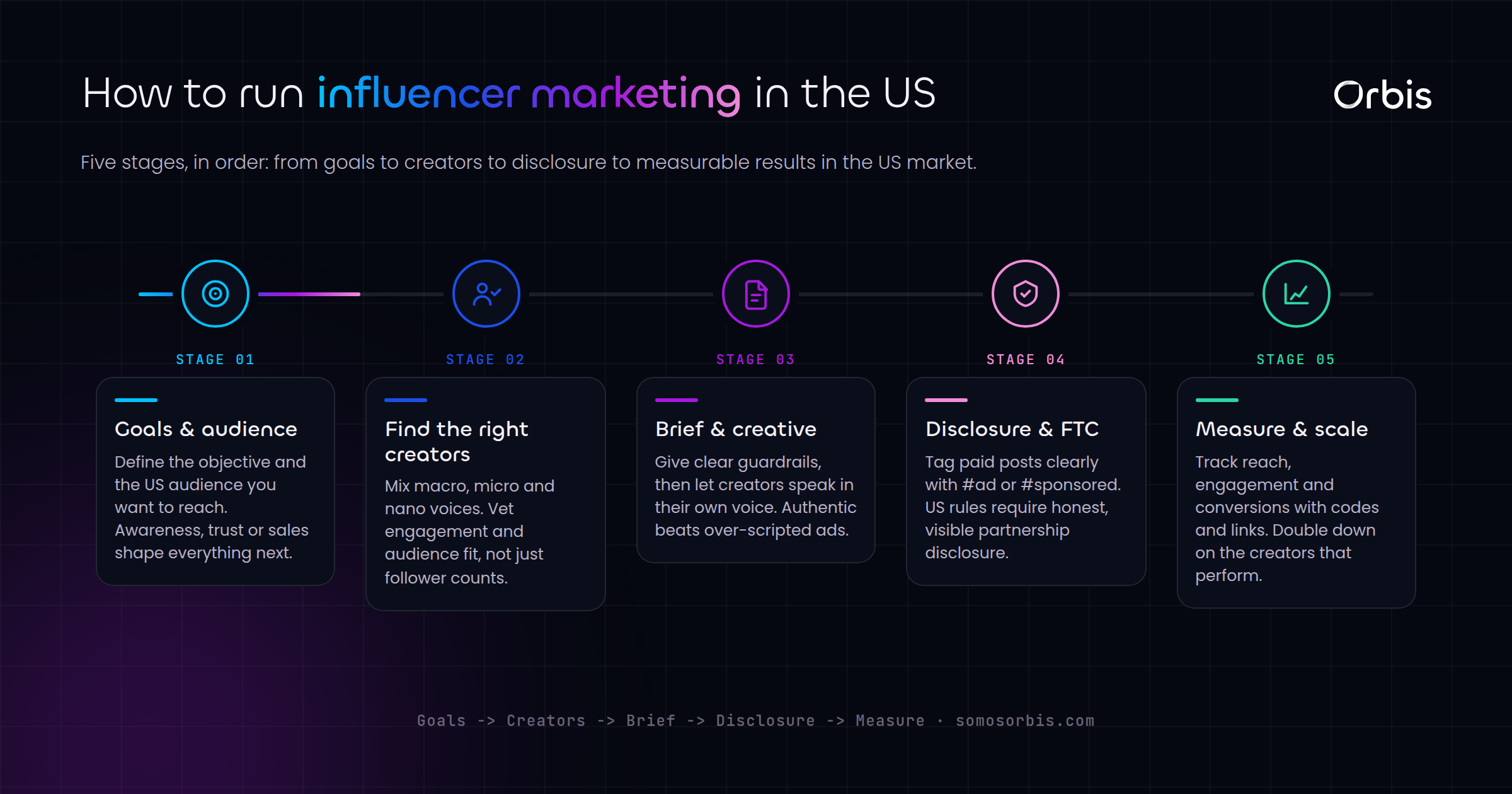
Most brands start by searching hashtags and DMing whoever has the biggest follower count. That is the slowest, least reliable way to build a roster. Here is a better sequence.
Start with the audience, not the creator
Before you look at a single profile, define who you need to reach: city or region, language preference, age band, platform, and purchase intent. A back-to-school campaign for a Chicago kids' apparel brand needs parents, not teens. A tax-season fintech push needs creators whose audiences are financially engaged adults. Write this down first so you can disqualify mismatches fast.
Build a discovery shortlist from multiple sources
- Platform-native search: Use TikTok and Instagram search with location and topic keywords, then study who their audiences also follow.
- Your own customers: Some of your best creators already buy from you. Pull a list of customers with public, engaged accounts.
- Competitor and category mapping: Look at who is creating content in your category nationally and in target cities. You are not copying their roster, you are learning the landscape.
- Creator platforms and agencies: Marketplaces speed up discovery, but you still vet manually.
Tier your shortlist by size
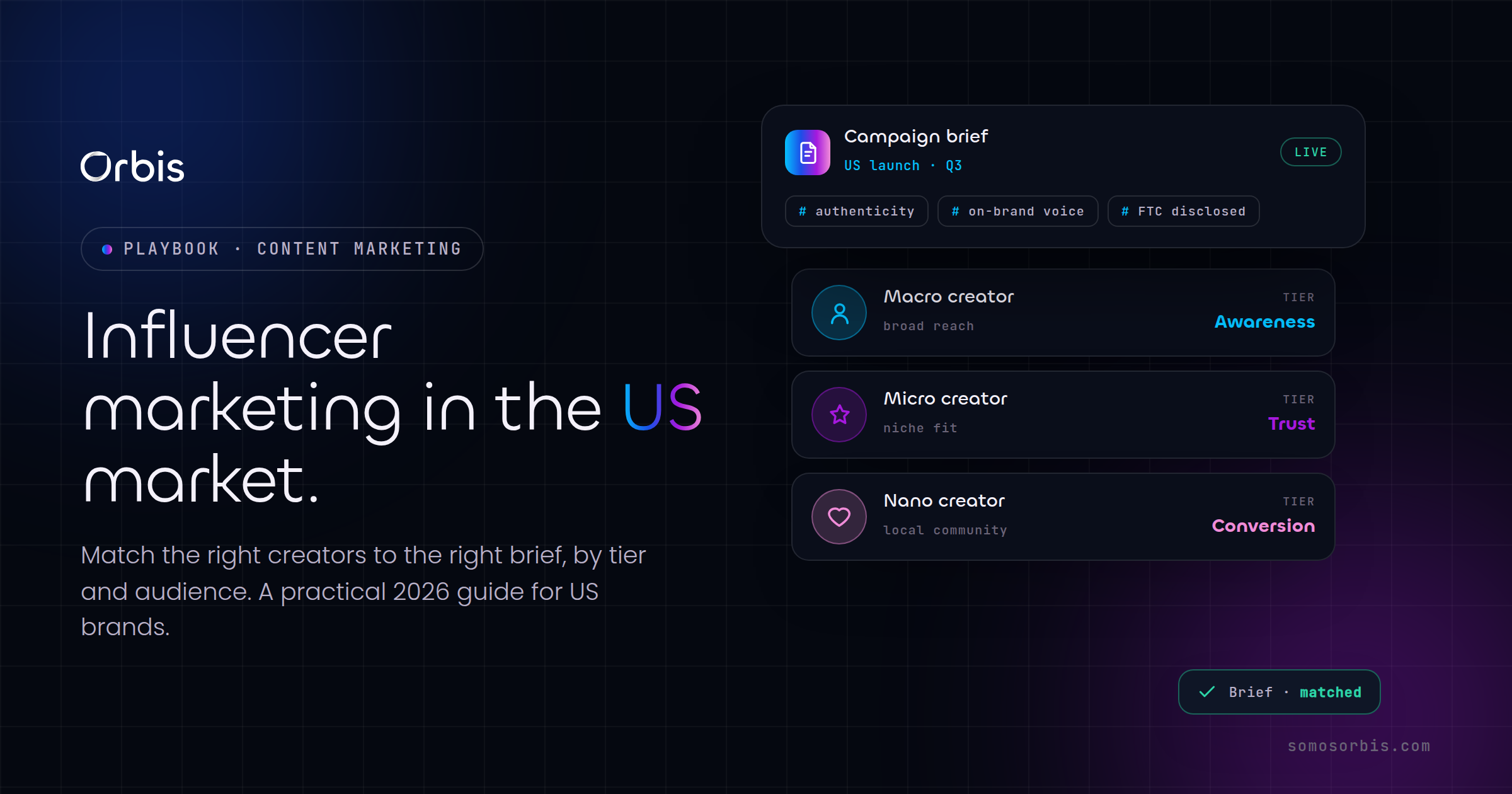
Influencer "size" in the US is usually grouped as follows. Each tier has a different job:
- Nano (1K to 10K followers): Highest trust and engagement, lowest reach. Excellent for hyper-local plays (a single Houston neighborhood, a specific bilingual community) and for volume UGC.
- Micro (10K to 100K): The workhorse tier. Strong engagement, real niche authority, manageable rates. Most US performance campaigns are built here.
- Macro (100K to 1M): Reach and credibility for awareness pushes around major moments like Prime Day or Black Friday. Higher cost, more negotiation, more legal care.
- Mega / celebrity (1M+): Brand-building and PR, rarely efficient for direct response.
A healthy US program usually mixes tiers: a few macro creators for reach during a seasonal peak, a deep bench of micro and nano creators for sustained, trustworthy conversion.
How to vet creators before you pay them
This is where most budget gets saved or wasted. Follower count tells you almost nothing. Vet every shortlisted creator against the following checklist before sending a contract.
- Engagement quality, not just rate. Read the comments. Are they real conversations or emoji spam and bot replies? A 2% engagement rate with genuine comments beats 8% of "🔥🔥🔥".
- Audience location and language. Ask for audience analytics screenshots. You want proof that their followers actually live in your target US markets and match your language strategy.
- Audience authenticity. Watch for sudden follower spikes, mismatched like-to-comment ratios, and generic followers. These signal bought audiences.
- Brand safety and history. Scroll back a year. Look for past controversies, competing sponsorships, and whether their values align with yours.
- Content fit and consistency. Does their organic content already look like something your customer would trust? You want creators whose natural style fits your brand, so the ad does not feel like an ad.
- Disclosure habits. Do they already disclose past partnerships clearly? A creator who is sloppy with disclosure is a liability.
The fastest way to lose money in US influencer marketing is to pay for reach you cannot verify. Verify first, pay second.
FTC disclosure: get this right or pay for it
In the US, paid partnerships must be disclosed clearly and conspicuously so a reasonable viewer understands the relationship is sponsored. This protects consumers, and it protects you. Build disclosure into your brief and your contract, do not leave it to the creator's discretion.
Practical disclosure rules to enforce
- Make it unmissable. Disclosure should be in the caption near the top, not buried after "more" or hidden in a wall of hashtags.
- Use clear language. Plain terms like "paid partnership," "sponsored," or "ad" work. Vague tags do not.
- Match the format. In video, the disclosure should appear both verbally and on screen. In Stories and Reels, it needs to be visible long enough to read.
- Bilingual content needs bilingual disclosure. If a creator posts in Spanish for the US Hispanic market, the disclosure must be clear in Spanish too.
- Use the platform tools. Built-in "paid partnership" labels are good, but they supplement clear language, they do not replace it.
We bake these requirements into every brief and require creators to confirm them in writing. It is a small step that removes a large category of risk. This is exactly the kind of compliant-by-design process that protects a brand's reputation while it scales.
USD rate benchmarks: what to actually pay
Rates vary widely by platform, niche, content rights, and exclusivity, so treat these as starting ranges for negotiation, not fixed prices. They reflect typical US market expectations in USD for a single piece of sponsored content. Always confirm what is included: usage rights, whitelisting for paid ads, exclusivity windows, and the number of revisions.
- Nano (1K to 10K): Often $50 to $250 per post, sometimes product-only for the smallest accounts. Great value for UGC volume.
- Micro (10K to 100K): Roughly $250 to $1,500 per post depending on platform and niche. Higher for finance, B2B, and specialized verticals.
- Macro (100K to 1M): Commonly $1,500 to $10,000+ per post, with significant variation by reach and category.
- Mega (1M+): $10,000 and up, frequently negotiated as packages.
What changes the price
- Usage rights and whitelisting. If you want to run their content as a paid ad from their handle, expect to pay a premium, often a percentage on top of the base rate.
- Exclusivity. Locking a creator out of competitors for a period costs more.
- Seasonal demand. Rates climb around Black Friday, Cyber Monday, Prime Day, and the holiday quarter. Book and lock pricing early.
- Deliverable volume. Bundles of multiple posts plus Stories usually earn a better per-asset rate than one-offs.
The single best way to control cost is to negotiate for content rights up front. Owning the creative lets you reuse top performers in paid media long after the post goes live, which dramatically lowers your effective cost per asset.
How to brief creators so the content performs
A weak brief produces generic content. A strong brief gives direction without strangling the creator's voice, which is the entire reason you hired them. Every Orbis creator brief includes:
- The one core message. If the viewer remembers one thing, what is it? One message, not five.
- Audience and context. Who they are talking to, in which US market, and in which language.
- Must-include and must-avoid points. Claims you can and cannot make, plus competitor mentions to avoid.
- Hook guidance, not a script. Suggest opening hooks but let the creator write in their own voice.
- A clear call to action. The exact link, code, or next step, with UTM tracking attached.
- Disclosure requirements. Non-negotiable, written into the brief.
- Timeline tied to the season. For a back-to-school or Prime Day push, work backward from the date so content is live during the buying window, not after it.
Measuring what matters
Reach and impressions are inputs, not results. Tie every campaign to outcomes you can defend in a revenue meeting:
- Trackable links and codes. Unique UTMs and promo codes per creator so you know who actually drove sales.
- Cost per acquisition in USD. Compare creator CPA against your paid social and search benchmarks.
- Content performance for reuse. Flag the assets that earn the most engagement and conversions, then license and re-run them as paid ads.
- Incrementality over time. Watch for lift in branded search and direct traffic in target cities after a wave of creator content.
Documenting these results after every wave is what turns influencer marketing from a gamble into a predictable, engineerable revenue channel.
Related guides
Influencer marketing is one piece of a larger content engine. To put it in context, start with our pillar resource, the content creation guide for US brands in 2026, which frames how creators fit alongside owned and paid content. Then dig into UGC content strategy for US brands to learn how to systematize the user-generated assets that nano and micro creators produce so well.
Turn creators into a revenue channel
Done well, US influencer marketing is not about chasing the biggest names. It is about a disciplined loop: define the audience, vet relentlessly, brief clearly, disclose properly, pay smart in USD, and measure against revenue. Run that loop across the seasonal calendar, from tax season through Prime Day, back-to-school, and Black Friday, and creators become one of your most efficient growth channels.
If you want a partner to build and run that engine, explore our influencer marketing services. We handle discovery, vetting, compliant briefs, USD negotiation, and measurement, so your creator spend ties directly to documented results. Let's turn reach into revenue.