
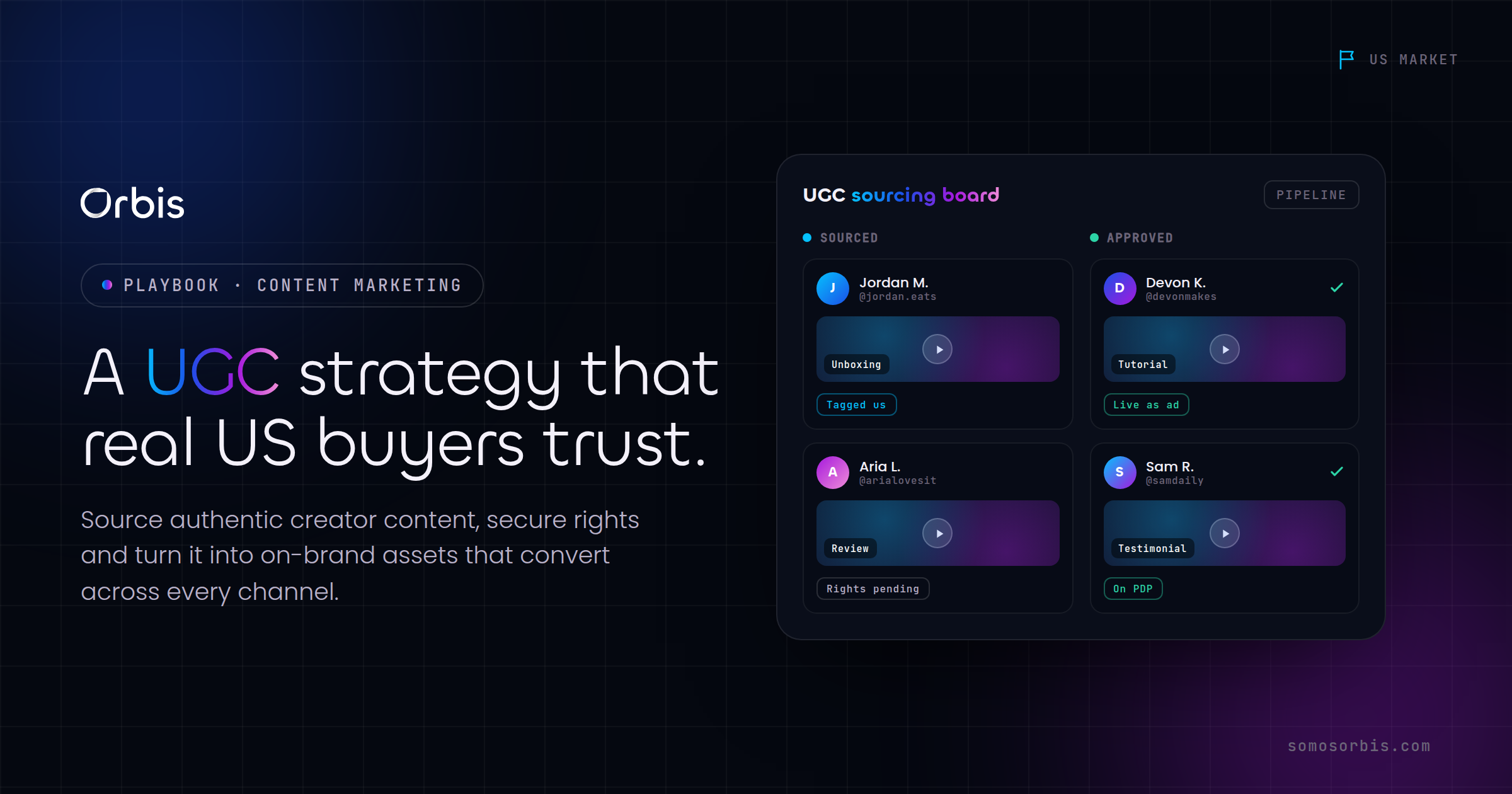
US shoppers have grown skeptical of polished brand advertising. They trust people who look like them, sound like them, and shop where they shop. That is why user-generated content (UGC) has become one of the highest-leverage assets a brand can build. When a customer in Miami posts a thirty-second clip unboxing your product, or a creator in Houston films a quick how-to in Spanish, that content carries a credibility no studio shoot can buy. For brands competing across markets as different as New York, Los Angeles, Chicago, and Dallas, a deliberate UGC strategy is no longer a nice-to-have. It is the engine that fills your ad accounts, product pages, and social feeds with proof.
This guide breaks down how to source, manage, and scale UGC for the US market, with a practical focus on rights management and the bilingual EN/ES creators who help you reach the large US Hispanic audience. Everything here is built to be executed by a real team with real deadlines, not theory.
Why UGC Outperforms Brand Content in the US
UGC works because it removes the distance between the shopper and the proof. A founder talking about their product is selling. A customer talking about it is recommending. That shift in framing changes how the message lands, and US consumers have become especially good at telling the two apart.
There are three structural reasons UGC tends to outperform in the US market:
- Trust at scale. Reviews, testimonials, and creator clips signal that real people already took the risk you are asking the next shopper to take. This is social proof doing the heavy lifting.
- Volume and variety. One brand shoot gives you a handful of assets. A working UGC pipeline gives you dozens of angles, formats, and voices you can test against each other in paid and organic.
- Native fit. UGC looks like the content people already consume on TikTok, Reels, and Shorts. It does not interrupt the feed, it belongs in it. That lowers cost per acquisition because the ad does not announce itself as an ad.
For a deeper view of where UGC sits inside your broader content operation, the foundation is laid out in our complete content creation guide for US brands in 2026. UGC is one pillar of that system, and it performs best when it plugs into a wider content engine rather than standing alone.
The Three Sources of UGC
Before you can scale UGC, you need to know where it comes from. There are three primary sources, and a mature strategy uses all three at once.
1. Organic Customer Content
This is content your customers create on their own, with no payment and no prompt from you. It is the most credible kind of UGC and the hardest to control. Your job is to make it easy to create and easy to find. Add a branded hashtag to packaging inserts, prompt for a photo or video at the moment of delivery, and run simple seasonal campaigns timed to US shopping peaks like Black Friday, Cyber Monday, Amazon Prime Day, and back-to-school.
Practical tactics that consistently surface organic UGC:
- Print a short, friendly ask on your packaging with a hashtag and handle.
- Trigger a post-purchase email that requests a photo or clip a few days after delivery, when the product is in use.
- Reshare every customer post you are allowed to. Visible appreciation creates more contributors.
- Run a giveaway tied to a clear, low-effort prompt, especially around tax-season refunds when discretionary spending rises.
2. Paid Creator UGC
Paid UGC creators are people you hire specifically to produce content in the native, authentic style of organic posts. They are not always influencers with large followings. Many of the best UGC creators have modest audiences but excel at making content that converts. You own or license the output and run it as ads or on-site assets.
This is where most brands get the highest return, because you get authentic-feeling content with the reliability of a paid deliverable. You can brief for specific hooks, test seasonal angles for Cyber Monday or Prime Day, and request volume on a schedule. To set this up properly with vetted creators, clear briefs, and managed production, see our UGC content service.
3. Influencer-Generated Content
Influencer content overlaps with UGC but serves a different goal. Here you are paying partly for the creator's audience and credibility, not only the asset. The content often gets repurposed as UGC afterward. If audience reach and creator authority are central to your plan, the mechanics of vetting, briefing, and measuring partners are covered in depth in our guide to influencer marketing in the US market.
Rights Management: The Step Most Brands Skip
This is the single most important operational section of this guide, and the one most brands handle badly. Using someone's content without clear, written permission is a legal and reputational risk, especially when you put that content behind paid spend. A creator screenshot or a casual DM saying "sure, go ahead" is not enough when budget and brand reputation are on the line.
A defensible rights process has these components:
- Written usage rights. Get explicit, written permission that names the platforms, the duration, and whether the content can run as paid media. Verbal or implied consent does not hold up.
- Whitelisting and paid amplification terms. If you plan to run ads through a creator's own handle, that must be spelled out separately. Running paid spend on borrowed credibility without consent is where brands get burned.
- Exclusivity and category terms. Decide whether the creator can promote competitors during your usage window, and document it.
- Privacy and consent for people on camera. If other people appear in the content, the creator must have the right to feature them. This matters more as US privacy expectations tighten and shoppers grow more aware of how their image and data are used.
- An organized rights library. Keep a single source of truth that logs every asset, the creator, the rights window, the platforms covered, and the expiry date. When a window closes, you pull the asset.
Treat rights management as part of your compliance-by-design process. Document the permission before the content goes live, store it where your team can find it, and build expiry into your workflow so nothing runs past its authorized window. Clean processes here protect both your spend and your reputation.
Handled well, rights management is not a brake on UGC. It is what lets you scale UGC confidently, because every asset in your library is cleared, traceable, and ready to deploy.
Reaching the US Hispanic Market with Bilingual Creators
The US Hispanic audience represents enormous and growing purchasing power, and it is concentrated in markets brands cannot ignore: Los Angeles, Houston, Miami, Dallas, Chicago, and New York all have large, active Hispanic communities. Generic English content translated word-for-word almost always underperforms here. What works is content created natively in Spanish, or in the blended EN/ES register that bilingual US consumers actually speak.
To build a bilingual UGC pipeline that resonates rather than condescends:
- Hire bilingual creators, not translators. A creator who lives in both languages will make content that feels native because it is. Translation alone misses tone, humor, and cultural reference.
- Let creators code-switch naturally. Many US Hispanic shoppers move fluidly between English and Spanish in a single sentence. Content that mirrors that pattern feels authentic and signals that you understand the audience.
- Respect cultural specificity. Mexican, Puerto Rican, Cuban, and Central American audiences are not interchangeable. A creator from the right community brings nuance you cannot brief into someone from outside it.
- Localize the seasonal calendar. Blend US retail moments like Black Friday and back-to-school with the cultural dates that matter to your audience, and let bilingual creators frame them in their own voice.
Bilingual UGC is not a separate side project. It is a way to double the reach of the same product story across two audiences that overlap in geography but differ in language and culture.
Building a UGC Pipeline That Scales
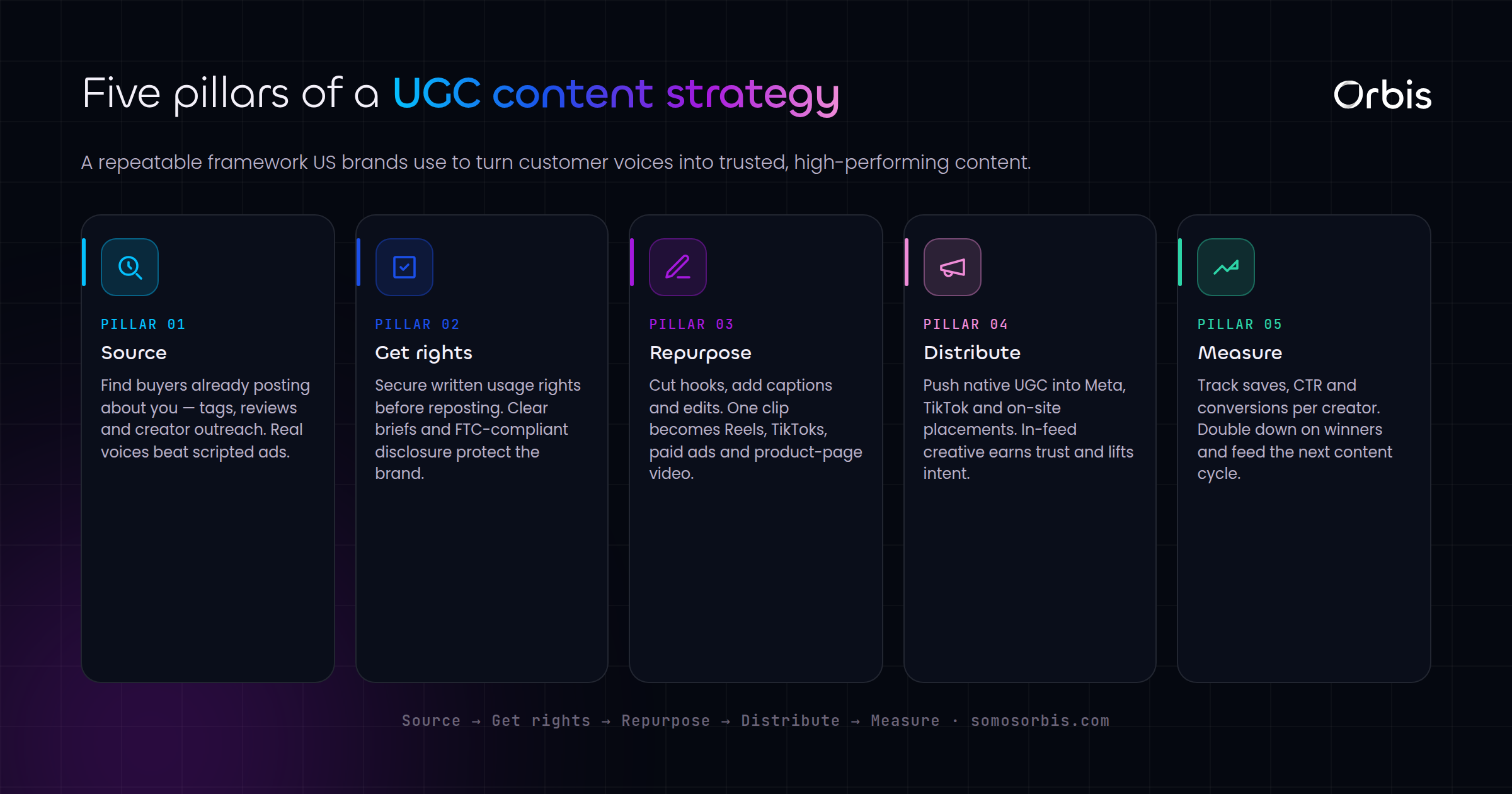
One viral clip is luck. A pipeline is a system. The difference between brands that occasionally get good UGC and brands that reliably produce it is documented process. Here is the workflow we use to keep UGC flowing.
Step 1: Define Your Content Pillars and Hooks
Decide the three to five recurring themes your UGC should hit: the core benefit, a common objection answered, a use-case demo, a before-and-after, and a seasonal angle. For each, write two or three hook variations. Creators perform better with a clear hook than with a vague "be authentic" brief.
Step 2: Source and Brief Creators
Recruit a mix of paid creators and organic advocates. Give every paid creator a one-page brief that includes the hook, the format, the do's and don'ts, the rights terms, and one or two reference clips. Keep the brief tight. Over-direction kills the authenticity that makes UGC work.
Step 3: Manage Production and Rights in Parallel
Collect content and clear rights at the same moment. Never let an asset enter your library without its rights record attached. This single discipline prevents the most common and most expensive UGC mistakes.
Step 4: Test, Measure, and Double Down
Run your UGC variations against each other in paid and organic. Track the metrics that map to revenue: cost per acquisition, click-through rate, hold rate on video, and conversion rate on product pages that feature UGC. Kill what underperforms, scale what wins, and feed the winning hooks back into your next round of briefs.
Step 5: Recycle Across Channels
A single strong UGC asset should work across paid social, your product detail pages, email, retargeting, and organic. Cut it into multiple lengths and aspect ratios so one production effort populates every surface. This is how a documented pipeline turns a fixed budget into compounding output.
Common UGC Mistakes to Avoid
Even brands with budget make these errors. Watch for them:
- Over-editing the authenticity out. Polishing UGC until it looks like a commercial defeats the purpose. Leave the texture in.
- Skipping rights and hoping for the best. The savings are not worth the exposure. Document permission every time.
- Translating instead of localizing. Spanish content built from English copy reads as foreign. Create natively for each audience.
- Treating UGC as one-and-done. A handful of clips is a campaign. A pipeline is a system. Build the system.
- Ignoring the data. If you are not measuring which assets drive revenue, you are guessing. Test and reallocate.
Related Guides
UGC is one part of a larger content operation. To go deeper, start with the complete content creation guide for US brands in 2026, the pillar that frames how every content type works together. Then read our guide to influencer marketing in the US market to see how creator partnerships and UGC reinforce each other.
Turn UGC Into a Revenue Engine
UGC is the most efficient way to fill your funnel with proof your customers actually believe. The brands that win treat it as a documented, rights-clean, bilingual system rather than a series of lucky posts. Source from all three channels, manage rights with discipline, build for the US Hispanic market with bilingual creators, and measure everything against revenue.
If you want a team that sources vetted creators, manages rights end to end, and ships UGC built to convert across English and Spanish audiences, explore our UGC content service and let's build your pipeline.