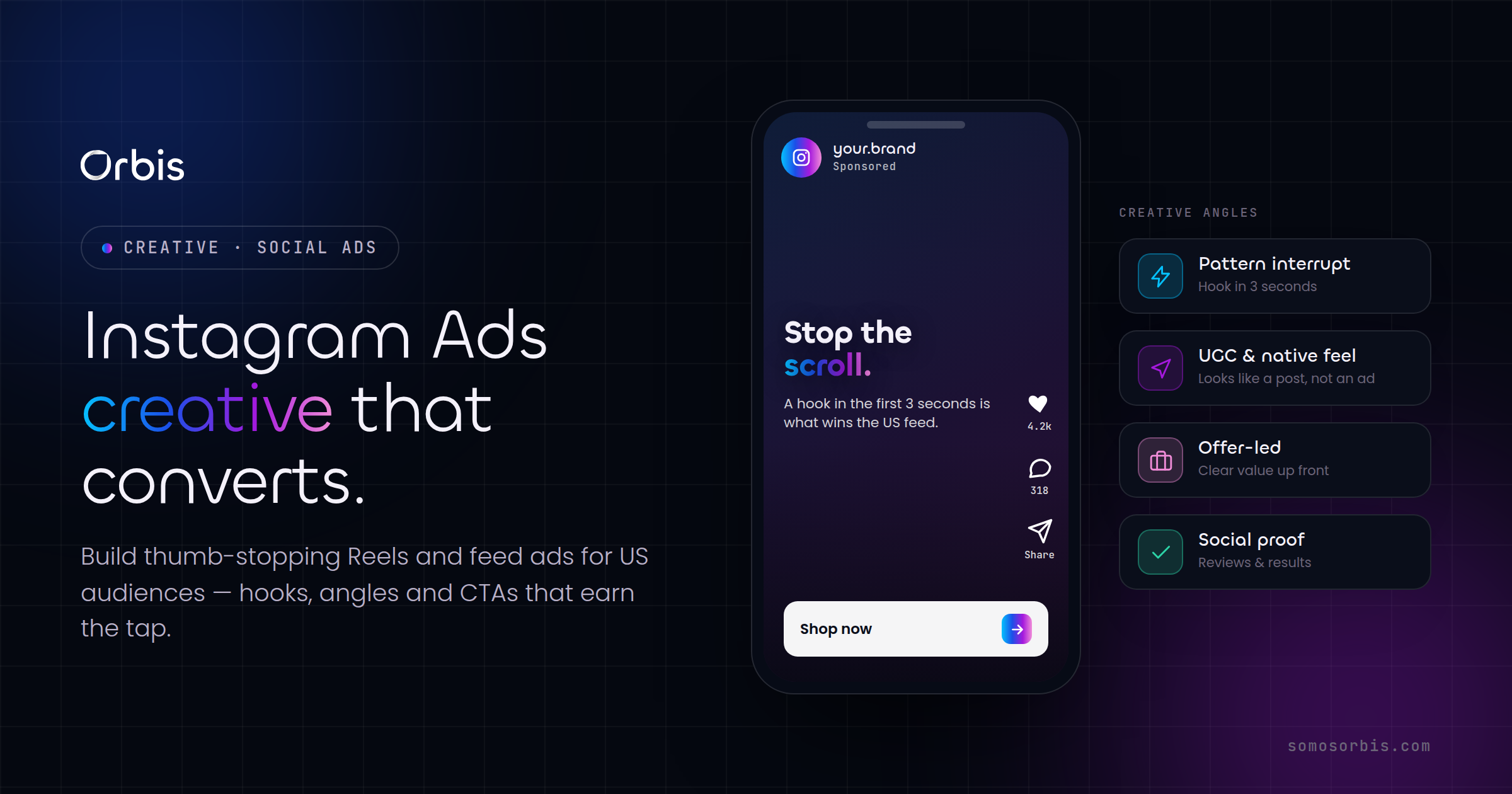
On Instagram, the account does not lose the auction. The creative does. In the United States, where the average user scrolls past thousands of ads a week across New York, Los Angeles, Chicago, Miami, Dallas, and Houston, your bid, your targeting, and your landing page all matter less than the first two seconds of your ad. If the hook does not land, nothing downstream gets a chance. This guide is about building Instagram creative that actually converts US audiences, format by format, with hooks tuned to US culture and bilingual EN/ES variations where they earn their keep.
Orbis has spent over 15 years building paid social programs for brands selling in the US market, and the pattern repeats: brands obsess over audiences and budgets while shipping creative that looks like a brochure. Meanwhile the accounts that win treat creative as the primary lever. That is the mindset shift this article is built around. If you want the broader strategic frame first, start with our social ads guide for US brands in 2026, then come back here to operationalize the creative.
Why Instagram Creative Is the Real Targeting
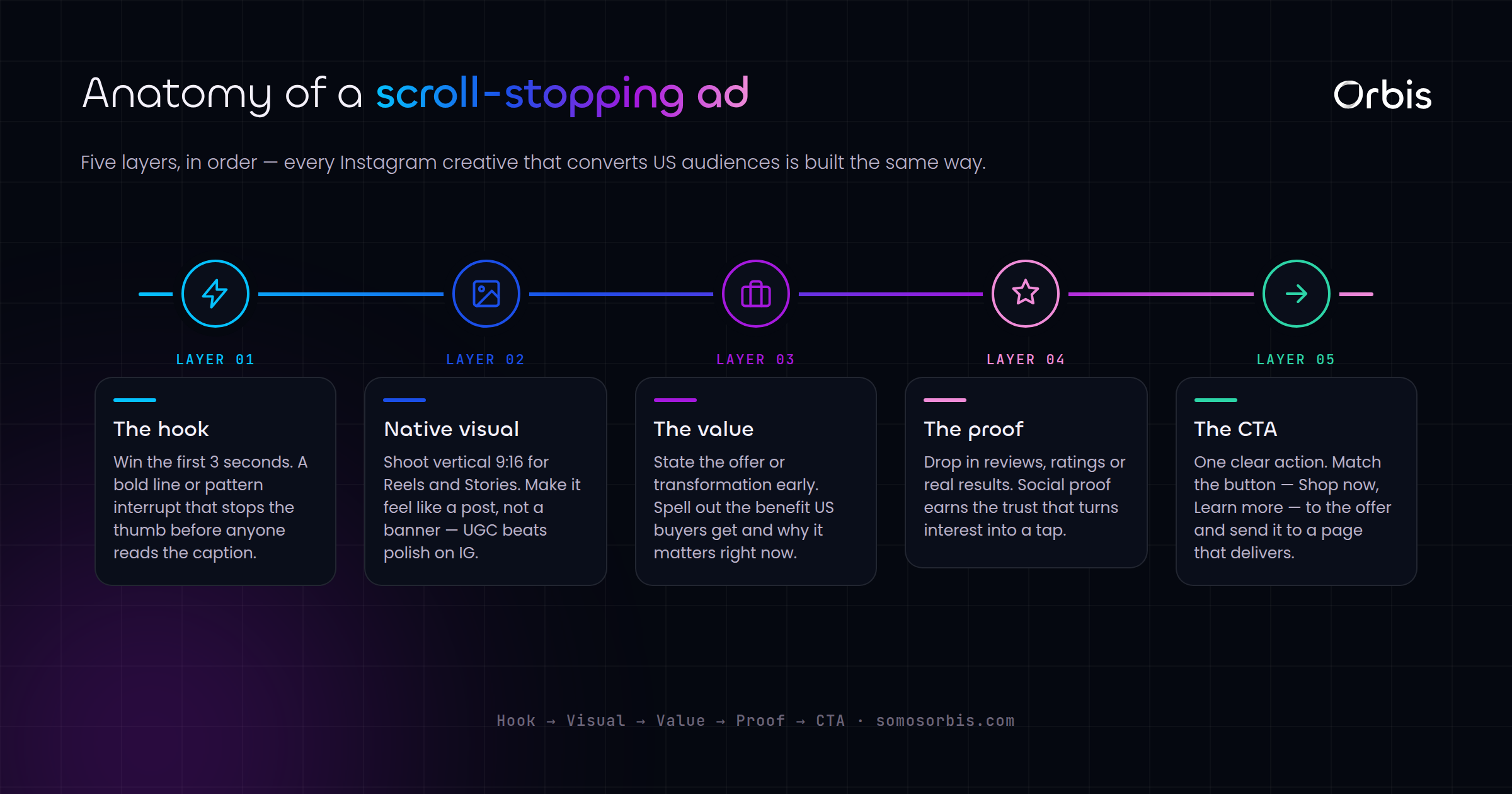
Meta's machine learning has gotten good enough that broad targeting plus strong creative usually outperforms narrow targeting plus weak creative. When you upload a strong hook, the algorithm finds the people who respond to it. That means your creative is doing the targeting work. A Reel that opens with "If you run a Shopify store in the US, stop doing this" will self-select store owners better than any interest stack you could build manually.
This has three practical consequences for US brands:
- Volume beats polish. You need many creative concepts in rotation, not three perfect ones. Plan to test 8 to 12 distinct hooks per month, not per quarter.
- The first frame is the headline. On Instagram, sound is often off and the thumbnail is the ad. Your opening visual has to communicate the offer before anyone reads a word.
- Native beats produced. Creative that looks like organic content from a friend outperforms studio-grade production in most US feeds. People came to see their cousin's vacation, not your commercial.
Reels: The Highest-Leverage Format in 2026
Reels is where Meta is pushing reach and where US attention has concentrated. It is also the format with the steepest creative learning curve, because a Reel that converts is a tiny film with a job to do in under 15 seconds. Here is the structure that works.
The Hook (Seconds 0 to 2)
The hook is the entire game. You have roughly two seconds before the thumb moves. Strong US hooks fall into a few reliable buckets:
- The callout: "Dallas business owners: this is costing you customers." Name the audience and they stop.
- The pattern interrupt: An unexpected visual or statement that breaks the scroll rhythm. A product used in a way nobody expects.
- The stakes: "I lost $4,000 in ad spend before I learned this." Money and loss aversion are universal, and dollar figures feel concrete to US buyers.
- The promise: "Three ways to cut your CPA by Black Friday." A clear, time-bound benefit tied to US seasonality.
The Build (Seconds 2 to 12)
Once you have the attention, deliver fast. Use jump cuts every 2 to 3 seconds to maintain momentum. On-screen captions are non-negotiable because most US viewers watch with sound off; burn the text into the video rather than relying on auto-captions. Show the product in use, not on a pedestal. If you are selling to Hispanic households in markets like Miami, Los Angeles, or Houston, a Spanish-language Reel with the same structure often outperforms a translated caption on an English video, because the spoken language signals "this is for you" instantly.
The Close (Seconds 12 to 15)
End with one clear action. "Tap the link to get yours before Cyber Monday." Do not stack three CTAs. The Reel's job is to earn the click, not to close the sale, that is the landing page's job. Keep the call to action visual and spoken so it lands with sound on or off.
Stories: Intimacy and Urgency
Stories sit in a more personal, full-screen, ephemeral space. US users tap through Stories quickly, which makes the format ideal for urgency-driven offers and for retargeting people who already know your brand. The creative rules shift slightly:
- Design for the thumb zone. Keep your CTA and key text in the lower-center third where the thumb naturally rests, but clear of the bottom UI where the "Sponsored" label and swipe-up sit.
- Use native Stories elements. Polls, sliders, and question stickers feel native and lift engagement. An interactive poll in an ad does not feel like an ad.
- Stack urgency. Stories disappear, so they pair naturally with time-bound offers. "Ends tonight" or "Last day of our Prime Day sale" matches the format's ephemerality.
- Vertical, always. Full 9:16. A repurposed square ad with letterboxing screams "I did not make this for Stories" and tanks performance.
For retargeting US shoppers who abandoned a cart, a Story that opens with the exact product they viewed plus a small incentive is one of the highest-ROAS placements you can run. It feels like a reminder from a brand they were already considering, not a cold pitch.
Carousels: The Conversion Workhorse
Carousels are underrated. They are quiet, they do not chase reach the way Reels do, but they convert because they let a US buyer move at their own pace through a considered decision. They shine for higher-consideration purchases and for ecommerce catalogs.
Carousel Structures That Work
- The problem-to-solution sequence: Card 1 names the pain, cards 2 through 4 build the case, the final card is the offer and CTA.
- The mini-listicle: "5 reasons US shoppers switched to us." Each card is one reason. Swipeable, skimmable, shareable.
- The product showcase: Different angles, use cases, or SKUs across cards. Strong for back-to-school bundles or Black Friday gift guides.
- The before-and-after: Card 1 before, card 2 after. The swipe gesture itself creates a small reveal moment.
The trick with carousels is the first card. It still has to function as a hook, because if nobody swipes, the other cards never get seen. Design card 1 to create an open loop the viewer wants to close. And design the cards to feel continuous, with a visual element that bleeds across the edges so the swipe feels rewarding.
Bilingual EN/ES Creative for the US Hispanic Market
The US Hispanic market is one of the largest and fastest-growing consumer segments in the country, concentrated heavily in markets like Miami, Los Angeles, Houston, Dallas, and Chicago. Treating it as an afterthought, or worse, machine-translating your English ad, leaves money on the table. Here is how to do bilingual creative properly:
- Transcreate, do not translate. A literal Spanish translation of an English hook usually reads stiff. Rewrite the hook so it carries the same emotional punch in Spanish, with idioms that feel native.
- Run parallel, not merged. Build a dedicated Spanish-language creative set and let Meta optimize delivery. Spanish-dominant viewers respond to spoken Spanish far more than to bilingual subtitles slapped on an English video.
- Respect cultural nuance. "Hispanic" spans many countries and generations. A second-generation bilingual buyer in Los Angeles and a Spanish-dominant first-generation buyer in Miami are different audiences with different references. Code-switching creative ("Spanglish") can resonate strongly with younger US-born Latino audiences.
- Match the offer, not just the language. Seasonality and cultural moments matter. Aligning creative with moments that resonate in Hispanic households builds relevance no translation can fake.
When you split EN and ES into separate creative sets, you also get cleaner data on which segment is actually driving your return, which makes budget allocation a decision instead of a guess.
US Seasonality: A Creative Calendar That Converts
US buying behavior is heavily seasonal, and creative that ignores the calendar competes at a disadvantage. Build your Instagram creative pipeline around these tentpoles:
- Black Friday and Cyber Monday: The most competitive auction window of the year. CPMs spike. Your creative has to be sharper than usual just to break even. Build urgency-led Reels and Stories, and have offer-specific carousels ready by early November.
- Amazon Prime Day: Even if you do not sell on Amazon, US shoppers are in deal-hunting mode. Counter-positioning ("skip the Prime Day chaos, here is a better deal") can win attention.
- Back-to-school: Late summer surge for a wide range of categories. Bundle-focused carousels perform well.
- Tax season: Early-year period when many US households have refund money to spend. Creative that frames a purchase as a smart use of a refund can convert.
Plan creative six to eight weeks ahead of each tentpole. The brands that win Black Friday were shooting their Reels in September. Pricing and offers should be in USD and framed in the way US shoppers expect, with clear before-and-after price points where compliant.
Testing: How to Find Your Winners
You will not guess your way to a winning hook. You test your way there. A disciplined US creative testing loop looks like this:
- Test hooks first, not whole ads. Run the same body with 4 to 6 different opening hooks. The hook is the biggest variable, so isolate it.
- Give creative enough budget to learn. Starving a test of spend gives you noise, not signal. Let each concept gather meaningful data before you judge it.
- Read the right metric per stage. Hook rate (3-second view rate) tells you if the opening works. Hold rate tells you if the body keeps attention. Click-through tells you if the offer lands. Diagnose at the stage where the drop-off happens.
- Kill fast, scale faster. When a concept clearly underperforms, cut it. When one breaks out, build five variations of it before the fatigue sets in.
- Refresh before fatigue. US audiences burn through creative quickly. Have the next batch in production before your current winners decline.
Track this with documented processes so insights compound instead of evaporating when a team member leaves. That discipline, treating creative as an engineered system rather than a series of one-off shoots, is the difference between a lucky month and a durable program.
Privacy and Compliance, Built In
US privacy expectations have tightened, and your creative and tracking setup should respect that by design. Be transparent in how you handle data, honor opt-out preferences, and make sure your pixel, conversions API, and consent handling are configured to current privacy norms before you scale spend. Compliant measurement is not just a legal posture; clean, consented data makes Meta's optimization work better, which directly improves your results. Building compliance into the workflow from the start avoids the painful rework of retrofitting it later.
Putting It Together: Format by Funnel Stage
A simple way to think about deploying these three formats across a US campaign:
- Top of funnel: Reels for reach and discovery. Bold hooks, broad targeting, let the creative find the audience.
- Middle of funnel: Carousels for consideration. Educate, compare, and build the case for buyers who are weighing options.
- Bottom of funnel: Stories for retargeting and urgency. Close the loop with people who already engaged.
Run all three in concert, feed them with a steady pipeline of tested hooks, split your EN and ES sets, and align everything to the US seasonal calendar. That is a creative engine, not a campaign.
Instagram creative is a craft, but it is also a system you can build and improve deliberately. If you want to go deeper on the platform mechanics and account structure, our social ads guide for US brands is the pillar that ties it all together, and if your growth runs through ecommerce, pair this with our breakdown of Meta and Facebook ads for US ecommerce to connect creative to catalog and conversion.
Ready to Build Creative That Converts?
You can run this playbook yourself, or you can plug into a team that has done it for over 500 clients across the US market for more than 15 years. Orbis is a Google Partner with a 4.9-star rating across 58 reviews, and a Meta partner, which means we are building your Instagram creative inside the same platform we help shape. We treat creative as engineered revenue: documented processes, disciplined testing, and compliance built in from day one.
If you want a partner to design, test, and scale Instagram creative that actually moves the needle in New York, Los Angeles, Miami, Dallas, Houston, and Chicago, explore our Instagram Ads service and let's build the engine together.