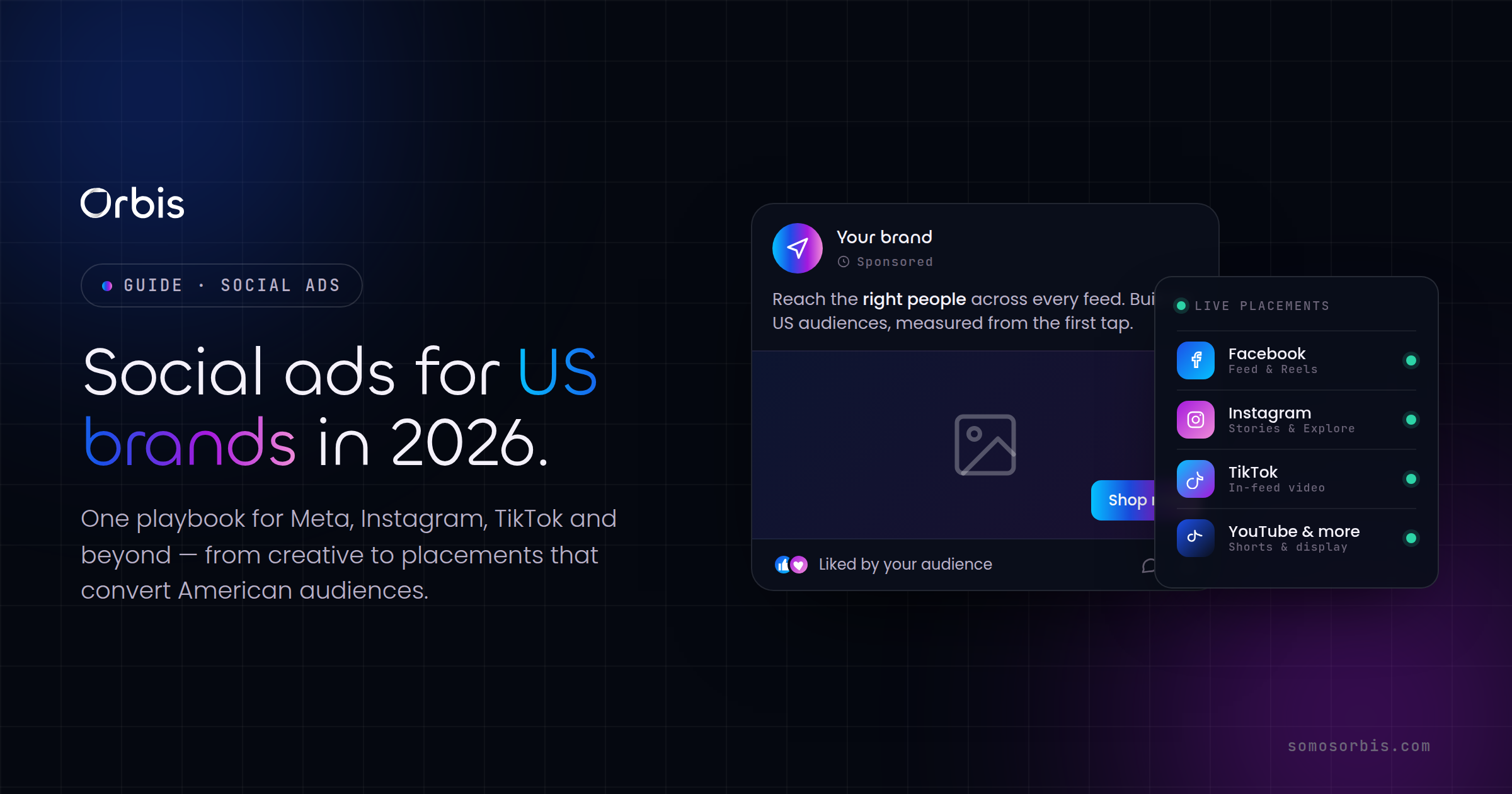
Paid social in the United States is no longer a single discipline. A brand running ads in New York, Los Angeles, Chicago, Miami, Dallas, or Houston is competing in six or seven distinct auction environments at once, each with its own creative grammar, audience expectations, and cost structure. The advertiser who treats Meta, Instagram, TikTok, LinkedIn, Pinterest, and Spotify as interchangeable buckets for the same campaign almost always overpays and underperforms. This guide is the platform-by-platform playbook we use at Orbis to build paid social programs that hold up across a full US calendar year, from tax season in the spring to Amazon Prime Day in the summer, back-to-school in late summer, and the Black Friday and Cyber Monday crush that defines Q4.
We will keep this practical. You will find USD budget ranges, structural recommendations, creative direction, and measurement guidance you can act on this week. We will also be honest about what each platform is good for and what it is not. There is no universal best channel. There is only the right channel for a specific audience, offer, and moment. If you want a partner to build and run this end to end, our social ads management service is built around exactly the framework you are about to read.
How to think about paid social in the US market
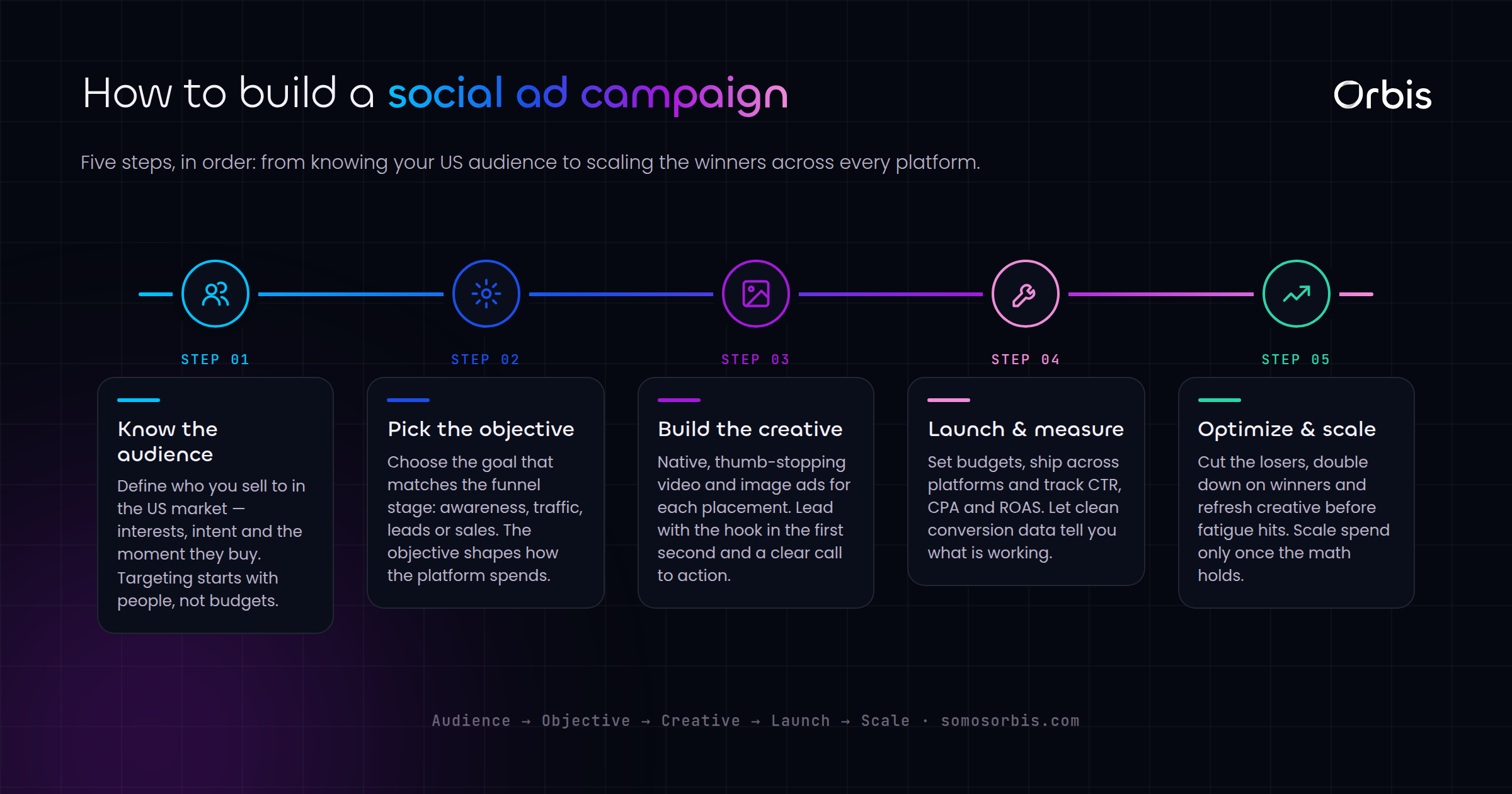
Before any platform-specific tactics, three principles separate brands that scale from brands that stall. Get these right and the platform choices become much simpler.
1. Match the platform to the buying intent, not the trend
Each platform sits at a different point on the intent curve. Pinterest and Spotify reach people in a planning or discovery mindset. TikTok reaches people open to impulse and inspiration. Meta and Instagram cover the broadest range, from cold discovery to bottom-funnel retargeting. LinkedIn reaches people in a professional context where the purchase is often a considered B2B decision. When you pick a platform because it is trending rather than because it matches how your customer actually buys, you are paying to be in the wrong room.
2. Build for privacy-aware measurement from day one
US privacy expectations have tightened, and consumers in states like California now expect clear control over how their data is used. The practical consequence for advertisers is that you can no longer lean entirely on pixel-based, last-click attribution. Server-side conversion tracking, modeled conversions, clean first-party data collection with explicit consent, and incrementality thinking are now table stakes. We design every account with consent-respecting measurement as a foundation rather than a patch. This is part of what we mean by Cumplimiento por Diseño, or compliance by design: the tracking is built to respect current regulations and consumer choice from the start, not retrofitted after a complaint.
3. Plan around the US calendar
The US retail and lead-gen year has a rhythm, and your budget should breathe with it. A simplified version of the calendar most of our clients plan against:
- January to April (tax season): strong intent for financial services, big-ticket purchases tied to refunds, and home improvement. Refund dollars hit consumer accounts and create real buying windows.
- May to June: momentum building, graduation and wedding spend, and the run-up to summer. A good time to test new creative cheaply before costs climb.
- July (Amazon Prime Day): the entire ecommerce ecosystem moves. Even non-Amazon sellers feel the demand spike and the competitive cost pressure.
- August to early September (back-to-school): the second-largest retail moment of the year, spanning apparel, electronics, and supplies.
- November to December (Black Friday, Cyber Monday, holiday): the highest-cost, highest-volume window. CPMs can double. You must enter with proven creative and warm audiences already built.
The mistake we see most often is brands that go dark in the cheap months and then try to acquire cold customers at peak CPM in November. Build your audiences when impressions are affordable so you can harvest them when intent is highest.
Meta and Facebook Ads: the workhorse of US paid social
For most US brands, Meta is still the foundation of the paid social mix. The scale is unmatched, the targeting and optimization tools are mature, and the platform covers the entire funnel from discovery through retargeting. If you only have budget for one channel, this is almost always where it goes first.
Account structure that survives the iOS era
The biggest shift in Meta advertising over the last few years has been the move toward consolidation and machine learning. The old approach of slicing audiences into dozens of tiny ad sets now starves the algorithm of the data it needs. Our default structure for a US ecommerce account looks like this:
- Prospecting campaign with broad targeting: let Meta's optimization find buyers rather than over-segmenting by interest. Feed it strong creative and a clean conversion signal.
- Advantage+ shopping campaign: for ecommerce with a real catalog, this consolidated format consistently delivers efficient returns when fed enough creative variety.
- Retargeting campaign: a tight funnel for site visitors, add-to-carts, and video viewers, with offers that move people from consideration to purchase.
For a deep, store-specific walkthrough including catalog setup, dynamic product ads, and the exact retargeting windows we use for US online stores, read our dedicated guide on Meta and Facebook ads for US ecommerce.
Budgets and benchmarks
A realistic starting point for a US direct-to-consumer brand serious about testing Meta is 3,000 to 6,000 USD per month. That is enough to gather meaningful conversion data within a couple of weeks without the account stalling in the learning phase. Below roughly 2,000 USD per month, you can still run, but expect slower learning and noisier results. Cost per acquisition varies enormously by category, but the discipline that matters more than any benchmark is this: judge campaigns on contribution margin after ad spend, not on raw return on ad spend in the platform dashboard.
Because Meta is where most US accounts concentrate spend, it is also where measurement discipline pays off most. Our Meta and Facebook ads management includes server-side conversion setup so your optimization signal survives browser and privacy restrictions, which directly protects performance during high-cost periods like Cyber Monday.
Instagram Ads: where creative quality is the entire game
Instagram runs inside the Meta ad system, so the targeting and buying mechanics overlap with Facebook. But treating Instagram as a placement checkbox is a costly mistake. The audience, the formats, and the creative standard are different enough that Instagram deserves its own creative strategy.
The formats that earn attention
Reels and Stories are where the engaged audience lives, and both reward native, fast, sound-on, vertical video. Static feed posts still have a role for retargeting and offer-driven ads, but for cold reach in the US, motion wins. The creative bar is high. A polished but obviously "ad" video will underperform a slightly rougher creator-style video that feels like it belongs in the feed.
Practical creative direction we give US brands on Instagram:
- Lead with a visual or verbal hook in the first second. Feeds move fast and you do not get a slow build.
- Design for sound-on but make sure the message survives with the sound off, since many viewers start muted.
- Use captions and on-screen text. They lift comprehension and accessibility at the same time.
- Show the product in a real US context: a Miami rooftop, a Chicago apartment, a Dallas backyard. Specificity reads as authenticity.
For our full breakdown of hook structures, creator-style production, and the creative testing cadence that drives down cost per result on Instagram, see Instagram ads creative that converts in the US.
Reaching the US Hispanic market on Instagram
One of the most underused opportunities in US paid social is the large and highly engaged US Hispanic audience. On Instagram in particular, bilingual EN/ES creative can dramatically expand reach and resonance for the right brands. This is not about running a translated version of an English ad. It is about producing creative that reflects bicultural reality, where English and Spanish coexist naturally. Brands that get this right in markets like Los Angeles, Houston, Miami, and Dallas often find a less saturated, more responsive audience than their English-only competitors are fighting over.
TikTok Ads: the discovery engine for US Gen Z and beyond
TikTok has moved from experimental line item to core channel for a large share of US consumer brands. Its strength is discovery and impulse: the platform is exceptionally good at putting products in front of people who were not searching for them but are immediately interested. For brands targeting younger US shoppers, it is often the single most efficient source of new customers.
Creative is the targeting
The defining truth of TikTok advertising is that the creative does most of the targeting work. The platform's recommendation engine is so strong that a well-made video finds its audience with minimal manual targeting. This flips the traditional workflow. Instead of obsessing over audience settings, you obsess over producing a high volume of native, authentic, entertaining videos and let the system distribute them.
What native looks like on TikTok in the US:
- Shot vertically, often on a phone, with real people rather than polished studio production.
- A strong hook in the first one to two seconds, frequently a question, a bold claim, or a surprising visual.
- Trends, sounds, and formats borrowed from organic content rather than imported from a TV-ad mindset.
- A clear, low-friction call to action that fits the platform's fast pace.
TikTok creative fatigues fast. Where a Meta video might run for months, TikTok creative often needs refreshing every few weeks. Budget for a steady creative pipeline rather than a single hero asset. For the complete playbook on Gen Z shopper behavior, Spark Ads, and the content velocity TikTok rewards, read TikTok ads for US Gen Z shoppers.
When TikTok is not the answer
We will be direct: TikTok is not right for every brand. High-consideration B2B purchases, products with a much older core customer, and offers that require lengthy explanation often perform better elsewhere. Run TikTok because your customer is there and your product can be shown quickly, not because the platform is fashionable. If you need help managing the creative volume the platform demands, our TikTok ads management service is designed around exactly that production cadence.
LinkedIn Ads: the channel for US B2B lead generation
For B2B brands, LinkedIn occupies a position no other platform can match: it reaches people in an explicitly professional mindset and lets you target by job title, seniority, company, and industry with precision. It is more expensive per click than consumer platforms, often substantially so, but the right lead from LinkedIn can be worth many times a consumer-platform click.
Match spend to deal size
The cardinal rule of LinkedIn advertising in the US is that it only makes financial sense when your customer lifetime value supports a higher cost per lead. If you are selling a 50 USD product, LinkedIn will frustrate you. If you are selling software, services, or solutions with deal values in the thousands or tens of thousands of dollars, LinkedIn's premium pricing is easily justified by the quality and relevance of the audience.
Structural advice for US B2B advertisers:
- Use thought-leadership and value-led content for cold audiences. Hard sell to strangers wastes expensive impressions.
- Reserve lead-gen forms and demo offers for warmer, retargeted audiences who already know you.
- Lean on lead-gen form ads to reduce friction; native forms convert far better than sending cold traffic to a long landing page.
- Layer company-targeting for account-based programs where you have a defined list of target accounts in cities like New York, Chicago, or Dallas.
For the full B2B funnel, including the offer ladder, the content sequencing, and the budget ranges that make LinkedIn profitable for US service businesses, see LinkedIn ads for US B2B lead generation.
Pinterest Ads: the platform built for seasonal planning
Pinterest is the most underrated platform in most US media plans, and its single greatest strength is that users arrive in a planning mindset. People come to Pinterest to plan a wedding, a remodel, a holiday menu, a back-to-school wardrobe. That forward-looking intent makes Pinterest uniquely powerful for seasonal and considered-purchase categories.
Plan ahead of the season, not during it
Because Pinterest users plan weeks or months in advance, you must advertise ahead of the demand curve. Brands that want to win holiday sales on Pinterest are running their pins in October and early November, not late in the season. The same logic applies to every US seasonal moment, from back-to-school in summer to home and garden in spring. Pinterest rewards the advertiser who shows up early in the planning process and stays present as intent matures into purchase.
Categories where Pinterest consistently performs for US brands:
- Home, decor, and renovation, especially tied to seasonal refreshes.
- Fashion and apparel around back-to-school, holidays, and wedding season.
- Food, recipes, and entertaining around Thanksgiving and the December holidays.
- Weddings, events, and any high-planning, high-consideration purchase.
For the seasonal calendar, the keyword and idea-pin tactics, and the budget pacing that aligns Pinterest spend with US shopping seasons, read Pinterest ads for US seasonal shopping.
Spotify Ads: audio reach for US audiences in moments other platforms miss
Audio is the channel most brands ignore, and that is precisely why it is an opportunity. Spotify reaches US listeners in moments when screens are not available: commuting through Los Angeles traffic, working out, cooking, working. Audio ads build brand familiarity and reach audiences in a low-competition environment where your message is not fighting six other ads for the same square inch of screen.
What audio does well and what it does not
Be realistic about the role of audio in the mix. Spotify is a brand and reach channel first. It is excellent for building awareness, reinforcing a message, and reaching people who are hard to capture on visual platforms. It is not a direct-response workhorse the way Meta is. The smart play is to use Spotify to warm an audience and build familiarity, then convert that familiarity through your retargeting on visual platforms.
Practical guidance for US audio advertising:
- Write for the ear. A great audio ad is conversational, clear, and built around a single memorable idea.
- Repeat the brand name and the action you want, since listeners cannot scroll back.
- Use streaming and playlist context to reach specific moods and moments, from workout playlists to focus playlists.
- Pair audio reach with visual retargeting so the awareness you build has a place to convert.
For the full audio strategy, including how to structure audio plus visual sequencing and how to measure a channel that does not rely on clicks, see Spotify ads for US audio audiences.
Building the integrated US social ads stack
The brands that win in US paid social do not pick one platform and stop. They build a stack where each channel does the job it is best at and the channels reinforce one another. A mature US program might look like this:
- Meta and Instagram as the full-funnel engine carrying the majority of direct-response budget.
- TikTok as the discovery and new-customer machine for consumer brands with younger audiences.
- LinkedIn for B2B lead generation where deal sizes justify premium pricing.
- Pinterest as the seasonal planning channel, scaled up ahead of each US shopping moment.
- Spotify as the reach and brand-familiarity layer that warms audiences for everything else.
Measure across the stack, not platform by platform
The most expensive mistake in multi-platform paid social is letting each platform claim credit for the same conversion. When every dashboard reports a positive return, you can still be unprofitable in aggregate. We solve this with blended measurement: total revenue or qualified leads divided by total ad spend across all channels, validated against incrementality tests. This is the heart of what we call Ingeniería de Ingresos, revenue engineering. We are not optimizing platform vanity metrics; we are engineering a system where every dollar of spend is accountable to real business outcomes.
This integrated, measured approach is also where documented process matters. A paid social program that depends on one person's memory falls apart the moment that person is unavailable. Procesos Documentados, documented processes, means your campaign structure, naming conventions, testing cadence, and reporting are written down and repeatable, so the program is resilient and the results are auditable. That is the difference between a media buyer and a marketing operation you can trust with serious budget through a full US calendar year.
Related guides for each platform
This pillar is the map. Each linked guide below is the deep dive for a specific platform. Read the ones that match your audience and offer:
- Meta and Facebook ads for US ecommerce — catalog setup, dynamic product ads, and retargeting for online stores.
- Instagram ads creative that converts in the US — hooks, creator-style production, and bilingual EN/ES creative.
- TikTok ads for US Gen Z shoppers — Spark Ads, content velocity, and native creative.
- LinkedIn ads for US B2B lead generation — lead-gen forms, account-based targeting, and the offer ladder.
- Pinterest ads for US seasonal shopping — seasonal pacing, keyword tactics, and idea pins.
- Spotify ads for US audio audiences — audio creative, sequencing, and measuring a clickless channel.
Where to start
If you are building or rebuilding a US paid social program, start with the platform that matches how your customer actually buys, get your privacy-aware measurement in place before you scale, and plan your budget around the US calendar so you build audiences cheaply and harvest them at peak. Do not chase trends. Build a stack, measure it in aggregate, and document the process so it compounds.
Paid social is not a lottery. It is an engineering discipline: the right platforms, real measurement, documented process, and creative built for the way US audiences actually scroll, watch, and listen.
When you are ready to put a team behind it, Orbis builds and runs this entire stack for US brands. As a Google Partner with a 4.9-star rating across 58 reviews, more than 500 clients served, and over 15 years of experience, we bring documented process and revenue engineering to every account. Start with our social ads management service and let us build the platform-by-platform program your 2026 calendar deserves.