
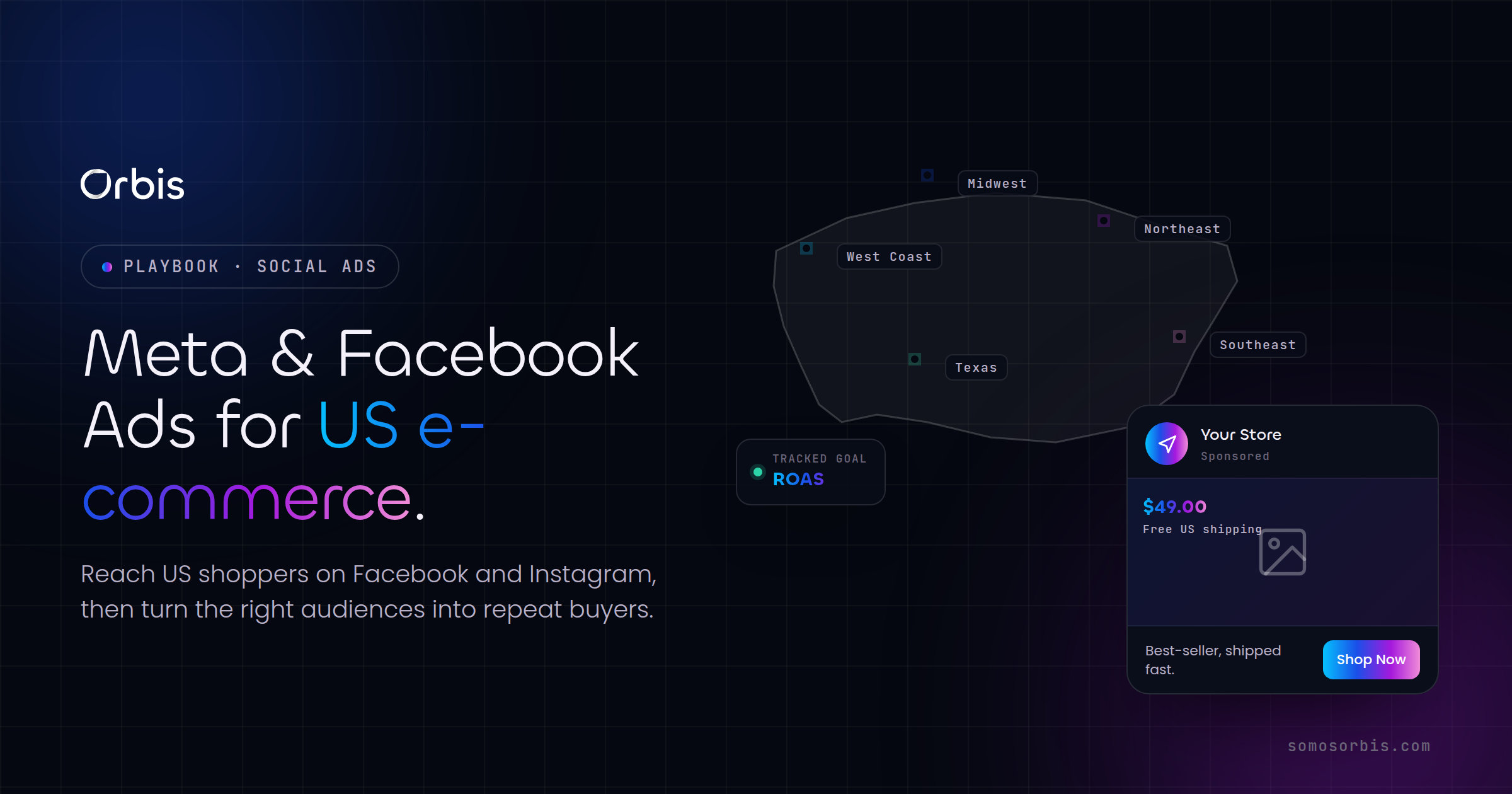
If you sell products online in the United States, Meta and Facebook Ads are still the workhorse of paid social. The platform reaches shoppers in New York, Los Angeles, Chicago, Miami, Dallas, and Houston at the exact moment they are scrolling, comparing, and deciding. But the version of Meta advertising that worked in 2020 is gone. Signal loss, Advantage+ automation, rising costs around Black Friday and Cyber Monday, and tighter privacy expectations under frameworks like CCPA and CPRA have rewritten the playbook for US e-commerce brands.
This guide gives you the practical structure we use to build Meta campaigns that hit real ROAS targets in USD: how to set up Advantage+ Shopping Campaigns, how to run a disciplined creative-testing system, how to keep measurement honest in a privacy-first world, and how to plan budgets around the US retail calendar. No fluff, no invented benchmarks. Just the moving parts that actually decide whether your Facebook and Instagram ads turn a profit.
Why Meta still wins for US e-commerce
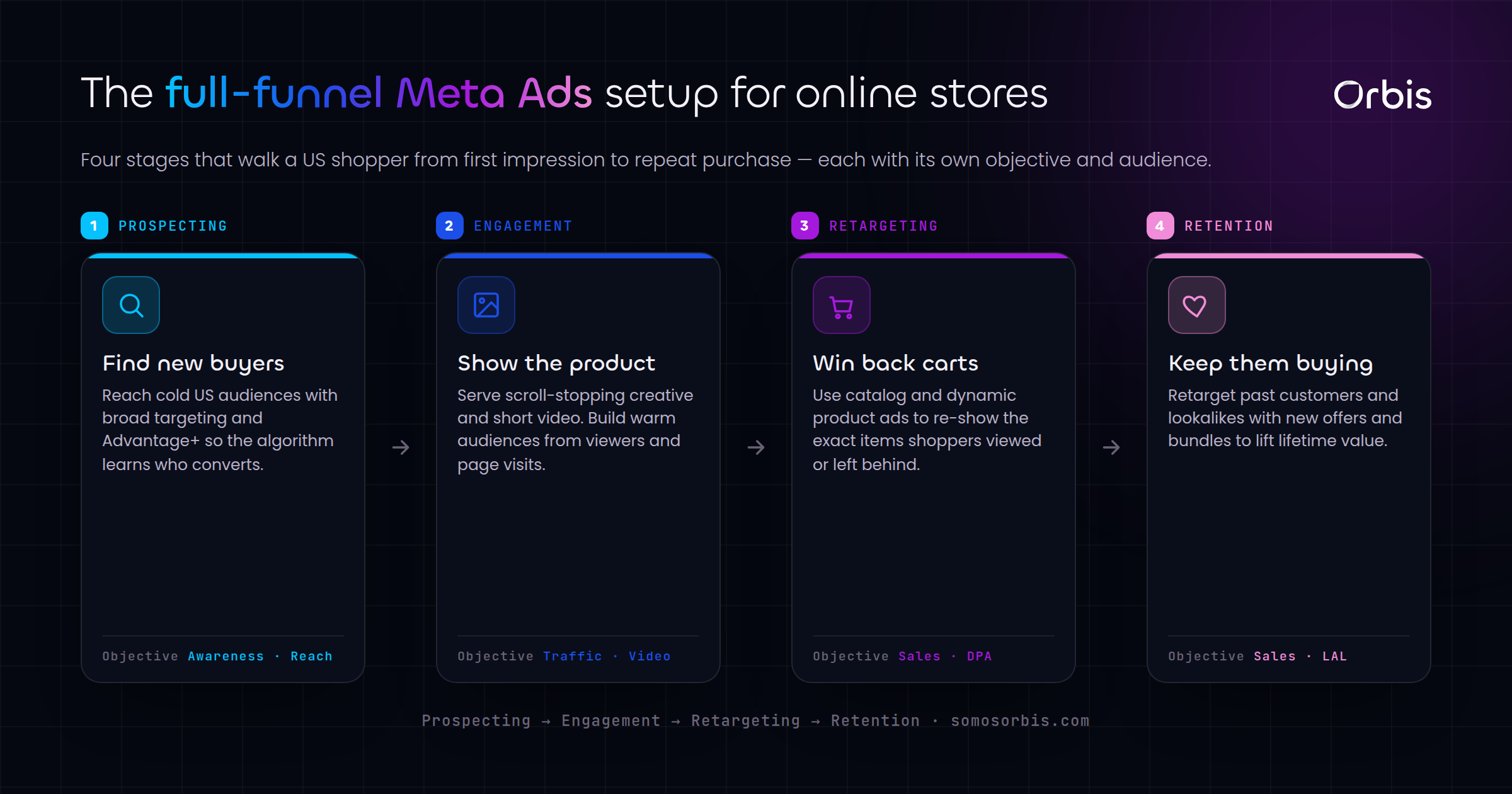
For most direct-to-consumer and retail brands selling in the US, Meta remains the highest-leverage channel for one simple reason: it pairs enormous reach with intent you can manufacture. Search captures demand that already exists. Meta creates demand by putting the right product in front of the right shopper before they were looking for it. For a candle brand in Brooklyn or a supplement line shipping out of Dallas, that demand-generation engine is the difference between flat months and a scaling business.
A few realities shape how you should approach the platform today:
- Automation is the default, not the exception. Advantage+ campaigns now do much of the targeting and placement work that media buyers used to control manually. Your job has shifted from micro-managing audiences to feeding the algorithm strong creative and clean signal.
- Creative is the new targeting. With broad, automated audiences, the ad itself decides who Meta shows it to. Your creative is your targeting lever.
- The US Hispanic market is too big to ignore. Bilingual EN/ES creative routinely unlocks audiences that English-only ads leave on the table, especially in Miami, Houston, Los Angeles, and parts of Texas. Treat Spanish-language variants as a first-class part of your test plan, not an afterthought.
- Measurement is fuzzier than it used to be. Privacy norms like CCPA and CPRA, plus browser and operating-system changes, mean you can no longer trust pixel-only attribution at face value.
Structuring Advantage+ campaigns the right way
Advantage+ Shopping Campaigns (ASC) are built for e-commerce, and for most US brands they should carry the majority of prospecting budget. The mistake we see most often is treating ASC like an old-school campaign with dozens of ad sets and overlapping audiences. That fragments your data and starves Meta's optimization.
Keep the account simple
A clean, consolidated structure lets the system learn faster and exit the learning phase sooner. As a starting framework:
- One primary ASC campaign for prospecting with a single, generous budget so the algorithm has room to optimize. Avoid splitting into many small ad sets that each fight for the same conversions.
- A separate retargeting campaign for warm audiences: site visitors, add-to-cart abandoners, past purchasers, and engaged social audiences. This is where your existing-customer budget cap inside ASC matters; set it deliberately so you do not overspend re-reaching people who would have bought anyway.
- A small, optional testing campaign if you want to isolate brand-new creative concepts before promoting winners into the main ASC.
Set ROAS targets in USD before you launch
Every campaign needs a number to be judged against. Work backward from your unit economics:
- Start with your average order value in USD and your gross margin after product cost, shipping, and payment fees.
- Calculate your break-even ROAS. If your margin after fulfillment is 50%, you break even at roughly 2.0x ROAS before overhead.
- Set a target ROAS above break-even that funds your team, your overhead, and your profit. For many US e-commerce brands, that lands somewhere between 2.5x and 4x on prospecting, with retargeting expected to run higher.
Do not chase a ROAS number you invented because it sounds healthy. Anchor it to your actual margins. A 2.2x ROAS can be wildly profitable for a high-margin digital product and a money-loser for a low-margin commodity good.
Feed the algorithm clean conversion signal
Advantage+ is only as smart as the data you send it. Make sure your Conversions API is implemented server-side alongside the pixel, deduplicated correctly, and passing high-quality event parameters. Server-side tracking recovers signal that browser-based tracking loses to ad blockers and privacy settings, which directly improves optimization and reported results.
A creative-testing system that actually compounds
Because creative is your real targeting lever, your testing process is the most important system in the account. Random one-off ads do not build a learning machine. A structured cadence does.
Test concepts, not just colors
The biggest wins come from new angles, not minor tweaks. Before you A/B test button colors, test fundamentally different messages:
- Problem-agitation: lead with the pain your product solves.
- Social proof: reviews, ratings, user-generated content, "+500 customers"-style trust signals when they are real and verifiable.
- Offer-led: bundle, free shipping threshold, or seasonal promotion (especially around Black Friday, Cyber Monday, and back-to-school).
- Founder or origin story: why the brand exists, which builds trust with US shoppers wary of faceless dropshippers.
- Demonstration: show the product working in a real US setting, like a Chicago apartment kitchen or a Miami beach day.
Build a creative volume habit
Winning brands ship creative consistently. Aim for a steady cadence of new concepts each month rather than a big batch once a quarter. Format mix matters too:
- Short-form vertical video for Reels and Stories, where most cheap reach now lives.
- Static and carousel for clear product detail and offers.
- User-generated content that looks native to the feed, not like a polished commercial.
- Bilingual EN/ES versions of your top performers to extend reach into the US Hispanic market without rebuilding from scratch.
The brands that win on Meta are not the ones with the best targeting settings. They are the ones with the most disciplined creative pipeline and the cleanest measurement.
Read results without fooling yourself
Give each test enough budget and time to gather meaningful conversions before you call it. Killing an ad after a handful of clicks is noise-chasing. At the same time, do not let a losing concept bleed budget for weeks. Set a clear rule, such as a minimum spend or conversion threshold per ad, and decide at that checkpoint.
Privacy-resilient measurement under CCPA and CPRA
US privacy norms have changed what "tracking" means. California's CCPA and CPRA, along with similar expectations spreading across other states, push you toward consent-aware, first-party data practices. This is not just compliance hygiene; it directly affects what you can measure and optimize.
Practical steps that keep your measurement honest and your brand on the right side of privacy expectations:
- Respect consent signals. Honor opt-outs and "do not sell or share" requests, and make sure your tag setup actually enforces them. Treat this as a baseline of quality processes, not an obstacle.
- Lean on server-side and first-party data. The Conversions API plus a solid first-party data foundation gives you more durable signal than the pixel alone.
- Triangulate, do not trust one number. Compare Meta's reported ROAS against your actual order data in Shopify, blended ROAS across all channels, and post-purchase surveys that ask "how did you hear about us?" The gap between platform-reported and real revenue is where bad decisions hide.
- Watch incrementality, not just last-click. Use holdout tests or geo-based lift checks when budget allows, so you know whether Meta is creating sales or taking credit for sales that would have happened anyway.
Budgeting around the US retail calendar
US e-commerce runs on a predictable rhythm, and your Meta budget should anticipate it rather than react to it. Auction costs climb when everyone bids at once, so plan ahead.
- Black Friday and Cyber Monday: the most competitive and expensive window of the year. Warm up your retargeting audiences in October and early November so you are not paying peak prices to acquire cold traffic during the rush.
- Amazon Prime Day: a demand spike even for non-Amazon sellers. Shoppers are in buying mode; a well-timed offer can ride that wave.
- Back-to-school: strong for apparel, electronics, home, and family categories from mid-summer into early fall.
- Tax season: the refund window in late winter and early spring puts extra discretionary USD in shoppers' pockets, useful for higher-ticket items.
The strategic move is to spend on prospecting and audience-building before each peak, then scale retargeting hard during it. Trying to build a cold audience from zero on Black Friday is the most expensive mistake in the calendar.
Common mistakes that quietly kill ROAS
- Over-segmenting audiences so Meta never gathers enough data per ad set to optimize.
- Judging campaigns too early, before they exit the learning phase.
- Trusting platform-reported ROAS without reconciling it against real order data.
- Neglecting creative volume, letting winners fatigue with no fresh concepts in the pipeline.
- Ignoring bilingual EN/ES creative, and leaving a large US audience untapped.
- Reacting to seasonality instead of planning budget around it.
Where this fits in your broader social strategy
Meta is one engine inside a larger paid-social machine. If you want the full picture of how channels, budgets, and creative fit together for the US market, start with our pillar overview: the complete social ads guide for US brands in 2026. And because so much of Meta's reach now lives on Instagram, pair this with our deep dive on Instagram ads creative that converts US audiences, where the creative principles above get platform-specific.
Make Meta a profit center, not a guessing game
Profitable Meta advertising for US e-commerce is not luck. It is a system: consolidated Advantage+ structure, ROAS targets anchored to real USD margins, a relentless creative-testing cadence, privacy-resilient measurement under CCPA and CPRA, and budget planning that respects the US retail calendar. Get those five things right and the platform rewards you. Get them wrong and you will keep wondering why your reported ROAS never matches your bank account.
If you want a team that builds this system with documented processes, real revenue engineering, and compliance by design, our Meta and Facebook Ads service for US brands is where to start. We are a Google Partner with a 4.9-star rating across 58 reviews, over 500 clients, and more than 15 years building paid-acquisition systems that hold up under scrutiny. Let's turn your Meta account into a measurable, scalable profit center.