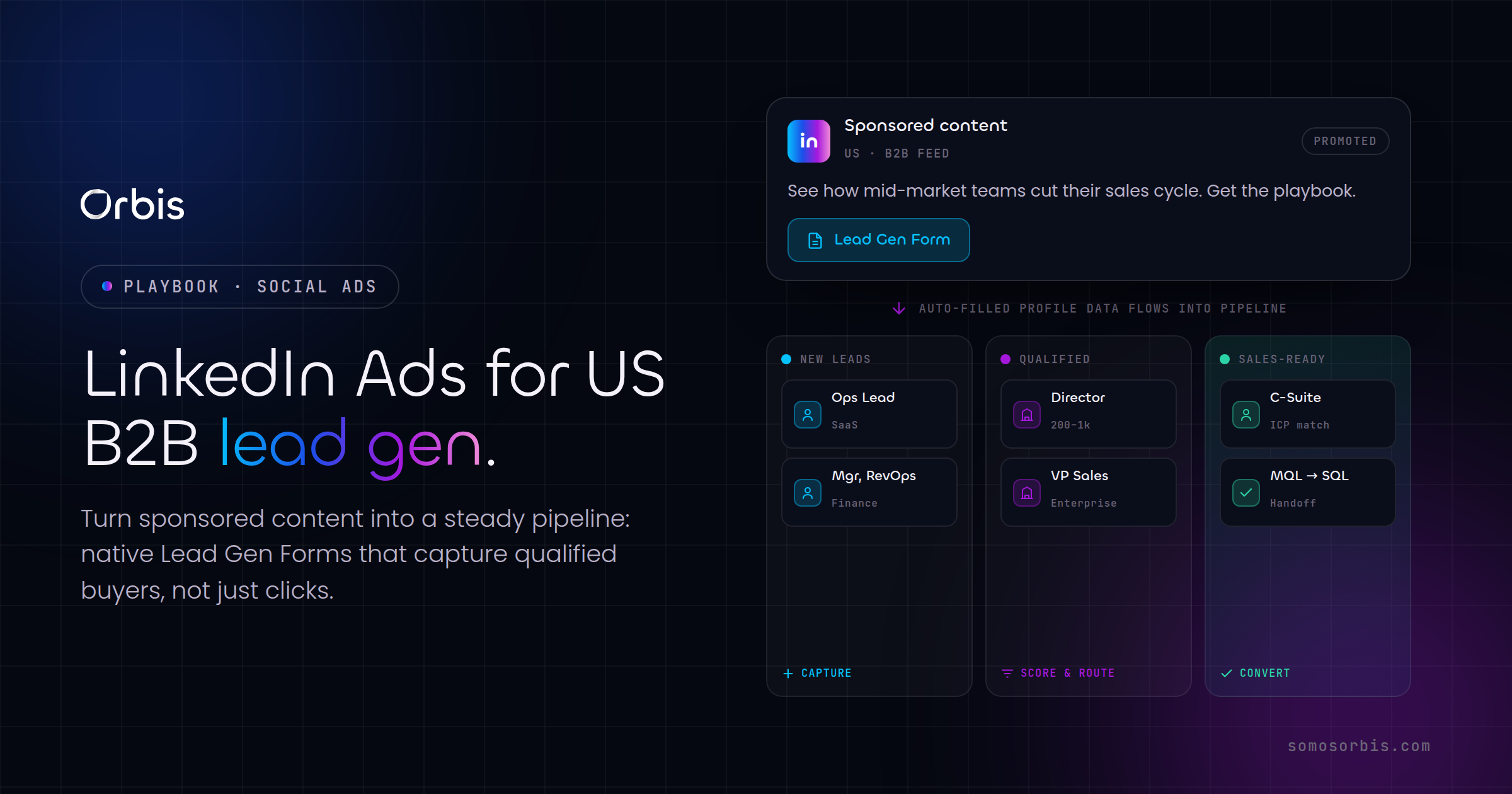
If you sell to other businesses in the United States, LinkedIn is the one paid channel where your buyer is already wearing their work hat. A VP of Operations in Chicago, a procurement lead in Dallas, a marketing director in New York, a founder in Miami: they are all on LinkedIn with their real job title, company size, and seniority attached to their profile. No other platform lets you target US decision-makers with that precision. The trade-off is cost. LinkedIn clicks and leads are expensive in USD, so a sloppy campaign burns budget fast. This guide shows you how to run LinkedIn Ads for US B2B lead generation the way that actually works: tight audiences, the right ad formats, Lead Gen Forms, and realistic cost-per-lead benchmarks so you know whether your numbers are healthy or bleeding.
This is a tactical companion to our complete social ads guide for US brands in 2026. If you also run consumer or e-commerce campaigns, the playbook is different, and our breakdown of Meta and Facebook Ads for US e-commerce brands covers that side. Here we stay strictly on B2B.
Why LinkedIn Ads work for US B2B (and when they don't)
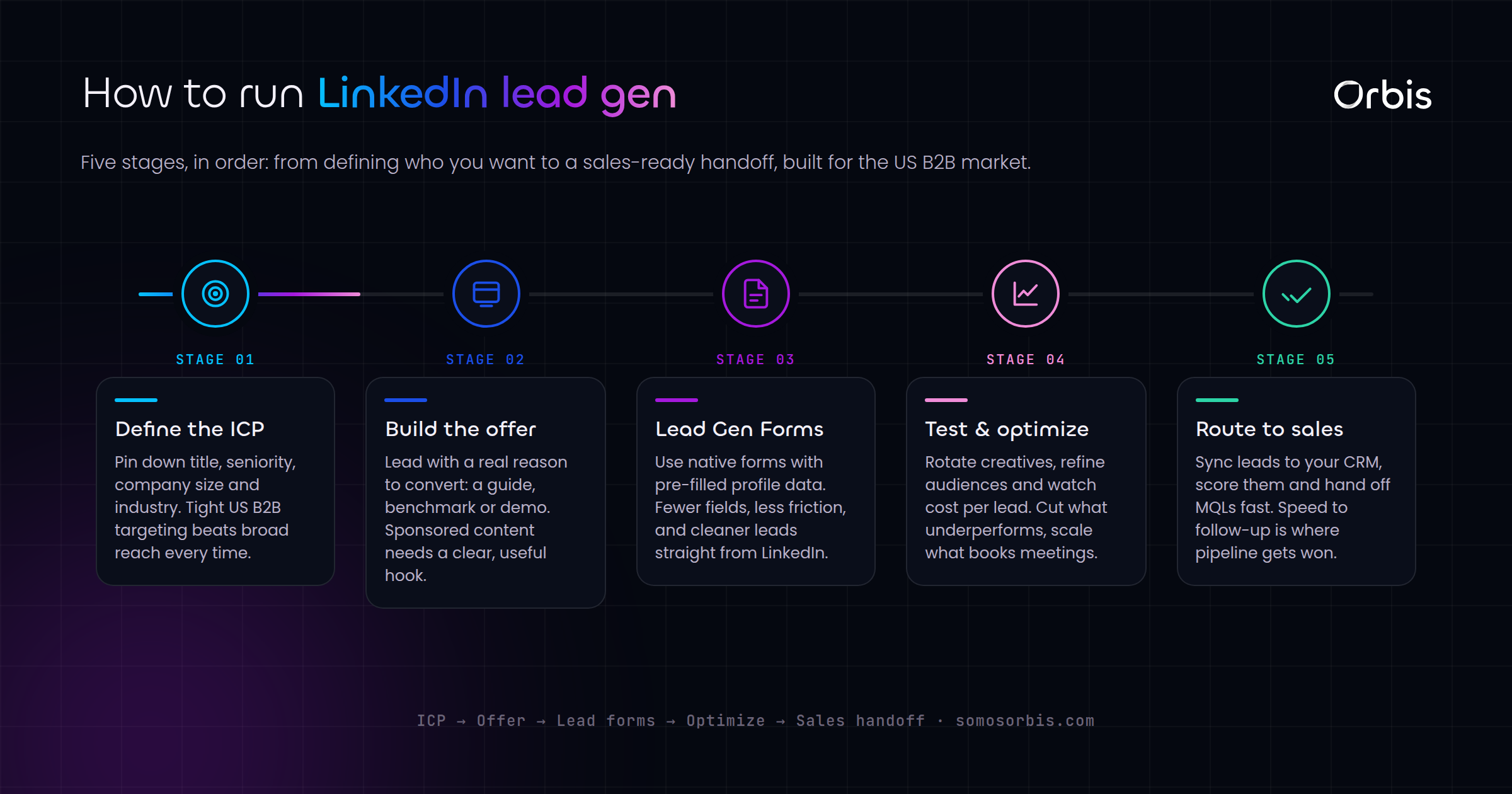
LinkedIn's value is targeting quality, not volume. You are not buying impressions; you are buying access to a named list of the exact people who can sign your contract. For a US B2B company with an average deal size above roughly $5,000 USD, the math usually works even at high cost-per-lead, because one closed deal pays for dozens of leads. Below that deal size, LinkedIn often gets expensive relative to return, and you should weight your budget toward search and Meta instead.
LinkedIn earns its premium when you have at least one of these:
- A clear ideal customer profile defined by job title, function, seniority, company size, or industry.
- A deal large enough that a $150-$300 USD cost-per-lead still produces strong return on ad spend after close rates.
- An account-based motion where you already have a list of target companies in markets like New York, Los Angeles, or Houston.
- A long sales cycle where nurturing decision-makers over weeks beats chasing a same-day click.
If your product is a low-ticket SaaS subscription or a self-serve tool, LinkedIn can still build awareness, but expect your lead generation cost to be high. Be honest about that before you commit spend.
Build US audiences that are tight, not just big
The most common mistake American advertisers make on LinkedIn is building an audience of two million people and wondering why their cost-per-lead is brutal. Tight audiences win. Here is how to structure them.
Start with the three-layer targeting stack
Combine layers so each prospect must match all of them:
- Who they are: job function plus seniority (for example, Marketing function, Director and above), or specific job titles if your buyer has a narrow role.
- Where they work: company size and industry. A 50-person agency and a 5,000-person enterprise buy very differently, so don't lump them together.
- Where they are: the United States as a whole, or specific metros when your offer is regional. If you only sell in California or only serve the Texas triangle of Dallas, Houston, and Austin, set location accordingly.
Keep each audience between roughly 50,000 and 300,000 people. Smaller than that and delivery stalls; larger and you lose the precision you are paying for.
Use account-based marketing audiences for named targets
If your sales team already has a wish list of US companies, upload it as a matched company list. This is where LinkedIn beats every other channel: you can run ads exclusively to employees of, say, 400 named accounts in financial services across New York and Chicago. Layer your job-function targeting on top, and you are only paying to reach the right roles inside the right companies. For ABM motions, pair this with a contact list upload so your ads and your sales outreach hit the same accounts in the same weeks.
Reach the US Hispanic professional market deliberately
The US Hispanic workforce includes a large and growing share of business decision-makers, especially in metros like Miami, Los Angeles, Houston, and Dallas. If your offer serves bilingual teams or Latino-owned businesses, run a parallel ad set with Spanish-language creative (or bilingual EN/ES copy) targeted to the same job functions. Don't assume English-only creative reaches everyone equally; testing a Spanish variant often lowers cost-per-lead in those markets because the relevance is higher.
Pick the right ad format for the job
LinkedIn offers several formats, and choosing wrong wastes money. Match the format to the stage of the funnel.
- Single image Sponsored Content: the workhorse. Clean, reliable, good for both lead forms and traffic. Start here.
- Document ads: upload a one-page checklist or short guide that users swipe through in-feed. These earn strong engagement and feed your lead form when gated, because the value is visible before the ask.
- Thought-leader ads: Sponsored Content published from a real person's profile (your founder, your VP of Sales) rather than the company page. These consistently outperform brand-page ads because US B2B buyers trust people over logos. If you have an executive willing to put their name on it, this is one of the highest-leverage moves available.
- Conversation and Message ads: direct-to-inbox formats. Use sparingly and only for high-intent offers like a demo or an exclusive event; overuse annoys your audience and tanks brand perception.
- Video ads: good for awareness and retargeting, weaker for direct lead capture.
For most US B2B lead gen programs, a combination of single-image Sponsored Content plus thought-leader ads, both pointing to Lead Gen Forms, is the strongest starting stack.
Lead Gen Forms: capture leads without losing them to a landing page
LinkedIn Lead Gen Forms are native in-platform forms that pre-fill with the user's profile data. The prospect taps your ad, sees a form already populated with their name, work email, company, and title, and submits in two taps without ever leaving LinkedIn. Conversion rates are dramatically higher than sending traffic to an external landing page, because you eliminate the page load, the friction, and the typing.
How to set them up well
- Ask for the minimum. Name, work email, company, and job title are usually enough. Every extra field cuts your completion rate. If you need to qualify, add one custom question, not five.
- Write a clear offer headline. "Get the 2026 US B2B benchmark report" beats "Learn more." Tell people exactly what they receive.
- Set up the thank-you action. Send leads straight to your booking page or resource the moment they submit, so the momentum isn't lost.
- Connect your CRM. Pipe leads into your CRM in real time. A lead that sits in LinkedIn's dashboard for three days is a cold lead. This is exactly the kind of documented, repeatable process that turns a campaign into a revenue engine rather than a list of names nobody calls.
Respect US privacy expectations
US buyers are increasingly privacy-aware, and several states now give consumers strong data rights. Keep your data handling clean: state clearly what you collect and why, honor opt-out and deletion requests promptly, and only ask for information you will actually use. Treating privacy as a design principle, not an afterthought, protects you and builds trust with cautious B2B buyers who notice how you handle their information.
USD cost-per-lead benchmarks: what healthy looks like
LinkedIn is the most expensive major social platform per click and per lead, and that is normal. Use these USD ranges as orientation, not as guarantees, since cost varies heavily by industry, seniority, and how tight your audience is.
- Cost-per-click: commonly $8-$15 USD for US B2B audiences, higher for senior executives and competitive industries.
- Lead Gen Form cost-per-lead: often $50-$150 USD for mid-funnel content offers, and $150-$400 USD for high-intent demo or sales-call requests.
- Form completion rate: a healthy Lead Gen Form converts 10-15% of clicks, sometimes higher with a strong offer, far above what an external landing page typically achieves.
The number that actually matters is not cost-per-lead in isolation. It is cost per qualified lead and, ultimately, cost per closed deal. A $300 USD lead that closes a $40,000 USD contract is a bargain. A $40 USD lead that never qualifies is expensive. Track leads all the way through your pipeline, not just at the form. Engineering revenue from this channel means tying ad spend to closed-won, not to vanity submission counts.
Structure, budget, and timing for the US market
Campaign structure that stays manageable
Don't over-fragment. A clean starting structure:
- One campaign per core audience segment (for example, one for marketing leaders, one for operations leaders).
- Two to four ad variations per campaign so the algorithm has room to optimize.
- A separate retargeting campaign for people who engaged but didn't convert.
Set a realistic minimum budget
Because LinkedIn clicks are expensive, a budget that is too small never gathers enough data to optimize. Plan for at least a few thousand USD per month per active campaign so you generate enough leads to learn from. Spreading $500 across five audiences teaches you nothing.
Mind US B2B seasonality
B2B buying rhythms in the United States are real and worth planning around:
- Q4 budget flush: many US companies spend remaining budget before year-end, so October and November are strong for closing.
- January planning season: decision-makers are setting priorities and researching vendors; great for top-of-funnel content offers.
- Tax season (roughly January through April): finance and accounting buyers are slammed, so timing outreach to those roles matters.
- Summer slowdown: July and August see slower response in many industries as people take vacation; lower budgets or shift to nurture.
Unlike consumer channels, LinkedIn B2B is less about Black Friday or Prime Day and more about fiscal calendars and planning cycles. Align your strongest offers with when your buyers are actually budgeting.
A simple optimization loop
Once your campaigns are live, run a weekly review and act on the data:
- Pause weak audiences. If an audience's cost-per-qualified-lead is double your best one after enough spend, cut it.
- Refresh creative every two to four weeks. LinkedIn audiences are smaller, so ad fatigue hits faster than on broader platforms.
- Double down on thought-leader ads that are working; these often have the best cost-per-lead.
- Feed the sales team fast. The faster a lead is contacted, the higher it converts. Speed-to-lead is a process problem, and processes can be documented and improved.
The advertisers who win on LinkedIn aren't the ones with the biggest budgets. They are the ones with the tightest audiences, the clearest offer, and a documented process that moves every lead from form submission to sales conversation without dropping it.
Put it to work
LinkedIn Ads are the sharpest tool in US B2B lead generation when you respect what makes them work: precise targeting, the right formats, native Lead Gen Forms, honest USD benchmarks, and a process that connects spend to closed revenue. Build tight audiences, gate genuine value, measure all the way to closed-won, and treat privacy and speed-to-lead as features of your system rather than afterthoughts.
If you want a team that builds and runs this end to end, with documented processes and revenue engineering tied to your pipeline, explore our LinkedIn Ads services for US B2B. We'll help you turn decision-maker targeting into qualified pipeline, not just a list of names.