
Ask most US B2B marketing teams where their paid budget goes and the answer is predictable: Google Ads first, LinkedIn second, maybe a retargeting line on Meta. Microsoft Ads almost never makes the shortlist. That is exactly why it is one of the most overlooked channels for B2B advertisers in the United States right now, and why the teams that do invest in it tend to quietly outperform on cost per qualified lead.
The reasoning is simple. Microsoft Ads (formerly Bing Ads) powers search results across Bing, Yahoo, AOL, DuckDuckGo, and — critically for B2B — every desktop running Edge with default settings, plus the search box baked into Windows itself. The audience skews toward exactly the people who sign B2B contracts: desktop-heavy, higher-income, often in corporate environments where IT locks the default browser to Edge. If you sell software, professional services, manufacturing equipment, or financial products, a meaningful slice of your buyers are searching on Microsoft properties during the workday and you are simply not showing up.
This guide walks through why the channel matters for US B2B, how to think about its unique LinkedIn-based targeting, and a practical setup you can stand up in an afternoon. If you are still building your overall search foundation, start with our paid media guide to Google Ads for the US in 2026 — Microsoft Ads works best as a complement to a healthy Google program, not a replacement for it.
Why Microsoft Ads is underrated for US B2B
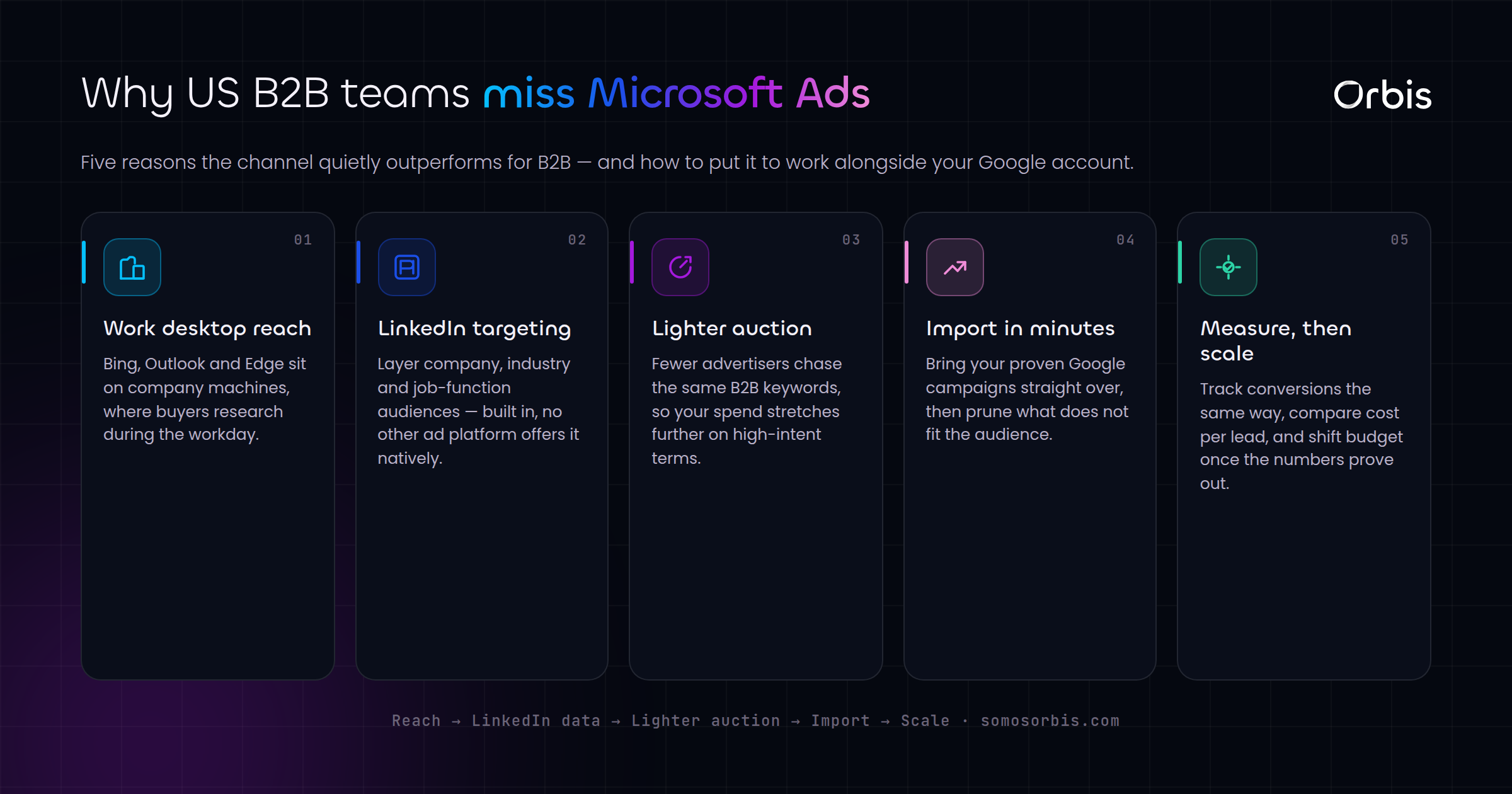
The knock against Microsoft Ads has always been volume. Google handles the overwhelming majority of US search queries, so the instinct is to put every dollar there. But volume is the wrong metric for B2B. What matters is whether the right buyers are reachable at a price that beats your blended cost per acquisition. On both counts, Microsoft Ads frequently wins.
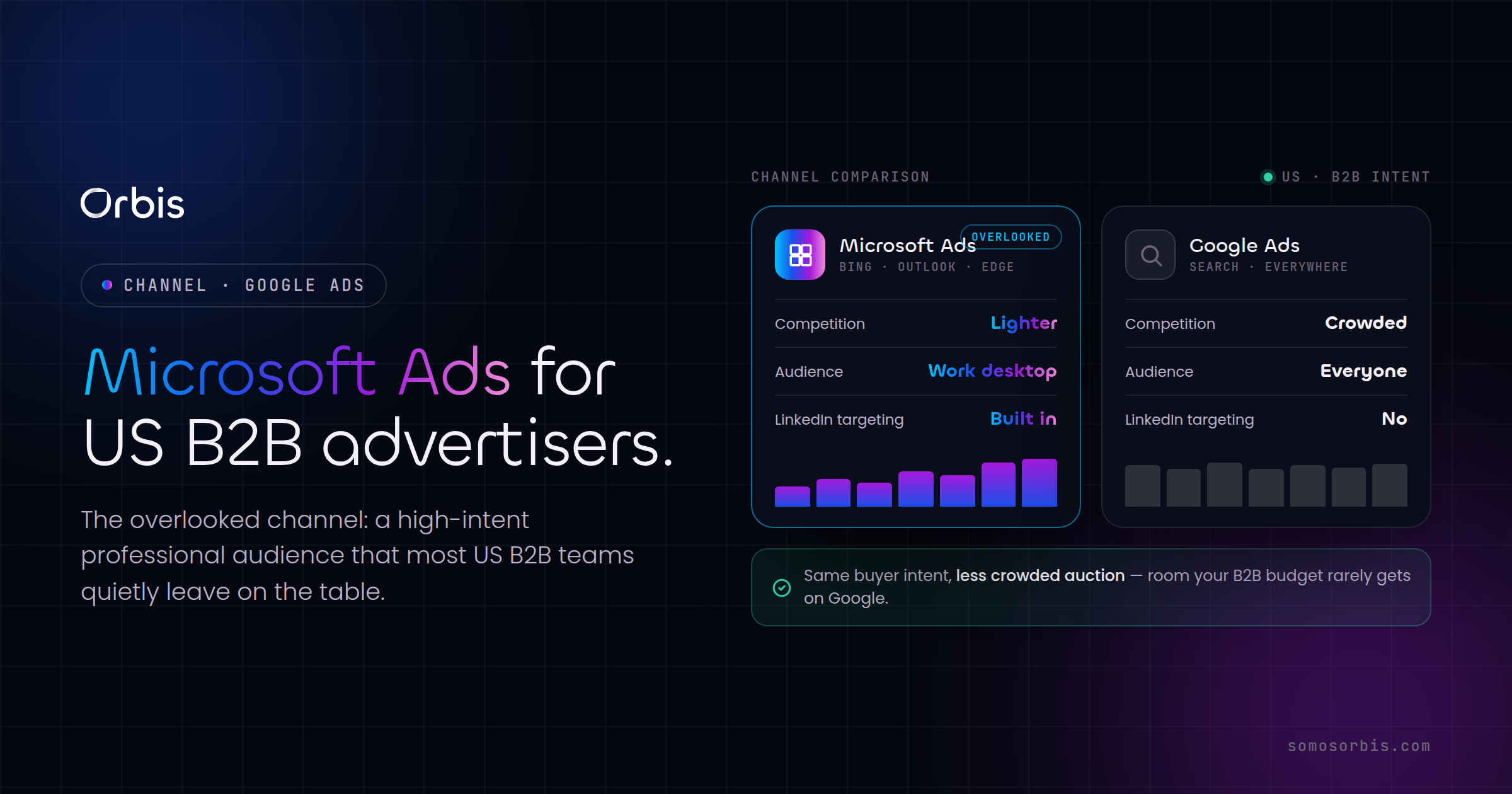
- Lower competition, lower CPCs. Because fewer advertisers bother, auctions on Microsoft are often less crowded than the equivalent Google auction. For competitive B2B terms — "managed security services," "enterprise CRM," "industrial automation supplier" — that gap can mean 20% to 40% lower cost per click in many US markets. Same intent, smaller bill.
- A desktop-heavy, high-income audience. Microsoft's own audience data skews older, more affluent, and more likely to be on a desktop or laptop. That profile maps almost perfectly onto B2B decision-makers in cities like New York, Chicago, and Dallas who research vendors from a corporate workstation.
- Captive enterprise distribution. Many large US employers — banks, hospitals, government agencies, Fortune 500 firms — standardize on Edge and lock the default search engine. The people searching from those environments are, by definition, inside your target accounts.
- Easy import from Google. Microsoft lets you import existing Google campaigns directly, so you are not building from a blank slate. You can be live in hours, then optimize from there.
None of this means Microsoft replaces Google. It means a portion of your highest-value buyers are reachable there at a discount, and ignoring them leaves qualified pipeline on the table.
The killer feature: LinkedIn profile targeting
Here is the capability no other major search engine offers, and the single best reason a B2B advertiser should care about this channel. Because Microsoft owns LinkedIn, Microsoft Ads lets you layer LinkedIn profile targeting directly onto your search and audience campaigns. You can target — or adjust bids for — users based on three professional dimensions:
- Company: reach people who work at specific organizations or company lists. This is account-based marketing inside a search auction.
- Industry: narrow to verticals that match your ideal customer profile — financial services, healthcare, manufacturing, SaaS, and so on.
- Job function: bid more aggressively when the searcher's LinkedIn role aligns with your buyer — IT, finance, operations, marketing, procurement.
Think about what that unlocks. A generic query like "data backup solution" tells you intent but nothing about fit. Layer LinkedIn job-function targeting on top and you can bid 30% higher when the searcher is an IT Director and pull back when they are a student or job-seeker. You are no longer buying keywords blind — you are buying keywords plus the professional context that LinkedIn already knows. For US B2B, that combination is genuinely hard to find anywhere else at this price point.
A practical note: in most cases you should start by using LinkedIn targeting as a bid modifier ("bid only" or "bid and target") rather than a hard restriction. Hard targeting can shrink reach dramatically. Modifiers let you stay in the broader auction while paying a premium for the profiles that matter most.
Setting up your first Microsoft Ads B2B campaign
You can stand up a credible US B2B program in an afternoon if you already run Google Ads. Here is a sequence that works.
1. Import, then prune
Use the Google Import tool to bring over your best-performing search campaigns. Do not import everything. Pull in the campaigns and ad groups that drive qualified leads, then immediately review for things that do not translate: callout extensions referencing Google-specific features, location targets you do not actually want, and budgets that need rescaling for lower Microsoft volume. Treat the import as a starting draft, not a finished build.
2. Rebuild conversion tracking from scratch
Import does not carry over your conversion setup, and getting this right is non-negotiable for B2B. Install the Universal Event Tracking (UET) tag, define conversion goals for your real money moments — demo requests, qualified form fills, quote submissions — and confirm they fire before you scale spend. For longer B2B cycles, set up offline conversion imports so closed-won deals from your CRM flow back into the platform and teach the bidding algorithm what a good lead actually looks like. Without this, you are optimizing toward form fills instead of revenue.
3. Layer on LinkedIn targeting
Once campaigns are live and tracking is verified, add LinkedIn company, industry, and job-function targeting as bid modifiers on your core B2B ad groups. Start conservative — a 15% to 25% bid increase for ideal job functions — and let data accumulate before pushing harder.
4. Mind quality and relevance
Microsoft uses a quality score model conceptually similar to Google's, and the same fundamentals apply: tight keyword-to-ad relevance, strong expected click-through rate, and a landing page that matches the promise. If you want a deeper treatment of how this works and why it controls both your cost and your visibility, read our breakdown of Google search ads Quality Score for the US market — the principles carry over almost directly to Microsoft Ads, and improving relevance on one platform usually lifts the other.
5. Set realistic budgets
Because volume is lower, do not just copy your Google daily budget. Start with a test budget large enough to gather data — often 15% to 30% of your Google search spend for the same campaigns — and scale based on cost per qualified lead, not impression volume. The goal is efficient pipeline, not big numbers.
US-specific plays that work
The US market rewards advertisers who tune for local context. A few patterns we see drive results for B2B accounts on Microsoft Ads:
- Geo-tiered bidding by metro. Concentrate budget where your buyers cluster — financial services in New York, energy and logistics in Houston and Dallas, entertainment and media in Los Angeles, trade and finance in Miami. Bid up in metros where your sales team closes and pull back where you cannot service efficiently.
- Bilingual EN/ES for the right verticals. The US Hispanic market is large and growing, and for industries like logistics, construction, professional services, and financial products, Spanish-language ad groups can reach decision-makers competitors ignore. Run parallel ES campaigns where it fits your audience and route to Spanish landing pages.
- Seasonality beyond retail. B2B has its own calendar. Tax season drives demand for accounting and financial software; Q4 budget-flush spending lifts enterprise purchases; back-to-school timing matters for ed-tech and institutional buyers. Even Black Friday and Cyber Monday now pull B2B SaaS promotions. Plan budget pacing around these US-specific windows instead of running flat year-round.
- Privacy-conscious tracking by design. US privacy expectations are tightening, and your measurement should respect them from the start. Build consent-aware tracking, lean on server-side and first-party data where you can, and treat compliant measurement as a feature, not an afterthought. Clean data also happens to make your bidding smarter.
Measuring what actually matters
The most common Microsoft Ads mistake in B2B is judging the channel on the wrong yardstick. It will almost never match Google on raw volume — that is not its job. Judge it on these instead:
- Cost per qualified lead, not cost per click or cost per raw form fill. A cheaper click that never becomes pipeline is not a win.
- Lead-to-opportunity rate by source, so you can see whether Microsoft traffic converts as well as — or better than — Google for your business.
- Pipeline and revenue influenced, tied back through offline conversion imports. This is the number that justifies the budget to your CFO.
- Incremental reach — the qualified buyers you reached on Microsoft who never appeared in your Google data at all. That incrementality is the whole point of the channel.
The teams that win on Microsoft Ads treat it as a precision instrument for reaching high-value B2B buyers at a discount — not as a second-string Google clone judged by volume.
Common pitfalls to avoid
- Import-and-forget. A Google import is a draft. Left untouched, it wastes spend on settings that do not fit Microsoft's audience and ignores the LinkedIn targeting that makes the channel worth running.
- Skipping conversion tracking. Without UET and offline conversions wired up, you are flying blind and the algorithm optimizes toward the wrong outcomes.
- Over-restricting with LinkedIn targeting. Hard-targeting too aggressively can starve campaigns of volume. Use modifiers first.
- Copy-pasting Google budgets. Mismatched budgets either throttle learning or burn cash inefficiently. Scale to Microsoft's volume reality.
- Ignoring landing page relevance. Low relevance raises costs on Microsoft just as it does on Google. Match the ad's promise to the page.
Where this fits in your paid program
Microsoft Ads should sit alongside a healthy Google search program and a defined account-based strategy — not in place of either. Google gives you scale. LinkedIn gives you precision targeting. Microsoft Ads sits in the overlap: search intent plus LinkedIn-grade professional targeting, at a cost per click your competitors are not bidding up. For US B2B advertisers, that is a rare combination, and the channel's relative obscurity is precisely what makes it an advantage today.
The work is straightforward — import, fix tracking, layer LinkedIn, tune for US metros and seasonality, measure on qualified pipeline — but doing it well takes discipline and a clear view of how it connects to the rest of your funnel. That is exactly the kind of documented, revenue-focused execution we build for clients.
Ready to put Microsoft Ads to work?
If you want a channel that reaches high-income, desktop-heavy B2B buyers with LinkedIn-grade targeting at a discount to Google, Microsoft Ads deserves a line in your budget. Our team builds and manages these programs end to end — from import and conversion tracking to LinkedIn layering and pipeline reporting your CFO will trust. Explore our Microsoft Ads management services and let's turn an overlooked channel into qualified US pipeline.