
If you run Google Search campaigns in the United States, Quality Score is the lever most advertisers underuse. It quietly decides how much you pay for every click in USD and whether your ad even shows when a high-intent buyer in New York, Los Angeles, Chicago, Miami, Dallas, or Houston types your keyword. Two competitors can bid on the same term, and the one with the stronger Quality Score can sit higher on the page while paying less per click. That is not luck. It is the result of disciplined account structure, relevant ad copy, and landing pages that match what the searcher actually wants.
This guide breaks Quality Score down into the three components Google scores, then walks through the practical moves that lower your cost-per-click and improve Ad Rank for US audiences. No theory for the sake of theory. Every section is something you can act on this week.
What Quality Score actually measures
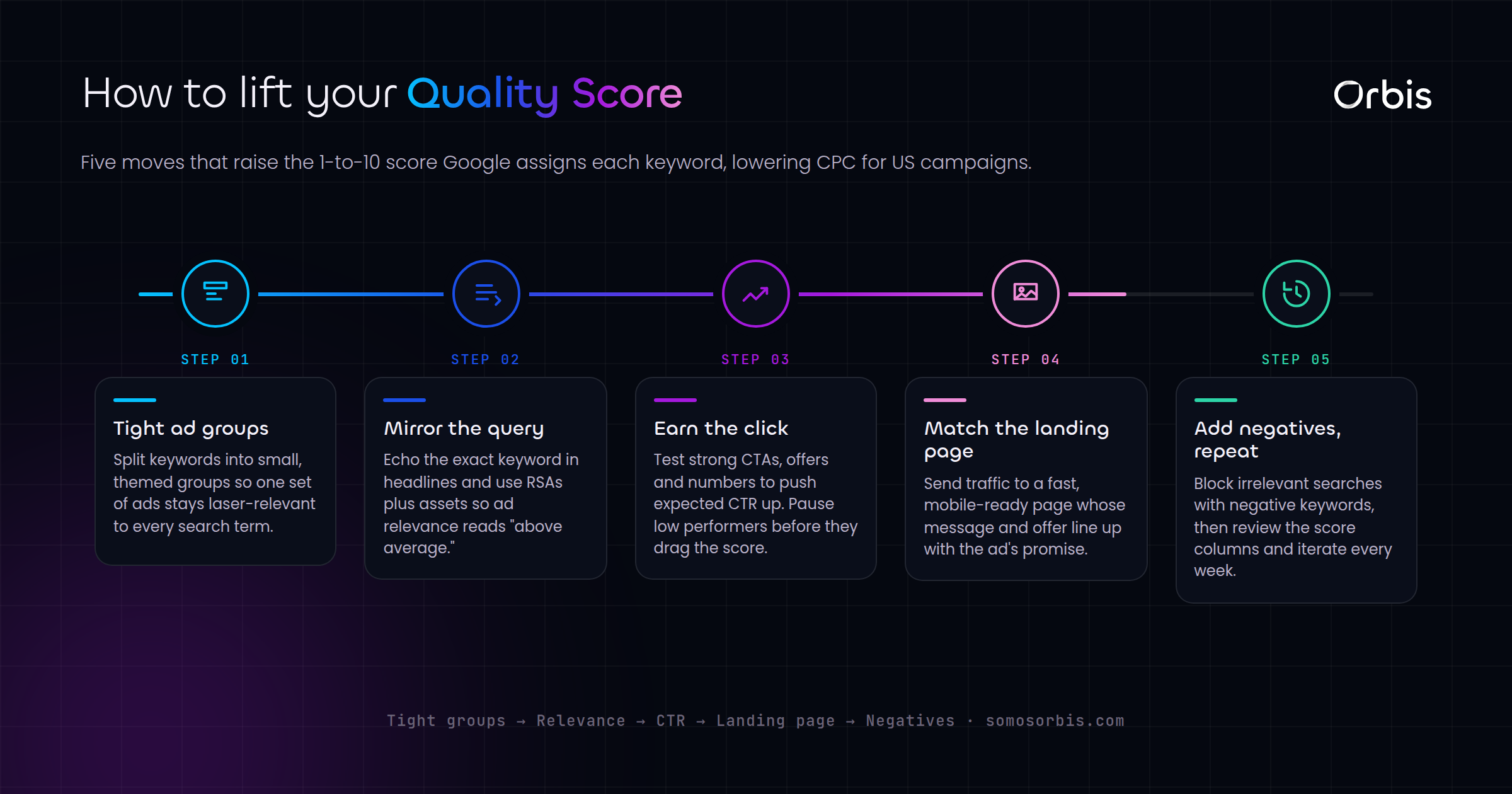
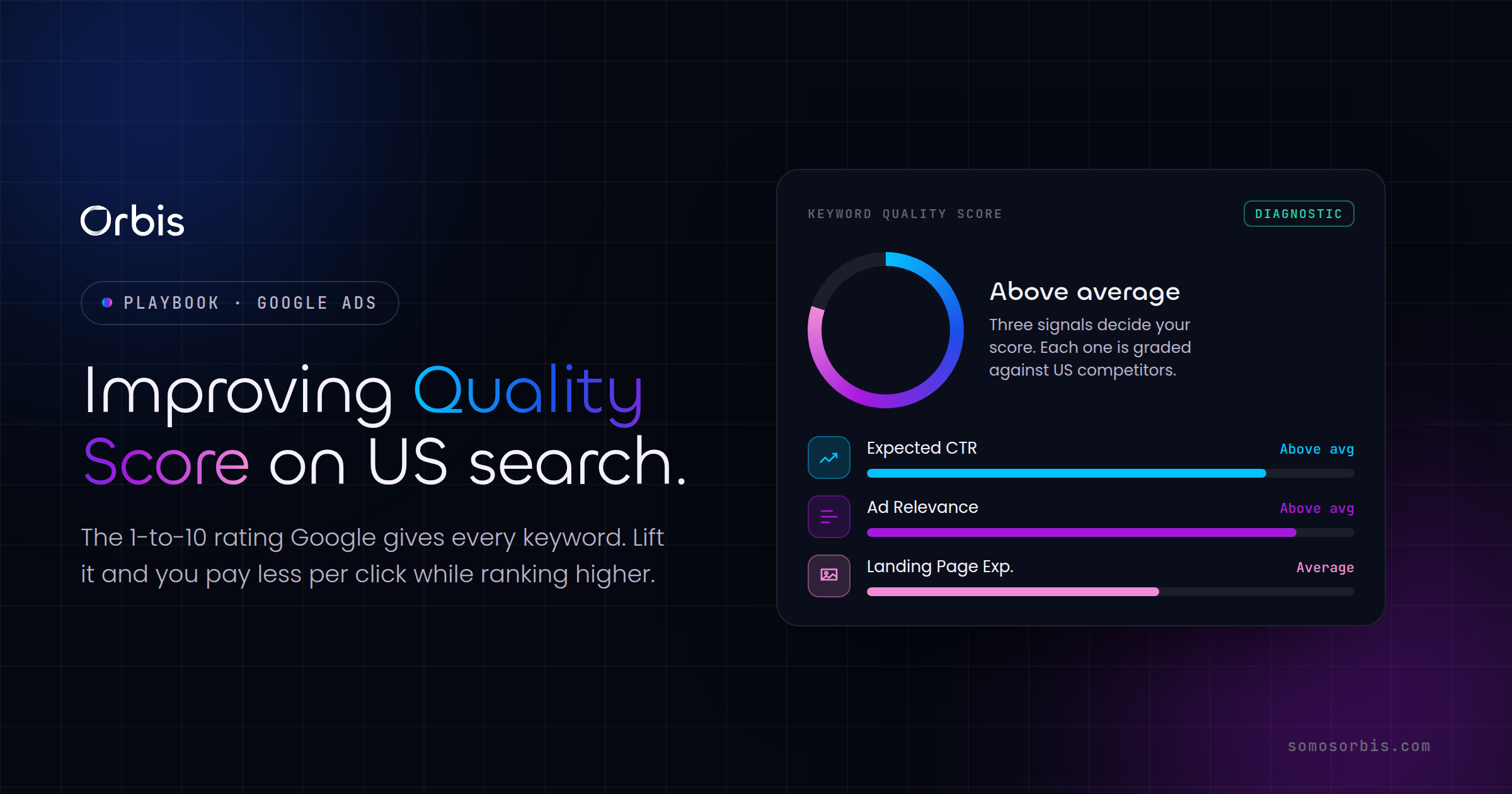
Quality Score is a 1-to-10 diagnostic Google assigns at the keyword level. It is a directional signal, not the live number used in every auction, but it maps closely to the real-time quality factors that determine Ad Rank. It is built from three inputs:
- Expected click-through rate (CTR): how likely your ad is to be clicked when it shows for a given keyword, normalized for position.
- Ad relevance: how closely your ad copy matches the intent behind the search query.
- Landing page experience: how relevant, transparent, and easy to navigate your landing page is for someone who clicked.
Each is rated "Above average," "Average," or "Below average." Anything marked below average is a direct instruction from Google about where your money is leaking. The reason this matters in dollars: Ad Rank is roughly your bid multiplied by quality factors, and your actual CPC is the Ad Rank of the advertiser below you divided by your own quality factors. Raise quality and your effective CPC drops even if your bid stays flat. For a US advertiser spending real budget during peak windows like Black Friday and Cyber Monday, a one-point improvement across a campaign can mean the difference between profitable scale and pausing ads.
Tighten your ad groups around single intent
The single biggest structural mistake we see in US accounts is the bloated ad group: 40 loosely related keywords sharing two generic ads. When one ad has to speak to "emergency plumber Dallas," "water heater repair cost," and "tankless installation," it speaks well to none of them. Expected CTR and ad relevance both suffer.
The fix is to build tightly themed ad groups where every keyword shares the same intent, so a single set of ads can be genuinely relevant to all of them. Practical guidelines:
- Keep ad groups small enough that one promise covers every keyword in it. Many strong accounts run 5 to 15 keywords per group, but the real rule is shared intent, not a magic number.
- Separate commercial intent ("buy," "pricing," "quote") from research intent ("how to," "vs," "best"). They convert differently and deserve different ads.
- Split by service or product line, then by modifier. A Miami HVAC advertiser might separate "AC repair" from "AC installation" from "AC maintenance" rather than dumping all three together.
- Use Single Keyword Ad Groups (SKAGs) sparingly. Modern match types and Smart Bidding make giant SKAG sprawl less necessary, but a tight thematic group still wins on relevance.
When the ad group is tight, you can put the keyword theme directly in the headline. A searcher who types "tax preparation services Houston" and sees a headline reading "Houston Tax Preparation" gets an immediate relevance signal. That lifts expected CTR, which lifts Quality Score, which lowers your CPC.
Write ads that mirror the query
Ad relevance rewards copy that reflects the language of the search. Responsive Search Ads (RSAs) let you supply up to 15 headlines and 4 descriptions, and Google assembles combinations. Your job is to feed it raw material that is both relevant and varied.
Headlines that earn relevance
- Include the core keyword theme in at least 3 headlines so Google always has a relevant option to surface.
- Pin sparingly. Over-pinning kills the testing that improves expected CTR. Pin only when a legal or brand requirement demands it.
- Speak to US buyers in concrete terms: "Free Quote," "Same-Day Service," "USD Pricing Upfront," "Serving the Dallas Metro."
- Differentiate. If every advertiser says "Fast & Affordable," the searcher tunes it out. Lead with a real, citable advantage.
Use ad assets to expand and qualify
Assets (formerly extensions) are free real estate that lift CTR and give Google more relevance signals. Sitelinks, callouts, structured snippets, location, and call assets all expand your footprint on the results page. For a US service business, location and call assets matter especially during high-urgency moments. Reaching the large US Hispanic market? Bilingual EN/ES callouts such as "Se Habla Espanol" can lift relevance and CTR for the right audiences without splitting your campaign.
For US Hispanic audiences specifically, consider mirroring search language. If your data shows Spanish-language queries, dedicated ES ad groups with ES copy will out-perform a forced English ad every time on both relevance and conversion.
Fix the landing page experience
Landing page experience is the component most advertisers ignore because it lives outside the ads interface. Yet it is often the cheapest Quality Score win because it compounds with conversion rate. If the click lands on a generic homepage instead of a page about the exact thing they searched, both relevance and conversions drop.
What Google looks for, and what your US visitors expect:
- Message match: the headline on the landing page should echo the ad and the query. Searched "back-to-school laptop deals"? The page should say exactly that, not "Shop All Electronics."
- Speed: page load is a ranking and experience factor. Mobile speed especially matters for US traffic that skews heavily mobile. Compress images, defer non-critical scripts, and aim for a fast Largest Contentful Paint.
- Transparency: show pricing in USD, list a real US address or service area, and make your contact and policy information easy to find. US shoppers expect clarity, and privacy norms like CCPA/CPRA mean your cookie and data notices should be visible and honest without burying the page in legal text.
- Relevance depth: the page should answer the question the keyword implies, not force the visitor to hunt. One clear primary action beats five competing buttons.
Rule of thumb: if you would not click your own ad and immediately feel you landed in the right place, neither will the searcher. Quality Score is Google charging you for that gap.
Use negative keywords to protect relevance
Irrelevant impressions drag down expected CTR. If your "premium leather office chair" ad shows for "free office chair" or "office chair repair," those non-clicks tell Google your ad is not relevant, and your Quality Score erodes. A disciplined negative keyword list keeps your ads in front of the right US searchers.
- Mine the Search Terms report weekly. Every irrelevant query that triggered your ad is a negative keyword candidate.
- Build a shared negative list for obvious wastes: "free," "jobs," "salary," "DIY," "used" (unless you sell used).
- Add cross-campaign negatives so research-intent terms do not steal traffic from commercial campaigns and vice versa.
- Layer geographic negatives if you only serve specific metros. A Chicago-only installer should not pay for clicks from Phoenix.
Match types and Smart Bidding work together
Quality Score improvements amplify everything downstream, including your bidding strategy. Broad match has improved with machine learning, but it needs strong conversion signals and tight negatives to behave. A practical US approach:
- Start exact and phrase match on your proven money keywords to keep relevance high and CPCs controlled.
- Test broad match in separate, well-monitored ad groups paired with a Target CPA or Target ROAS strategy and a robust negative list.
- Let Smart Bidding adjust by device, location, time, and audience signals automatically once you have enough conversion volume. During seasonal spikes like Amazon Prime Day or tax season, give the algorithm clean conversion data so it bids into demand instead of guessing.
Higher Quality Score lowers the cost the algorithm has to pay for each conversion, which means your Target CPA goals become easier to hit and you can scale spend without scaling waste.
A weekly Quality Score routine
Quality Score is not a set-and-forget number. It responds to disciplined, repeatable maintenance. Here is a routine you can run in under an hour a week:
- Monday: pull the Search Terms report, add negatives, note any new high-intent queries worth their own ad group.
- Wednesday: review keywords with Quality Score below 5. Check which component is "Below average" and fix that specific lever first.
- Friday: audit RSA asset strength and CTR by ad group. Replace "Low" rated assets and pause underperforming combinations.
- Monthly: revisit landing pages for your top-spend keywords. Tighten message match and re-check mobile speed.
Document the process so it survives staff changes and account handoffs. Repeatable, written processes are what separate accounts that improve quarter over quarter from accounts that drift.
Common Quality Score myths to ignore
- "Raising bids fixes Quality Score." It does not. Bids affect Ad Rank, not the underlying quality components. You can buy position temporarily, but you keep overpaying.
- "Pausing low Quality Score keywords helps account-level quality." There is no separate account-level Quality Score you can game by pruning. Fix the keyword or replace it with a better-matched one.
- "More keywords means more reach means better scores." Bloated ad groups dilute relevance. Fewer, tighter keywords usually score higher.
- "Quality Score does not matter with Smart Bidding." The quality factors that build Quality Score are the same factors inside the real-time auction Smart Bidding plays in. They always matter.
Putting it together for US campaigns
Improving Quality Score is engineering, not magic. You tighten ad groups around single intent, write ads that mirror the query, point clicks at landing pages that deliver on the promise, prune irrelevant traffic with negatives, and let Smart Bidding compound the gains. Done consistently, your CPCs in USD fall, your Ad Rank climbs, and your budget reaches more high-intent buyers across New York, Los Angeles, Chicago, Miami, Dallas, and Houston, plus the large US Hispanic market when you serve them in their language.
This is the same discipline we apply for clients as a Google Partner with 4.9 stars across 58 reviews and more than 500 clients over 15-plus years. If you want a team that treats Quality Score as a measurable, documented process rather than a guessing game, our Google Search Ads management service builds and maintains campaigns engineered to lower cost per click and grow revenue.
Related guides
Quality Score is one piece of a larger paid media strategy. To see how it fits into a full Google Ads program, read our pillar guide on paid media and Google Ads for the US in 2026. And when peak season hits, make sure your budget is ready with our breakdown of holiday PPC budget planning for US Black Friday.
Ready to lower your CPCs and put Quality Score to work? Start with our Google Search Ads management service and turn relevance into revenue.