
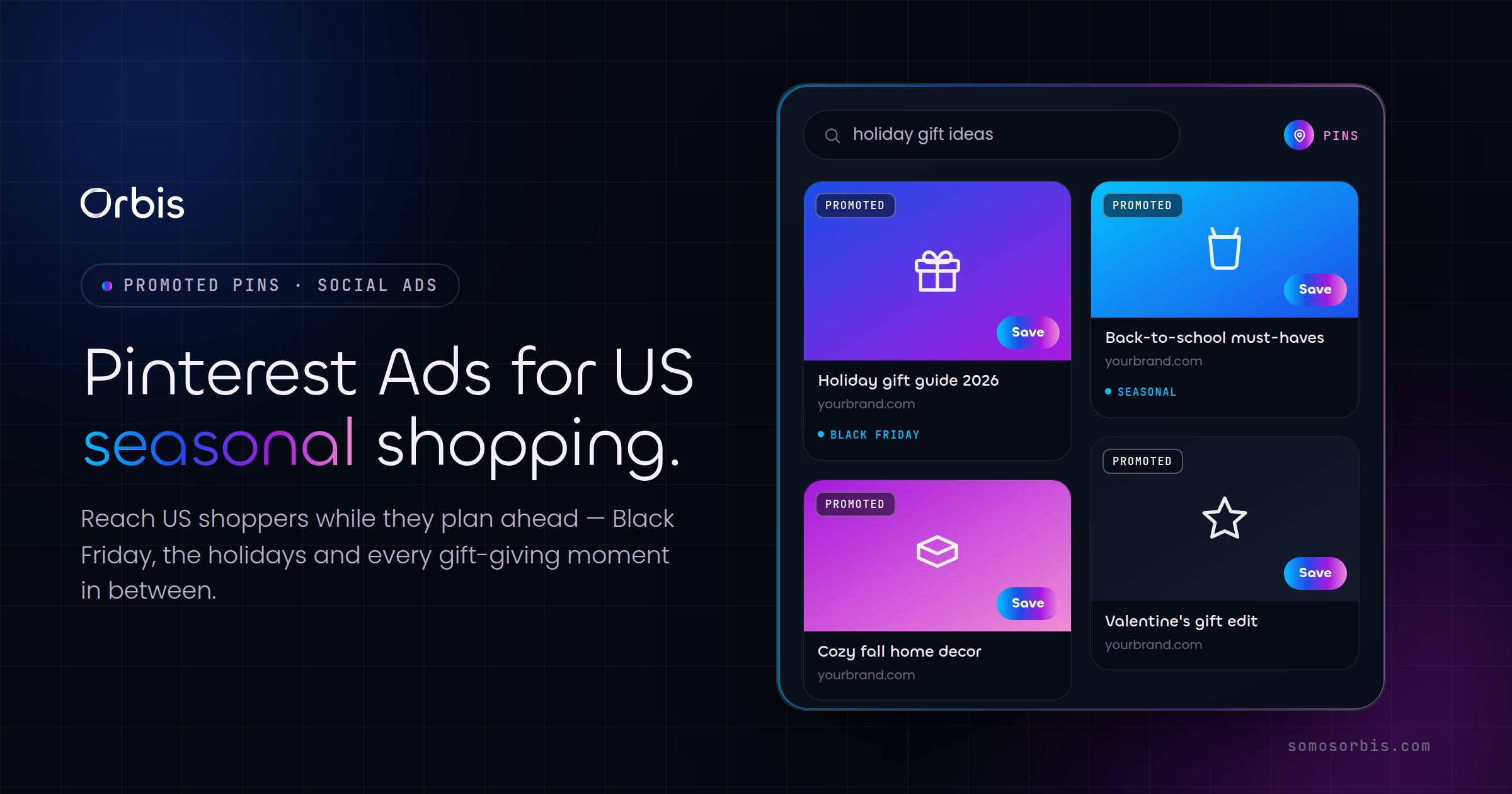
Pinterest is where Americans plan their purchases before they make them. While most paid social platforms chase the bottom of the funnel, Pinterest captures shoppers weeks and months ahead of the moment they swipe their card. For US brands that live and die by seasonal demand, that lead time is a strategic gift. A parent in Houston starts pinning back-to-school outfits in July. A bride in Miami builds her wedding board the winter before the ceremony. A homeowner in Chicago saves Thanksgiving tablescapes in October. By the time these planners are ready to buy, the brands that showed up early own the consideration set.
This guide breaks down how to run Pinterest Ads that capture high-intent US planners around the seasonal moments that matter most, with USD budget benchmarks, creative formats that perform, and a measurement approach that respects the long planning cycle. If you are building a full-funnel paid social program, this fits inside a broader strategy you can read in our social ads guide for US brands in 2026. Pinterest is one piece. Used well, it is the piece that fills your funnel before competitors even know the season has started.
Why Pinterest Wins on Intent, Not Interruption
The core difference between Pinterest and feed-based platforms is mindset. On most networks, your ad interrupts entertainment. People are watching, scrolling, and being distracted, and your job is to stop the thumb. On Pinterest, people arrive with a task. They are actively searching for ideas, products, and plans. That intent changes everything about how you should think about creative, targeting, and timing.
Pinterest behaves more like a visual search engine than a social feed. Users type queries, save results to boards, and return to those boards when they are ready to act. This means a Pinterest ad has a long shelf life. A pin saved in August can drive a purchase in November. That delayed conversion is invisible if you only measure last-click, which is why so many brands undervalue the channel. The planners are converting. They are just converting on their schedule, not yours.
For US advertisers, the audience skews toward high-purchase-intent categories that map directly to seasonal spending:
- Home and decor — peaks around fall, the winter holidays, and spring refresh.
- Fashion and apparel — back-to-school in late summer, holiday gifting, and spring wardrobe planning.
- Weddings and events — a year-round planning category with a strong winter-into-spring engagement surge.
- Food and entertaining — Thanksgiving, Christmas, Super Bowl, and summer cookouts.
- Beauty and self-care — gifting seasons and the New Year resolution window in January.
If your products sit in any of these lanes, Pinterest is not optional. It is the planning layer of your seasonal funnel, and it works alongside the interruption-driven reach of platforms like TikTok. We cover how the two complement each other in our breakdown of TikTok ads for US Gen Z shoppers — Pinterest captures the planner, TikTok captures the impulse, and together they cover the full decision arc.
Mapping Campaigns to US Seasonal Moments
The single biggest mistake brands make on Pinterest is launching campaigns when the season arrives. By then, the planners have already built their boards and made their shortlists. You are buying into a crowded auction to reach people whose minds are nearly made up. The fix is simple: launch early and let the platform's long save behavior work in your favor.
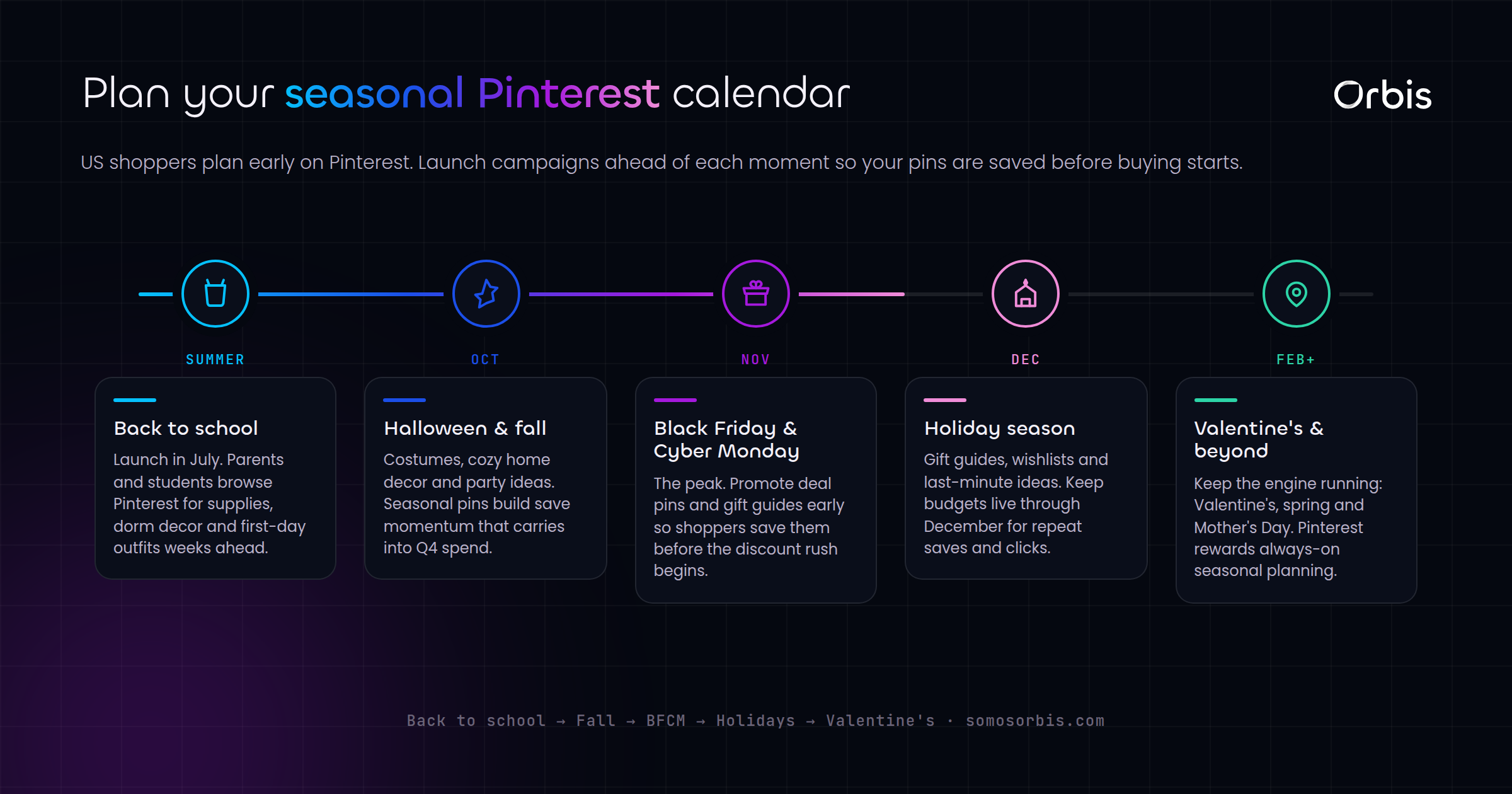
Here is a practical calendar for the US market. Treat the lead times as minimums, not targets.
Back-to-School (Launch by Early July)
Back-to-school is the second-largest US retail moment after the winter holidays, and Pinterest planning starts in early summer. Parents in Dallas and Los Angeles begin saving dorm setups, classroom outfits, lunch ideas, and supply organization weeks before stores fill their shelves. Launch back-to-school campaigns by early July with creative that solves a planning problem: a complete dorm checklist, a week of lunchbox ideas, a capsule wardrobe for the school year. The brands that win this moment are the ones answering the question the planner is already asking.
Holiday Season (Launch by Late September)
The winter holidays are Pinterest's marquee event, and the planning window is enormous. Gift guides, holiday recipes, decor inspiration, and party outfits start trending in September and October. By the time Black Friday and Cyber Monday arrive, the boards are built and the shortlists are set. Launch holiday campaigns by late September so your pins are saved during the research phase. Then, as Black Friday and Cyber Monday approach, layer in conversion-focused campaigns and promotional creative to harvest the demand you spent two months building. This early-then-harvest rhythm is what separates Pinterest pros from feed-only advertisers.
Weddings (Always On, Surge in Winter)
Wedding planning never stops, but engagement spikes around the holidays and into the new year, when proposals cluster and couples start serious planning. A bride in New York pins her venue, dress, florals, and tablescape ideas months ahead of the date. Wedding-adjacent brands — apparel, jewelry, stationery, home registry, beauty, travel — should run always-on Pinterest campaigns with a budget increase from December through March to ride the engagement surge.
Other US Moments Worth Owning
- New Year and self-improvement (January) — fitness, organization, beauty, and goal-setting categories see a planning surge.
- Spring refresh (February–March) — home, garden, and wardrobe planning ahead of warmer weather.
- Summer (April–May lead time) — travel, outdoor entertaining, and seasonal fashion.
- Tax season (January–April) — a real spending consideration window for big-ticket home and lifestyle purchases as refunds land.
Pinterest Ad Formats That Convert
Creative format matters more on Pinterest than on almost any other platform, because the content has to earn a save, not just an impression. A saved pin keeps working for you for months. Here are the formats that carry the most weight for US seasonal campaigns.
Idea Pins and Video
Idea pins — Pinterest's multi-page, video-forward format — are built for planning content. They let you tell a complete story: a full holiday tablescape from empty table to finished spread, a back-to-school morning routine, a step-by-step gift wrap. Because they hold attention and teach something, they earn high save rates, and saves are the currency of Pinterest reach. Lead your seasonal campaigns with idea pins and video, and keep them vertical (2:3 or 9:16), bright, and text-legible on mobile.
Standard and Collections Pins
Standard pins remain the workhorse for product discovery, especially when your creative looks native to the platform — lifestyle imagery over hard product shots. Collections pins pair a hero image with several product tiles underneath, which is ideal for gift guides and seasonal edits. A Miami home brand can run a "Holiday Hosting Essentials" collection that lets shoppers tap straight from inspiration to product.
Shopping Ads and Catalog Feeds
If you run ecommerce, connect your product catalog and turn on shopping ads. This pulls your full catalog into Pinterest, keeps pricing in USD current, and lets the platform match products to high-intent searches automatically. Catalog-powered campaigns scale far better than manually built pins, and they make seasonal merchandising — swapping in holiday or back-to-school collections — far less manual. Clean feed data is the foundation here; if your titles, prices, and availability are messy, your shopping performance will be too.
Budgeting in USD and Setting Realistic Benchmarks
Pinterest is often more affordable than the major feed platforms, particularly in the upper funnel, because you are reaching planners before the auction heats up. That said, budgets should scale with the seasonal calendar, not stay flat year-round.
A practical USD starting framework for a US small-to-mid-size brand:
- Testing phase — $1,500 to $3,000 per month to validate audiences, creative, and the planning-to-purchase signal. Resist the urge to judge results in week one; give pins time to be saved and revisited.
- Seasonal ramp — increase budgets 2x to 4x in the 60 to 90 days before a major moment (holidays, back-to-school) so your pins are present during the heavy save window.
- Harvest phase — shift a portion of budget into conversion-objective campaigns as the buying window opens, retargeting the planners who engaged during research.
On benchmarks: because of the long planning cycle, last-click ROAS will understate Pinterest's true contribution. Look at view-through and assisted conversions, and compare new-customer rates across your channels. Many brands find Pinterest drives a higher share of net-new customers than their feed platforms, because it reaches people earlier in the journey before they have settled on a brand. We will not invent a universal ROAS number for you — your category, margin, and season determine that. What we will say is this: measure the channel on the timeline the channel actually operates on, or you will turn off a profitable program because of an impatient dashboard.
Targeting High-Intent US Planners
Pinterest's targeting strengths lean into intent. Keyword targeting lets you reach people searching specific seasonal terms — "back to school dorm ideas," "Thanksgiving table setting," "fall wedding colors." Interest targeting reaches broad planning categories. The highest-value layer is often actalike and engagement audiences: people who have already interacted with your pins or visited your site, re-engaged as the buying window opens.
A few targeting principles for the US market:
- Start broad in the planning phase. Let keyword and interest targeting cast a wide net while planners are exploring. Narrowing too early starves the funnel.
- Layer retargeting in the harvest phase. The planners who saved your pins in October are your warmest audience in November. Build the audience early so it is large enough to be useful later.
- Use geographic and seasonal nuance. Spring and outdoor seasonality hits earlier in Los Angeles and Miami than in Chicago or New York. Stagger creative and budget by region where it matters.
Reaching the US Hispanic Market
The US Hispanic market is one of the fastest-growing and most underserved audiences in seasonal retail, and Pinterest is a strong channel for reaching it. Family-centered seasonal moments — holiday gatherings, quinceañeras, back-to-school, and weddings — carry deep cultural weight and high planning intent. Brands that show up with bilingual EN/ES creative, culturally relevant imagery, and recipes or traditions that reflect their audience earn outsized engagement. Do not simply translate an English pin; build creative that speaks to the moment authentically. A bilingual holiday hosting board or a quinceañera planning collection can open a high-intent audience that most competitors ignore entirely.
Privacy, Measurement, and Building Durable Audiences
US privacy expectations are rising, and your Pinterest setup should be built to last beyond third-party signals. Use Pinterest's conversion API alongside the tag so your measurement does not depend solely on browser cookies, and make sure your data collection is transparent and consent-respecting in line with current privacy norms. The brands that invest in clean, consented first-party data and server-side measurement now will have a measurement advantage as signals continue to degrade.
This is where a documented, well-engineered setup pays off. At Orbis, we approach paid social the way we approach every engagement — with documented processes, revenue engineering, and compliance built in by design. That means your tracking is reliable, your audiences are durable, your reporting ties spend to revenue across the long planning cycle, and your data practices respect the people you are marketing to. As a Google Partner with a 4.9-star rating across 58 reviews, more than 500 clients served, and over 15 years in the market, we have helped brands turn seasonal demand into measurable revenue rather than guesswork.
Your Pinterest Seasonal Playbook, Summarized
To put it all together, here is the operating rhythm for a US brand running Pinterest Ads around seasonal moments:
- Plan the calendar backward. Identify your two or three biggest seasonal moments and count back 60 to 90 days for launch.
- Lead with idea pins and video. Earn saves with planning content that solves a real problem.
- Connect your catalog. Let shopping ads scale product discovery with clean USD feed data.
- Budget to the season. Ramp ahead of the moment, then harvest demand as the buying window opens.
- Build audiences early. The planners you reach in research become your warmest retargeting pool at conversion time.
- Go bilingual where it counts. Reach the US Hispanic market with authentic EN/ES creative, not translations.
- Measure on the right timeline. Respect the long planning cycle and use server-side measurement to protect your signal.
Pinterest rewards the brands that show up early and plan deliberately. The season is always coming. The only question is whether your pins are already saved when your customers are ready to buy.
Ready to capture high-intent planners before your competitors do? Our team builds and manages Pinterest Ads campaigns for US brands with documented processes, USD budget discipline, and measurement that ties seasonal spend to real revenue. Let's plan your next seasonal moment together.