Gen Z in the United States doesn't "watch ads." They scroll, they screenshot, they stitch, and they buy, often inside the same app, sometimes within ninety seconds of discovering a product they had never heard of. For brands selling to shoppers born after 1997, TikTok is no longer an experimental line item. It is the storefront, the search engine, and the word-of-mouth engine, all at once. The question is no longer whether to advertise there. It is how to do it without burning USD on creative that screams "made by a marketing department."
This guide walks through how to build TikTok campaigns that actually move US Gen Z, from Spark Ads and TikTok Shop to creator collaborations and the trend literacy that separates brands that get added to carts from brands that get scrolled past. Everything here is built for the realities of the US market: USD budgets, the seasonal rhythm from back-to-school through Black Friday, and the diverse, often bilingual audiences that make up the most influential generation of American consumers.
Why US Gen Z Behaves Differently On TikTok
Before touching a single campaign setting, you need to understand who you're talking to. US Gen Z is the most racially and ethnically diverse generation in American history, and a large share grew up bilingual or in households where Spanish and English flow interchangeably. A snowboard brand in Denver, a beauty line in Los Angeles, and a streetwear label in Miami are not selling to the same person, and TikTok rewards brands that recognize that.
Three behavioral traits shape everything that follows:
- They distrust polish. A studio-lit, color-graded commercial reads as "skip." A clip shot on a phone in a New York apartment with a real person talking to camera reads as "trust."
- They treat TikTok as a search engine. Before buying a moisturizer, a desk lamp, or a protein powder, Gen Z searches TikTok for reviews and "is it worth it" videos. Your paid presence has to coexist with that organic reality.
- They expect to buy without leaving. The friction of "link in bio" is fatal. TikTok Shop collapses discovery and checkout into one motion, and Gen Z has been trained to expect it.
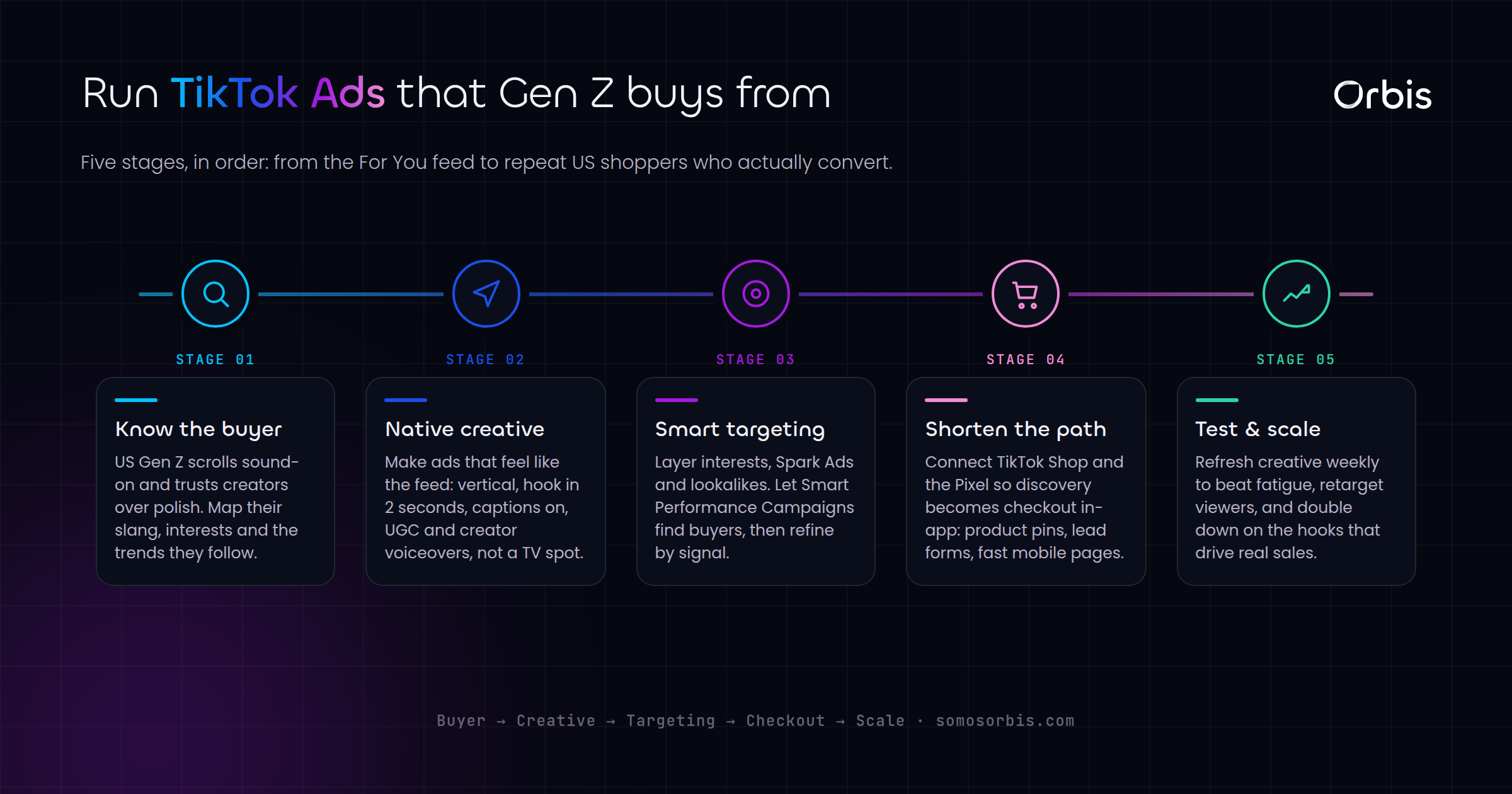
If you internalize only one thing, make it this: on TikTok, the creative is the targeting. The platform's algorithm is so good at finding the right people that your biggest lever isn't the audience panel, it's whether the first two seconds of the video earn attention. That single shift is why a strong TikTok Ads strategy looks nothing like a Google Search campaign.
Spark Ads: The Backbone Of US Gen Z Campaigns
Spark Ads let you turn an existing organic TikTok post, yours or a creator's, into a paid ad. This is the single most important format for reaching Gen Z, and here's why it outperforms traditional in-feed ads almost every time.
Native by default
A Spark Ad keeps the original creator's handle, the comment section, the likes, and the "follow" button. To a 19-year-old in Chicago, it looks identical to organic content their friends might share. There is no jarring "this is an ad" moment. The result is higher watch time, more saves, and comments that act as live social proof, the kind no scripted testimonial can replicate.
Built-in credibility
When a video already has 40,000 organic views and a comment thread full of "where do I buy this," boosting it with paid spend amplifies momentum that's already proven. You are paying to accelerate a winner, not gambling on an untested concept. For US brands managing a finite USD budget, that risk reduction is the whole game.
How to run Spark Ads well
- Source from real creators. Partner with US-based micro-creators (10K to 100K followers) whose audience overlaps yours. A Dallas fitness coach, a Houston home-cook, a bilingual beauty creator reaching Hispanic audiences across the Southwest, each brings a community that trusts them.
- Get authorization codes. The creator generates a code that lets you run their post as a Spark Ad. Build this into your collaboration agreement up front so you're never scrambling.
- Test multiple hooks, not multiple products. Run three to five versions of the same offer with different opening lines. Let spend flow to whichever hook holds attention past three seconds.
- Refresh weekly. Gen Z creative fatigues fast. A hook that crushed during back-to-school can flatline by mid-September. Plan for constant rotation.
TikTok Shop: Closing The Loop Inside The App
TikTok Shop is where US Gen Z's "see it, want it, buy it" instinct gets a checkout button. Products appear with a shopping cart icon directly in the video and in a dedicated Shop tab, and the entire purchase happens without ever leaving TikTok. For impulse-friendly categories, beauty, accessories, snacks, gadgets, apparel under roughly fifty USD, this is transformative.
What works in the US Shop environment
- Live shopping events. Host a creator-led live stream around a moment, a back-to-school dorm haul in August, a gifting edit before Black Friday and Cyber Monday, a "tax refund treat yourself" push in spring. Limited-time bundles and live-only discounts drive urgency.
- Affiliate creator programs. Let creators tag your products and earn commission. This turns TikTok Shop into a performance channel where you pay for results, ideal for stretching a USD budget across many small bets.
- Price for the impulse window. Gen Z buys fast at lower price points. If your hero product sits above fifty USD, lead with an entry-level item to open the relationship, then upsell.
Seasonality you can plan around
The US retail calendar gives TikTok Shop natural spikes. Map your inventory and creative to them: back-to-school in late summer, Amazon Prime Day as a competitive-shopping moment in midyear, the Black Friday and Cyber Monday surge in late November, and the post-holiday and tax-season window in the first quarter when refund dollars hit checking accounts. Each is a distinct buying mindset, and the creative angle should shift accordingly, "set up your dorm" hits different from "treat yourself with your refund."
Creator Collaborations: Borrowing Trust You Can't Buy Directly
Paid media buys reach. Creators buy trust. The brands winning with US Gen Z treat creator partnerships as a core channel, not a one-off stunt.
Micro and nano creators beat mega-influencers
A creator with 25,000 engaged followers in a specific niche, say, plus-size fashion in Atlanta or budget meal-prep for college students, often drives more sales per USD than a celebrity with two million. Their audience is tight, their recommendations feel personal, and their rates leave room to work with several creators instead of betting everything on one. Diversify across creators the way you'd diversify a portfolio.
Reach the US Hispanic audience deliberately
The US Hispanic market is young, mobile-first, and massively influential on TikTok culture, from sound trends to product virality. Work with bilingual creators who move naturally between English and Spanish, and let them script in their own voice rather than forcing a translated version of your English ad. A code-switching caption or a Spanish-language hook can dramatically outperform a literal translation, because it reads as real, not localized. This isn't a niche tactic; it's table stakes for serious reach in cities like Los Angeles, Houston, Miami, and Dallas.
Brief loosely, judge tightly
- Give creators the offer, the must-include claims, and the deadline, then get out of the way on execution.
- Provide a short list of "never say" items to stay inside quality processes and the relevant US advertising and privacy norms, without over-engineering it.
- Review for brand safety and accuracy, not for whether it "looks like our brand." It shouldn't.
The Trend Literacy Most US Brands Get Wrong
Trends are TikTok's currency, and Gen Z can smell a brand that's a week late or trying too hard. Two failure modes dominate: jumping on a trend after it's already dead, and forcing a trend that has nothing to do with your product.
Do this instead:
- Assign a trend watcher. Someone on your team should spend real time in the For You feed daily. Trends move in days, not weeks.
- Use trending sounds early. Audio drives the algorithm. Catching a rising sound in its first few days can hand you outsized organic reach that you then amplify with Spark Ads.
- Adapt, don't copy. Translate the format of a trend into something that genuinely showcases your product. The trend is the wrapper; your value is the gift inside.
- Respect cultural moments. US Gen Z cares about authenticity and context. Hijacking a serious cultural moment for a sales push backfires loudly. When in doubt, sit it out.
Privacy, Measurement, And Spending Responsibly
US Gen Z is privacy-aware, and the measurement landscape has shifted under everyone's feet. Build your TikTok program to be resilient:
- Honor consent and current privacy norms. Respect opt-outs, be transparent about data, and keep your tracking aligned with prevailing US privacy expectations. Treat user trust as a long-term asset, not a compliance checkbox.
- Lean on platform-native signals. Use TikTok's server-side events and conversion APIs so you're not wholly dependent on browser cookies that increasingly don't fire.
- Measure incrementality, not just last-click. Much of TikTok's value shows up as branded search lifts, direct traffic, and Shop conversions that last-click attribution under-credits. Watch the whole picture.
- Set a learning budget. Allocate a defined USD slice purely to testing hooks and creators. Treat it as research, not as performance you grade on day one.
A 30-Day Starting Plan
If you're launching from zero, here's a realistic first month:
- Week 1: Set up TikTok Shop, install conversion tracking, and recruit three to five US micro-creators including at least one bilingual creator. Lock authorization codes for Spark Ads.
- Week 2: Launch five Spark Ads from creator content, each testing a different hook against the same offer. Keep budgets small and even.
- Week 3: Cut the losers, double down on the winning hooks, and run your first creator-led live shopping event tied to whatever US seasonal moment is closest.
- Week 4: Scale winners, refresh tired creative, and build a repeatable weekly cadence of new hooks plus trend-driven content.
The brands that win on TikTok aren't the ones with the biggest budgets. They're the ones with the tightest feedback loop, real creative, fast iteration, honest measurement, and the discipline to keep showing up natively in a feed that punishes anything that smells like an ad.
Where TikTok Fits In Your Wider Social Strategy
TikTok is one channel inside a larger paid-social system, and it performs best when it's coordinated with the rest of your mix rather than run in isolation. For the full strategic picture, start with our pillar resource, the complete social ads guide for US brands in 2026, which frames how budget, creative, and measurement work together across platforms.
And because the same creative principles, native feel, strong hooks, real people, carry over to Meta's platforms with their own nuances, pair this with our breakdown of Instagram ads creative that converts US audiences. Reading the two side by side will sharpen how you decide which idea belongs on which feed.
Ready To Reach US Gen Z On TikTok?
You don't need a viral fluke to grow on TikTok. You need documented processes, a real creator pipeline, and a testing rhythm that turns USD into predictable, measurable revenue. That's exactly how we build it. If you want a TikTok program engineered for the US market, diverse, bilingual where it counts, and tuned to the American retail calendar, explore our TikTok Ads service and let's put a plan to work. Orbis is a Google Partner with a 4.9-star rating across 58 reviews, more than 500 clients served, and over 15 years turning attention into revenue. Bring us your offer; we'll bring the engine.