
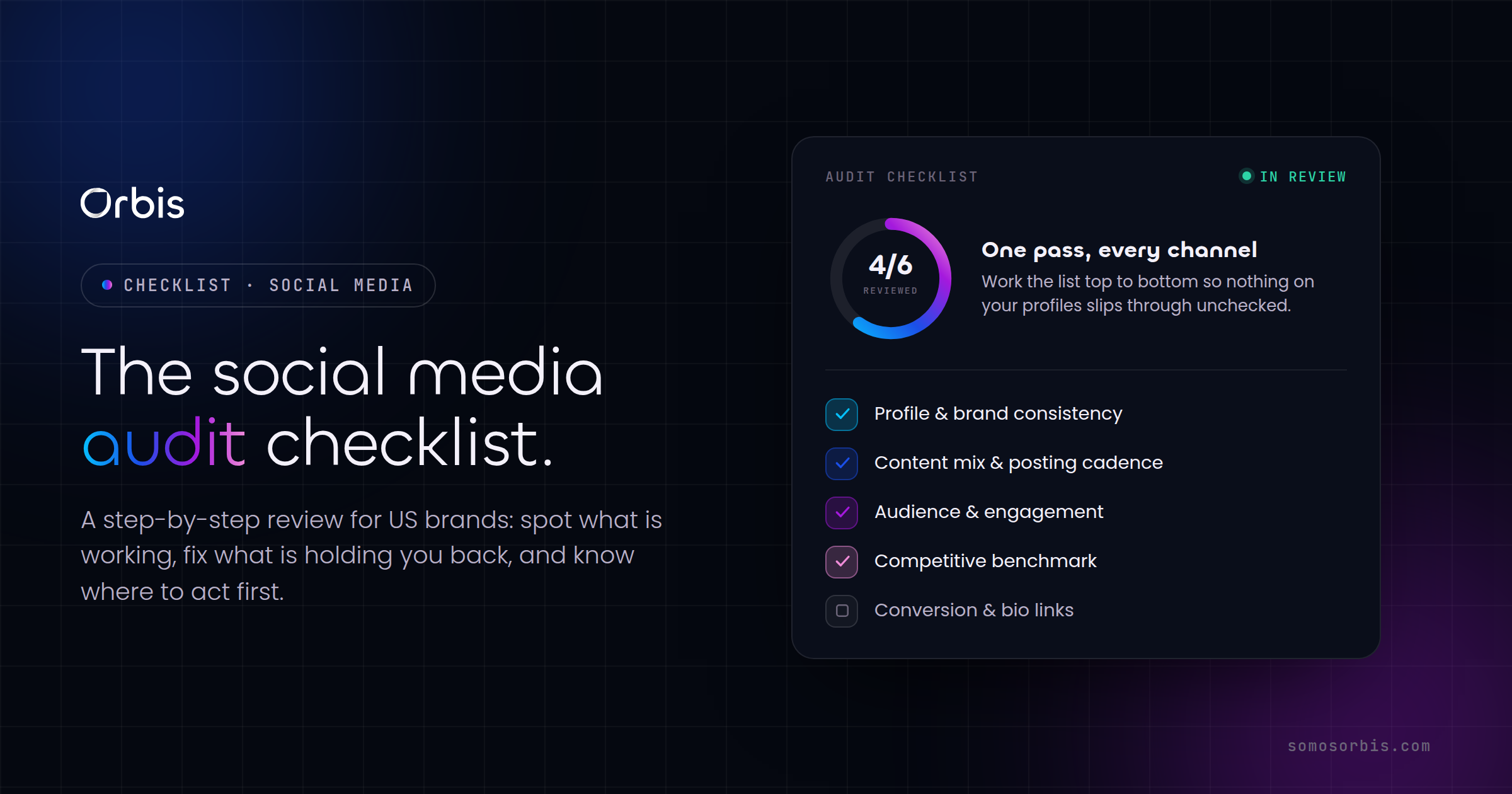
If your social media accounts have been running for more than a few months without a structured review, you are almost certainly leaking reach, budget, and trust. A social media audit is the diagnostic that tells you what is actually working, what is quietly underperforming, and where a US brand can win attention against louder competitors. This is not a vanity exercise. Done right, an audit becomes the foundation for every decision you make next quarter, from creative direction to paid spend allocation ahead of high-stakes US retail moments like Black Friday, Cyber Monday, and Amazon Prime Day.
This checklist walks you through a complete audit for US brand accounts: profile completeness, content performance, audience signals, and competitor benchmarking. It is built for marketing teams running real accounts in competitive markets like New York, Los Angeles, Chicago, Miami, Dallas, and Houston, where a half-finished profile or an off-key caption gets ignored in seconds. Work through it in order, document everything in a single spreadsheet, and you will finish with a prioritized action list instead of a vague sense that "something is off."
Why a Social Media Audit Matters for US Brands
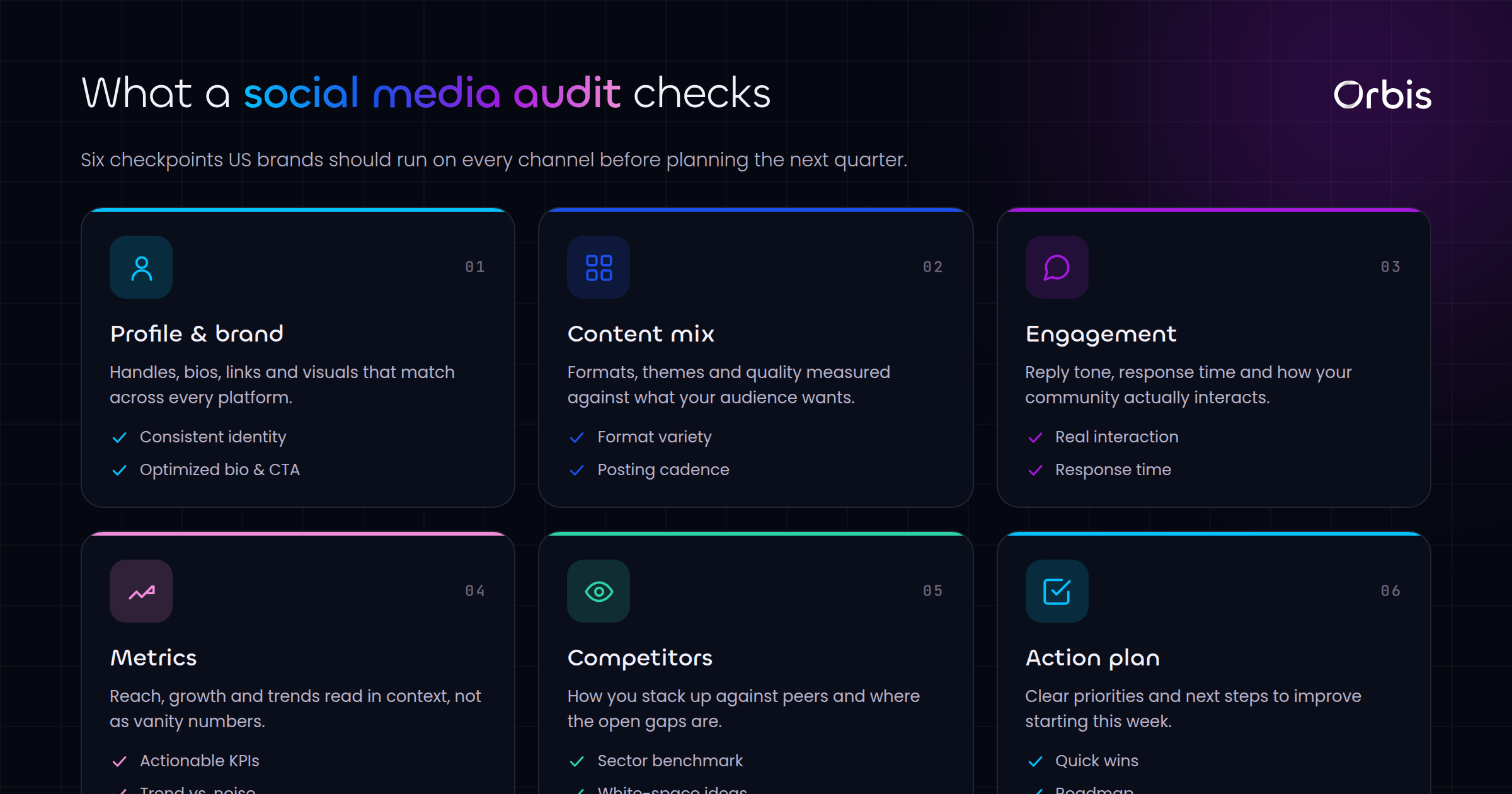
Most accounts drift. A campaign launches, the calendar fills up, the intern changes, the bio link breaks, and six months later nobody can say with confidence which platform drives revenue. An audit stops the drift. It forces you to separate what you assume is working from what the data proves is working.
For US brands specifically, an audit also surfaces three things that move the needle:
- Seasonality readiness. US calendars are unusually spiky. Back-to-school in August, tax season in the first quarter, Prime Day in summer, and the Black Friday and Cyber Monday window all concentrate demand. An audit tells you whether your accounts are set up to capture those spikes or whether you are posting at the wrong times to the wrong audience.
- Bilingual reach. The US Hispanic market is large, growing, and underserved by brands that treat Spanish as an afterthought. An audit reveals whether your content speaks to that audience in a natural EN/ES voice or whether you are leaving reach on the table.
- Privacy-aware data hygiene. US privacy norms have tightened. An audit is the right moment to confirm your pixels, tracking, and data collection respect current consent expectations and reflect the normativa vigente, so you are not building a strategy on data you cannot legally or ethically rely on.
If you want the strategic frame that sits above this audit, our complete social media strategy guide for US brands in 2026 explains how audit findings feed into a full-funnel plan. Treat this checklist as the diagnostic and that guide as the treatment.
Step 1: Inventory Every Account You Own
You cannot audit what you cannot see. Start by listing every profile your brand controls, including the ones you forgot about. Zombie accounts and abandoned regional pages confuse customers and dilute your search presence.
- List every platform: Instagram, Facebook, TikTok, LinkedIn, YouTube, Pinterest, X, and any Spotify or podcast presence.
- Record the handle, URL, follower count, and the person or agency responsible for each.
- Flag duplicate or outdated accounts for consolidation or deletion. A single abandoned Facebook page from a 2021 promotion can outrank your live page in search.
- Confirm you have admin access to every account. Losing access because a former employee held the password is a preventable crisis.
By the end of this step you should have a master list. Everything else in the audit attaches to this inventory.
Step 2: Audit Profile Completeness
Profile completeness is the cheapest win in social media. It costs nothing but attention, and an incomplete profile signals neglect to both customers and platform algorithms. Go through each live account and check every field.
Visual identity
- Profile photo. Is it the current logo, correctly sized and uncropped on every platform? Logos that look sharp on desktop often get clipped on mobile.
- Cover and banner images. Are they current? A banner promoting a tax-season offer in June tells visitors nobody is home.
- Visual consistency. A customer who finds you on TikTok and then checks Instagram should recognize the same brand instantly.
Bio and contact
- Bio copy. Does it state clearly what you do and for whom, in a voice that fits the US market? If you serve a bilingual audience, does the bio reflect that?
- Link in bio. Does it work, and does it point to the most relevant destination right now? Broken or stale links are reach you paid for and then wasted.
- Contact details. Phone, email, address, and hours should match your website and Google Business Profile exactly. Inconsistencies hurt local search in markets like Houston or Miami.
- Category and CTA buttons. Confirm the business category is set and any "Shop," "Book," or "Contact" buttons route correctly.
Score each profile out of 100 percent complete. Anything below full completeness goes straight onto your action list, because these fixes take minutes and compound across every future post.
Step 3: Analyze Content Performance
This is the heart of the audit. Pull at least the last 90 days of data per platform, and ideally a full year so seasonal patterns appear. Export the native analytics rather than relying on memory.
What to measure
- Reach and impressions. How many people saw your content, and is that number trending up or down?
- Engagement rate by reach. Engagement divided by reach is more honest than raw likes, because it accounts for follower count and algorithmic distribution.
- Saves and shares. On Instagram and TikTok, saves and shares often predict reach better than likes. High-save content is content people find genuinely useful.
- Click-through and conversions. Tie social activity to actual outcomes wherever you can, whether that is site visits, leads, or sales in USD.
- Video retention. For Reels, TikTok, and YouTube, the percentage of viewers who stay past three seconds and to the end tells you whether your hooks work.
Find your top and bottom performers
Rank every post by engagement rate and reach. Then study the extremes:
- Your top 10 posts. What format, topic, hook, length, and posting time do they share? This is your repeatable formula.
- Your bottom 10 posts. What pattern explains the misses? Often it is overly promotional copy, weak first frames, or posting into a dead time slot.
- Format breakdown. Compare carousels versus single images versus video versus text. Reallocate effort toward formats that earn reach.
One practical note for US brands: segment performance by seasonality. A post that flopped in February might be exactly the format that wins during the Black Friday and Cyber Monday rush. Tag posts by season so you can plan ahead rather than reacting.
Step 4: Review Audience and Timing
You are not auditing content in a vacuum; you are auditing it against the people it reached. Open the audience analytics for each platform.
- Demographics. Do age, gender, and location match the customer you think you are serving? A Dallas retailer whose audience is concentrated in another time zone has a targeting problem to fix.
- Top locations. Are your priority US metros, such as New York, Los Angeles, Chicago, Miami, Dallas, and Houston, actually represented? If a key market is missing, that is a content and paid-targeting gap.
- Language signals. If a meaningful share of your audience is Hispanic, test bilingual EN/ES captions and measure whether they lift engagement. Authentic Spanish content, not machine-translated filler, is what earns trust with this audience.
- Active times. Cross-reference when your audience is online with when you actually post. Misaligned timing is one of the most common and most fixable reach killers.
Step 5: Benchmark Against Competitors
Your numbers only mean something in context. A three percent engagement rate could be excellent or mediocre depending on your category. Competitor benchmarking gives you that context.
Choose the right competitors
- Pick three to five direct competitors plus one or two aspirational brands you admire.
- For each, record follower count, posting frequency, dominant formats, and an estimated engagement rate from their public posts.
What to look for
- Content gaps. What topics or formats are competitors winning with that you ignore? Those are openings.
- Cadence. Are they posting daily while you post twice a week, or the reverse? Match effort to results, not to a vanity calendar.
- Audience response. Read their comments. The questions and complaints customers leave on competitor posts are a free voice-of-customer research panel.
- Seasonal plays. How are competitors handling Prime Day, back-to-school, or the holiday rush? Borrow what works and avoid their mistakes.
An audit without benchmarking tells you where you are. An audit with benchmarking tells you where you stand. The second is the one that drives strategy.
Step 6: Check Data Hygiene and Compliance
Before you act on any of this, confirm the data underneath it is sound and collected responsibly. US privacy expectations have shifted, and an audit is the right moment to verify your house is in order.
- Tracking and pixels. Confirm conversion tracking fires correctly and that any pixels respect current consent requirements.
- Consent and data collection. Make sure lead forms, contests, and data capture reflect the normativa vigente and current US privacy norms, so your strategy rests on data you can rely on.
- Source of truth. Decide which analytics platform is authoritative so different tools reporting different numbers do not derail decisions.
This is where quality processes pay off. Treating measurement as a documented, repeatable system, rather than an afterthought, is what separates accounts that improve quarter over quarter from accounts that guess.
Step 7: Turn Findings Into a Prioritized Action Plan
A spreadsheet full of observations is not an audit. The audit is finished only when it becomes a ranked list of actions. Sort every finding by impact and effort.
- Quick wins. High impact, low effort. Completing profiles, fixing broken links, and shifting posting times belong here. Do them this week.
- Strategic bets. High impact, higher effort. Launching a bilingual content track, rebuilding your video hook formula, or reallocating budget toward Q4 belong here. Plan them this quarter.
- Deprioritize. Low impact work, no matter how easy, should wait. Protect your team's attention for what moves USD outcomes.
Once your action plan exists, the natural next question is how you will measure whether the changes worked. That is a reporting discipline, not an audit one, and our guide to social media reporting and the KPIs that matter for US brands shows you exactly which metrics to track so your next audit starts from a stronger baseline.
How Often Should You Run a Social Media Audit?
Run a full audit quarterly, with a lighter monthly check on the fast-moving metrics. Quarterly cadence aligns neatly with the US retail calendar, letting you audit before back-to-school, before the Black Friday and Cyber Monday window, and at the start of a new year. A brand that audits on this rhythm walks into every major US shopping moment knowing exactly what is working instead of hoping.
If you run paid campaigns, audit immediately before any significant budget increase. Pouring spend behind underperforming creative or a broken funnel is the most expensive mistake in social media, and it is entirely avoidable with a thirty-minute pre-flight check.
Put the Checklist to Work
A social media audit is the single highest-leverage thing most US brands can do with one focused afternoon. It costs nothing but discipline, and it replaces guesswork with a clear, ranked plan. Work through these seven steps, document everything in one place, and you will finish with a sharper understanding of your accounts than most of your competitors will ever have of theirs.
If you would rather hand the diagnostic to a team that runs audits for US brands every week, that is exactly what we do. Our social media audit service delivers a complete profile, content, audience, and competitor review with a prioritized action plan built around your market, your seasonality, and your goals, so you can spend your time executing the wins instead of finding them. With Google Partner status, a 4.9-star rating across 58 reviews, more than 500 clients, and over 15 years of experience, Orbis turns a one-time audit into an ongoing engine for revenue growth.