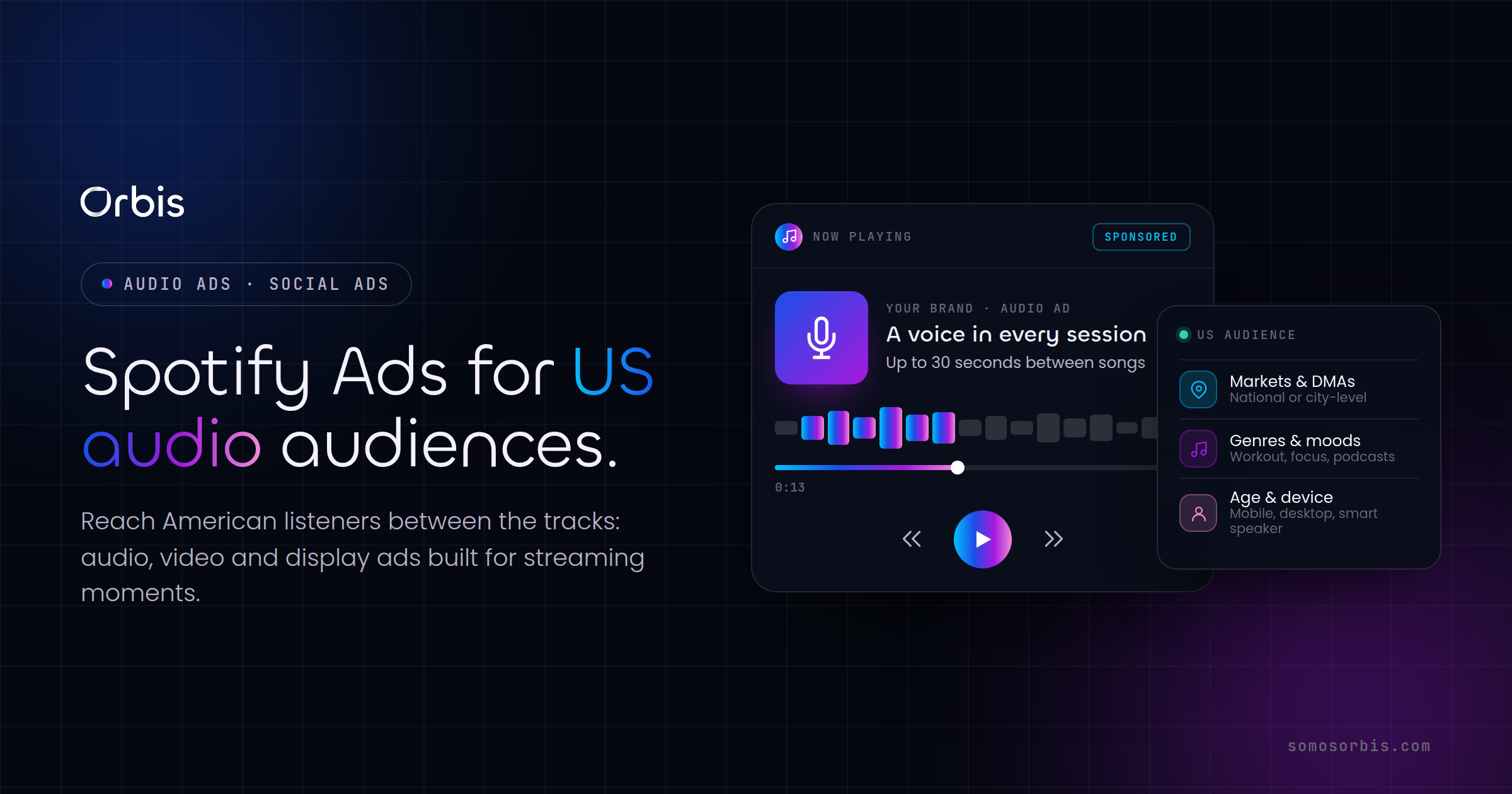
Audio is the channel most US brands still underrate. While budgets pile into crowded feeds, millions of Americans spend hours a day with earbuds in: commuting on the 405 in Los Angeles, riding the subway in New York, working out in Miami, cooking dinner in Chicago. Spotify reaches them in those moments with sound, and increasingly with video, in a context where there is no competing thumbnail to scroll past. For US audio audiences, that attention is the whole point.
This guide breaks down how to run Spotify Ads for US audio audiences the way a performance team actually does it: audience strategy across major metros, creative that works in audio-first environments, bilingual EN/ES execution for the large US Hispanic market, measurement that survives a privacy-conscious world, and a seasonal calendar built around how Americans actually buy. No fluff, no invented metrics, just the playbook.
Why Spotify deserves a line in your US media plan
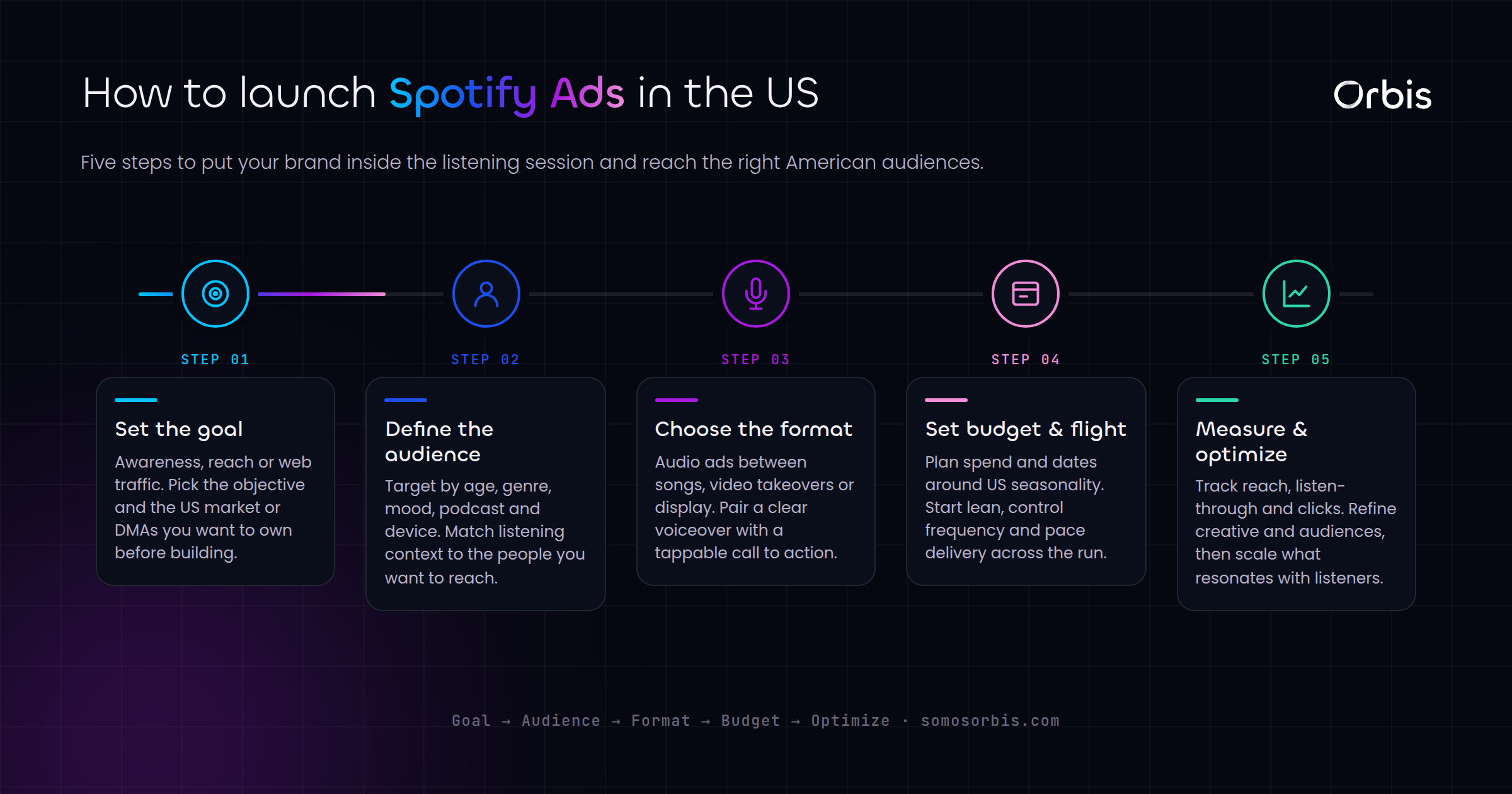
Most paid channels fight for the same attention: a feed full of competing posts, ads, and notifications. Audio is different. When someone is driving from Dallas to Houston or running along Lake Michigan, your ad is the only thing playing. There is no skip-to-the-next-video reflex because there is no next video. That captive context is rare and valuable.
Three structural advantages make Spotify worth a real test for US brands:
- Intent by mood and moment. People listen to specific playlists for working out, focusing, commuting, cooking, or winding down. That tells you something a demographic profile never could. A meal-kit brand reaching the "Dinner Cooking" moment is talking to someone literally thinking about food right now.
- Cross-device reach. Spotify lives on phones, laptops, smart speakers, cars, and TVs. You reach the same US listener across the day without depending on a single platform's feed algorithm.
- Audio plus video. Spotify is not only audio. Video Takeovers and video ads run when the app is in the foreground, so you can pair a sound-only message during background listening with a visual hit when the listener is looking at the screen.
None of this replaces your core social channels. It complements them. Think of Spotify as the channel that catches your US audience in the gaps the feed never reaches, then reinforces the message you are already running across your social mix.
Mapping Spotify ad formats to US objectives
Before you touch targeting, decide what the campaign is for. Spotify's inventory maps cleanly to different objectives, and using the wrong format for your goal is the fastest way to waste USD.
Audio ads
The classic 15-to-30-second spot that plays between songs for free-tier listeners, paired with a clickable companion banner. This is your workhorse for reach and brand recall across US metros. Because it plays during active listening sessions, completion rates are high relative to skippable video elsewhere. Use audio ads when you want to be heard by a lot of people in the right mood, cost-efficiently.
Video Takeover and video ads
Video runs when the listener is actively looking at the app, for example browsing playlists. These are good for product reveals, app installs, or any message that needs a visual. For a New York fintech launching a new card or a Miami DTC brand showing a product in motion, video carries weight that audio alone cannot.
Sponsored playlists and podcast inventory
Podcast ads, including host-read and dynamically inserted spots, let you reach US listeners inside content they trust. A B2B brand targeting decision-makers in Chicago or a wellness brand reaching commuters in Dallas can find highly relevant podcast environments. Treat this as a consideration and trust play, not a last-click channel.
A practical rule of thumb for US campaigns: lead with audio ads for efficient reach, layer video for the moments that need a visual, and use podcast inventory when context and trust matter more than raw scale.
Building US audio audiences that actually convert
Spotify's targeting is built around real listening behavior, which is its biggest edge. You are not guessing at interests from a profile; you are reaching people defined by what they are doing right now.
Targeting levers worth using
- Real-time context. Reach listeners by activity, such as working out, studying, commuting, or relaxing. A protein brand in the "Workout" context is talking to people mid-session.
- Genre and playlist affinity. Latin, hip-hop, country, indie, and other genres correlate strongly with lifestyle and culture. For a brand targeting the US Hispanic market, Latin genres and reggaeton playlists are a direct line.
- Geography down to the metro. Run distinct campaigns for New York, Los Angeles, Chicago, Miami, Dallas, and Houston. A retailer with stores in Miami and Houston can weight spend and creative differently for each city.
- Age, device, and daypart. Morning commute, lunchtime, and evening wind-down are very different mindsets. Schedule accordingly.
A metro-first structure
For multi-market US brands, build campaigns metro by metro rather than dumping the whole country into one ad set. This gives you cleaner reads on which cities respond, lets you adjust creative for local language mix, and protects budget in expensive markets. A typical structure might look like this:
- One campaign per priority metro (New York, Los Angeles, Miami, etc.).
- Within each, separate ad sets for English-only and bilingual EN/ES creative where the Hispanic share justifies it.
- A national prospecting campaign running underneath for efficient incremental reach.
This is the kind of disciplined account structure that separates a tidy media plan from a money pit. If you want a hand building it, our team runs this as part of a broader social program; see how it connects in our social ads guide for US brands.
Creative that works in an audio-first world
Audio creative is its own craft. You cannot recycle a muted feed video and hope it lands. The listener cannot see anything during background listening, so the sound has to do all the work.
Principles for US audio ads
- Lead with sound design and voice. A distinctive voice, a memorable sonic logo, and a clean mix beat a clever script read flatly. Brand recall on Spotify is driven by how you sound.
- One idea per spot. Fifteen to thirty seconds is not much. Pick a single message and a single action. Cramming three offers into one ad kills all of them.
- Say the brand early and again. Without a logo on screen, the name has to be spoken clearly, ideally near the start and the end.
- Make the call to action verbal and specific. "Search Orbis on Google" or "tap the banner" works because it respects how people listen. Vague CTAs vanish.
- Match the mood. A workout playlist wants energy. A focus playlist wants calm. Reading the room, or the playlist, lifts performance.
Pair audio with the companion banner
Every audio ad gets a clickable companion banner. Treat it as a real asset, not an afterthought. It should carry the logo, a short value line, and a clear button so the listener who glances at the screen has somewhere to go. The banner is your only visual during audio playback, so it earns its place.
Bilingual EN/ES audio for the US Hispanic market
This is where Spotify gets genuinely interesting for US brands, and where many advertisers leave reach on the table. The US Hispanic market is large, young, mobile-first, and a heavy consumer of audio, especially Latin music and Spanish-language podcasts. Audio is a natural home for reaching it.
Bilingual execution is not about translating an English script word for word. Done well, it respects how bicultural US Hispanic audiences actually move between languages.
- Run Spanish-language audio against Latin and reggaeton playlists. When the music is in Spanish, a Spanish ad feels native, not interruptive. This is the cleanest bilingual win available.
- Use English-dominant or code-switching creative for younger bicultural listeners. Many second- and third-generation US Hispanics listen in English but respond to cultural cues. A Spanish phrase, a familiar reference, or a bilingual hook signals "this is for me" without forcing a full Spanish read.
- Localize the offer, not just the words. Reference the specific metro, the season, or a culturally relevant moment. A Miami or Houston campaign can lean into a market where the Hispanic share is high.
- Cast voices that sound right. Accent, energy, and warmth matter. A flat, obviously dubbed read undercuts everything. Invest in voice talent that fits the audience.
Reaching this audience well is a competitive advantage precisely because so many advertisers do it lazily. A brand that treats bilingual audio as a craft, not a checkbox, stands out in the listener's ear.
A US seasonal calendar for Spotify
Audio demand and listener mindset shift across the US calendar. Planning your Spotify flighting around real American seasonality keeps spend efficient and messages relevant.
- Back-to-school (July to September). Families, students, and young professionals are buying. Reach study and commute contexts with relevant offers. Strong window for retail, tech, and services.
- Black Friday and Cyber Monday (November). The most competitive retail moment of the year. Spotify can be a cheaper attention channel while feeds are saturated and CPMs spike. Use audio to drive search and direct traffic before and during the rush.
- Holiday and end of year (December). Gifting, travel, and reflective listening. Brand-building audio plays well here as listeners settle into seasonal playlists.
- Amazon Prime Day (mid-year). A second retail peak. DTC and marketplace brands can use audio to capture demand around the event without bidding directly into the most crowded auctions.
- Tax season (January to April). Refund money creates a real spending window. Fintech, services, and considered-purchase brands can time audio pushes to when wallets open.
Map your two or three biggest moments first, reserve budget for them, and keep an always-on base layer running between peaks so you never restart from zero.
Measurement and privacy in a US context
Audio is harder to attribute than a last-click feed ad, and that scares some marketers off. It should not. You measure it the way you measure any upper- and mid-funnel channel: with the right metrics and a willingness to look beyond last click.
What to actually track
- Reach and frequency by metro. Are you reaching enough unique listeners in New York or Dallas, and not bludgeoning the same people fifteen times?
- Completion rate. Audio's strength. High completion means your spot is being heard, not skipped.
- Branded search and direct lift. Watch for rises in branded queries and direct traffic during and after Spotify flights. This is often the clearest signal that audio is working.
- Promo codes and dedicated URLs. A spoken code or a memorable vanity URL gives audio its own measurable footprint.
- Incrementality tests. Hold out a metro or run a geo lift test to see what Spotify adds on top of your other channels.
Respecting US privacy norms
US consumers are increasingly privacy-aware, and state-level rules around data and consent shape how you collect and use audience data. Build campaigns that lean on Spotify's first-party contextual and behavioral signals rather than stitching together fragile third-party trails. Honor opt-outs, keep your data practices clean, and follow normativa vigente. Privacy-respectful measurement is not just compliant; it is more durable as the tracking landscape keeps tightening.
Audio rewards brands that build memory, not brands that chase the last click. Measure the lift, respect the listener, and the channel pays you back.
How Spotify fits your wider US paid mix
Spotify is strongest as part of a connected plan, not a silo. The same audience you reach in their earbuds is the audience you retarget in the feed and convert on the site. Sequencing matters: an audio impression that plants the brand, followed by a social ad that shows the product, followed by a search click, is a far stronger journey than any single touch.
For B2B brands, audio also pairs naturally with professional targeting elsewhere. A founder commuting through Chicago who hears your podcast spot is the same person you can reach with precision later; see how that side of the mix works in our guide to LinkedIn ads for US B2B lead gen. And for the full picture of how every paid social channel fits together for American brands, start with our social ads guide for US brands.
A simple starting plan
If you are launching Spotify for the first time in the US, keep it disciplined:
- Pick two priority metros, for example Los Angeles and Miami.
- Produce one strong English audio ad and one bilingual EN/ES audio ad, plus companion banners.
- Run audio for efficient reach; add one video creative for the moments listeners are watching.
- Tie one upcoming US season, such as back-to-school or Black Friday, to a clear offer and spoken CTA.
- Track completion, branded search lift, and a promo code or vanity URL.
- Read results by metro after a few weeks and scale the winners.
Do that, and you will have a clean, measurable read on whether audio belongs in your permanent US media plan. In our experience, for the right brand it earns its place fast.
Get your Spotify audio program running
Spotify is a real opportunity for US brands willing to treat audio as a craft: smart metro targeting, creative built for the ear, bilingual EN/ES execution for the US Hispanic market, seasonal timing around how Americans buy, and privacy-respectful measurement that proves it works. As a Google Partner with a 4.9-star rating across 58 reviews, more than 500 clients, and over 15 years building revenue systems, Orbis runs this the way it should be run: documented processes, revenue engineering, and compliance by design.
Ready to reach US audio audiences where the feed cannot? Explore our Spotify Ads service for US brands and let's build a program that turns earbuds into customers.