
YouTube reaches more US adults than any cable network, and people in New York, Los Angeles, Chicago, Miami, Dallas, and Houston now treat it as both a search engine and a TV replacement. For US brands, that means YouTube Ads are no longer an "awareness only" line item. Done right, a campaign can move someone from never having heard of you to buying on the same weekend, all measured in USD inside Google Ads. Done wrong, it quietly burns budget on views that never convert.
This guide walks through the YouTube ad formats that actually matter in the US market, how to structure full-funnel campaigns, how to reach the large US Hispanic audience with bilingual EN/ES creative, and how to measure results without fooling yourself. It is written for operators who want a plan they can run on Monday, not a glossary.
Why YouTube belongs in your US media mix
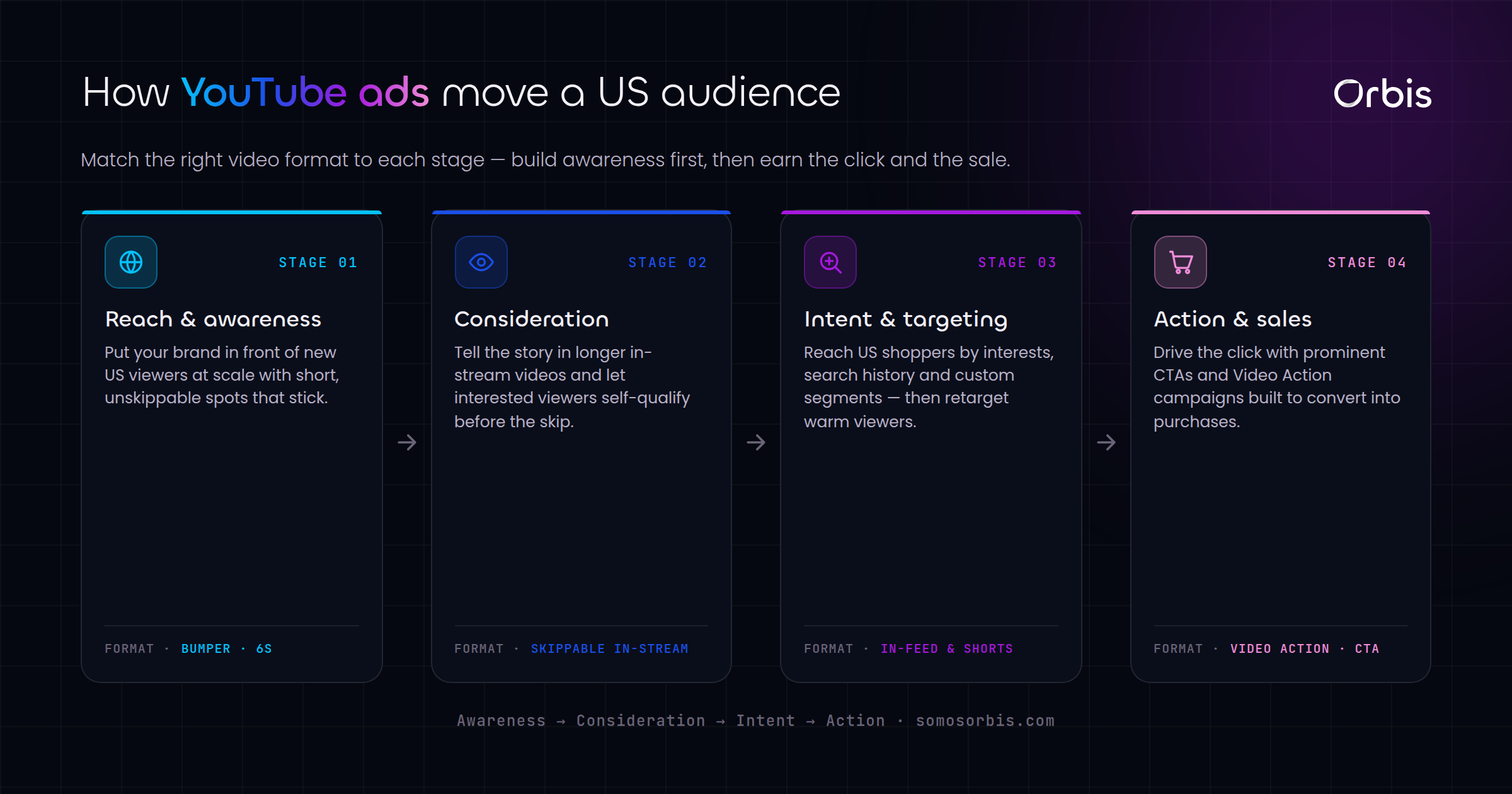
Three things make YouTube different from the rest of paid media. First, it sits inside Google's data and bidding system, so your YouTube campaigns can use the same conversion signals and audiences as your Search and Display work. If you have already built out search demand capture, the natural next step is documented in our complete guide to Google Ads for US brands in 2026, and YouTube becomes the upper- and mid-funnel engine that feeds it.
Second, YouTube is where US buying intent is built before it ever reaches Search. Someone researching a stroller in Dallas, a CRM in Chicago, or a roofing contractor in Houston often starts with a video. If your brand shows up there with a clear, well-targeted message, you shape the consideration set before a competitor does.
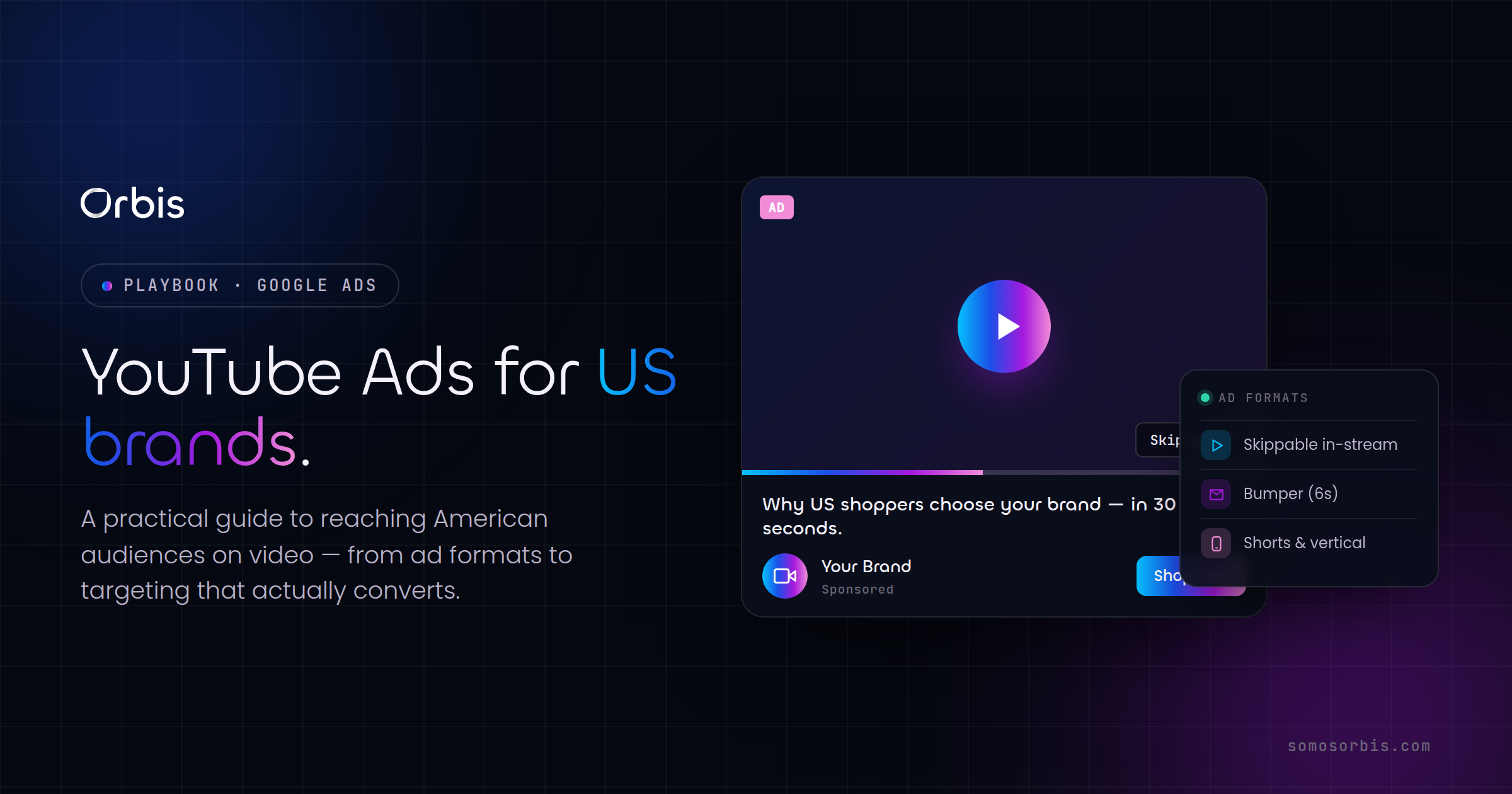
Third, the format range is wide. You can run a 6-second bumper for pure reach, a 15-second skippable in-stream ad for consideration, a vertical Shorts ad for younger mobile audiences, and a direct-response video that drives to a landing page, all from one account. That flexibility is the whole point of this guide.
The YouTube ad formats US brands should know
You do not need to master every placement. You need to know what each format is good at so you stop using a reach tool to chase conversions.
Skippable in-stream ads
These play before or during a video and can be skipped after 5 seconds. They are the workhorse of YouTube. Because you generally pay when someone watches 30 seconds (or the full ad) or interacts, you are not punished for the skip. Use these for consideration and, with the right targeting and offer, for conversions. The skill is front-loading: say who it is for and why it matters in the first 5 seconds, before the Skip button wins.
Non-skippable in-stream ads
Up to 15 seconds, no skip. You pay per impression. These guarantee the full message lands, which is useful around high-stakes US moments like Black Friday and Cyber Monday, Amazon Prime Day, back-to-school, and tax season, when you want a tight offer seen in full. The trade-off is that a forced 15 seconds with weak creative annoys people, so reserve these for your best-tested messages.
Bumper ads
Six seconds, non-skippable, priced per impression. Bumpers are reach and frequency tools. One brand idea, one visual, one line. They work beautifully as a follow-up layer: run a longer skippable ad to introduce the brand, then use bumpers to reinforce a single message cheaply across millions of impressions.
YouTube Shorts ads
Vertical, mobile, fast. Shorts inventory has exploded, and it skews toward younger and mobile-first US audiences, including a large share of bilingual Hispanic viewers. Creative here must be shot vertically and feel native: no letterboxed TV spots. A repurposed widescreen ad will underperform a clip built for the format.
In-feed video ads
These appear in YouTube search results and alongside related videos as a thumbnail and text invitation to click. They capture people who are actively browsing, which makes them strong for product education and for capturing mid-funnel research moments. The thumbnail and headline do the heavy lifting, exactly like an organic video.
Building a full-funnel YouTube structure
The most common US mistake is running a single "YouTube campaign" and judging it on last-click sales. YouTube earns its keep across the funnel, so structure it that way.
Top of funnel: build the audience
- Goal: reach the right US households and grow a remarketing pool.
- Formats: skippable in-stream and bumpers, plus Shorts for younger segments.
- Targeting: affinity and in-market audiences, broad demographics, and geographic focus on your core metros (for example, the New York and Los Angeles DMAs if that is where demand lives).
- Measure: reach, view rate, cost per view, and growth of your YouTube viewer and engager audiences, all in USD.
Mid funnel: drive consideration
- Goal: move warm viewers toward your site and your search demand.
- Formats: skippable in-stream with a clear call to action and in-feed video ads.
- Targeting: custom segments built from competitor searches and high-intent URLs, plus your video viewers from the top funnel.
- Measure: clicks to site, qualified sessions, and assisted conversions.
Bottom of funnel: convert and recover
This is where YouTube and Display work together. Once someone has watched your videos or visited your site, you keep showing up with offer-led creative until they convert. The mechanics of building those audiences and sequencing the messages are covered in depth in our breakdown of Google Display and remarketing for the US funnel, and the same audience lists power your YouTube remarketing.
- Goal: close the sale or recover abandoners.
- Formats: skippable in-stream and in-feed video tied to a specific offer, plus bumpers for frequency.
- Targeting: site visitors, cart abandoners, and your strongest customer-match and lookalike lists.
- Measure: conversions, cost per acquisition, and return on ad spend in USD.
Targeting US audiences with precision
YouTube's audience tools are the difference between a vanity reach buy and a profitable program. A few that consistently earn their place for US brands:
- In-market audiences: people Google identifies as actively researching a category. Strong starting point for consideration.
- Custom segments: built from keywords people search, apps they use, and websites they browse. This is how you reach "people researching competitor X" without guesswork.
- Your data segments: site visitors, YouTube channel viewers, and customer lists uploaded via customer match. These are your highest-converting pools.
- Demographic and geographic layers: tighten by age, household income tier, and metro. A Miami-only roofing brand should not pay for impressions in Seattle.
Resist the urge to stack five layers on day one. Over-targeting starves the campaign and inflates costs. Start broader at the top of the funnel, let the system learn, and tighten where the data tells you to.
Reaching the US Hispanic audience with bilingual creative
The US Hispanic market is one of the largest and fastest-growing consumer segments in the country, concentrated in metros like Los Angeles, Miami, Houston, and Dallas, and heavily engaged on YouTube and Shorts. Treating it as an afterthought leaves real revenue on the table.
A few practical principles:
- Build for bilingual reality, not stereotypes. Many US Hispanic viewers move fluidly between English and Spanish. Test EN-only, ES-only, and mixed EN/ES creative rather than assuming one wins.
- Localize the message, not just the language. A literal translation rarely lands. Adapt the hook, the cultural references, and the offer so the ad feels made for that viewer.
- Use language and geo signals together. Combine Spanish-language content placements and relevant audiences with your priority metros to concentrate budget where it pays back.
- Cast and produce authentically. Representation in the creative itself drives trust and view-through far more than a translated voiceover bolted onto a generic spot.
Creative that holds attention
YouTube creative is where most US campaigns are won or lost. The targeting can be perfect, but a slow, brand-first intro will be skipped before the message lands.
- Hook in 5 seconds. Lead with the problem, the audience, or a pattern-breaking visual. Save the logo lockup for later.
- Design for sound-off and sound-on. Many viewers start muted. On-screen captions carry the message; audio rewards those who turn it up.
- One ad, one job. A reach bumper and a conversion ad are different scripts. Do not ask one 30-second video to do everything.
- Tie creative to the US calendar. Refresh offers and messaging around Black Friday and Cyber Monday, Amazon Prime Day, back-to-school, and tax season so the ad matches what the viewer is already thinking about.
- Shoot vertical for Shorts. Repurposing is fine, reformatting is not optional. Vertical-native clips win.
Measurement: see the whole picture
Judging YouTube on last-click conversions alone is the fastest way to kill a campaign that is actually working. Awareness and consideration formats rarely get the last click; they create the demand that Search and Display close.
Track the full path:
- View-through and engaged-view conversions to credit the influence YouTube has on later actions.
- Brand lift signals such as growth in branded search and direct traffic from your priority metros after a flight runs.
- Assisted conversions across the funnel, so a top-funnel video that started the journey is not written off.
- Blended cost per acquisition in USD across YouTube, Search, and Display, rather than scoring each channel in isolation.
On privacy: build your measurement to respect current US privacy norms and give people clear choices over their data. Use consent-aware tagging and server-side measurement where appropriate so your reporting stays accurate as third-party signals fade. Working inside quality processes and current regulations is not a constraint on performance, it is what keeps the program durable.
A 30-day rollout plan
If you are starting from scratch, here is a sequence that avoids the usual waste:
- Week 1: confirm conversion tracking and consent setup, build your data audiences, and define priority metros and budgets in USD.
- Week 2: launch top-funnel skippable and bumper ads with broad audiences and at least two creative variants, including a bilingual EN/ES version.
- Week 3: add mid-funnel in-feed and consideration ads to video viewers and custom segments; begin a Shorts test.
- Week 4: turn on bottom-funnel remarketing tied to your strongest offer, review assisted and view-through data, and reallocate budget to the winners.
From there it is a steady loop: refresh creative before it fatigues, tighten targeting where the data is clear, and align flights to the US seasonal calendar.
Make YouTube a revenue engine, not a vanity buy
YouTube Ads reward brands that treat them as a system: the right format for each funnel stage, audiences built from real intent, bilingual creative for the US Hispanic market, and measurement that credits the full path to purchase. Get those four things right and YouTube stops being a place you "do awareness" and becomes a measurable driver of pipeline and sales in USD.
If you want a team that builds and runs this end to end, our Google and YouTube paid media services cover strategy, audience architecture, creative direction, and reporting, grounded in documented processes and the same revenue-engineering discipline we bring to every channel. Tell us your goals and your priority US metros, and we will map the campaign structure that gets you there.