
Search captures demand that already exists. The Google Display Network and remarketing capture something harder and more valuable: the attention of people who have not made up their minds yet, and the shoppers who came close but walked away. For US brands competing across crowded markets in New York, Los Angeles, Chicago, Miami, Dallas, and Houston, the funnel rarely closes on a single visit. The average consideration window for a mid-priced product spans several days and a dozen touchpoints. Display and remarketing are how you stay present across that window without burning budget on people who were never going to buy.
This guide is the practical, channel-level companion to our complete paid media guide for US advertisers in 2026. Where that pillar maps the entire paid landscape, here we go deep on one job: building Display and remarketing audiences that move US shoppers from "just looking" to "buying now" — with targeting that respects the privacy expectations of CCPA and CPRA without slowing your growth.
Why Display and Remarketing Earn Their Place in the US Funnel
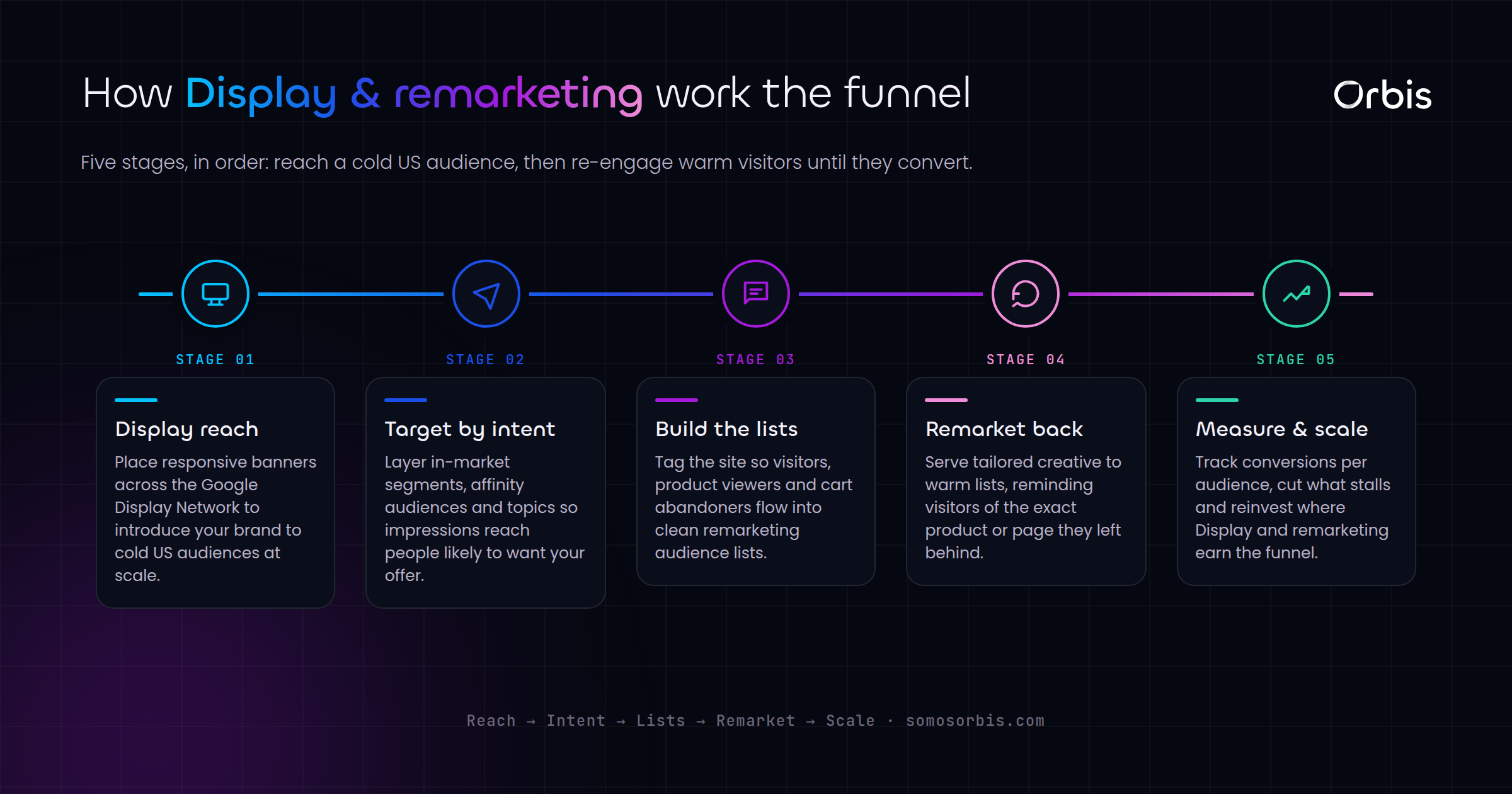
Plenty of US advertisers treat Display as a leftover line item — a place to dump remaining budget and hope for cheap impressions. That is exactly why so many Display campaigns underperform. Used deliberately, Display and remarketing do three things no other channel does as efficiently:
- They reach demand before it becomes a search. A shopper in Dallas browsing home-decor blogs has not typed "modern sectional sofa" into Google yet. Display puts you in front of that intent while it forms.
- They recover abandoned consideration. Roughly seven in ten online carts are abandoned. Remarketing is the most cost-effective way to bring those near-buyers back, often at a fraction of the cost-per-acquisition of net-new prospecting.
- They reinforce brand presence cheaply. Frequency builds familiarity. When the same Miami shopper sees your brand across a news site, a recipe app, and YouTube over three days, your eventual search-and-click rate climbs.
The catch is that Display only works when it is structured around the funnel — not treated as one undifferentiated blast. The rest of this guide walks that structure from top to bottom.
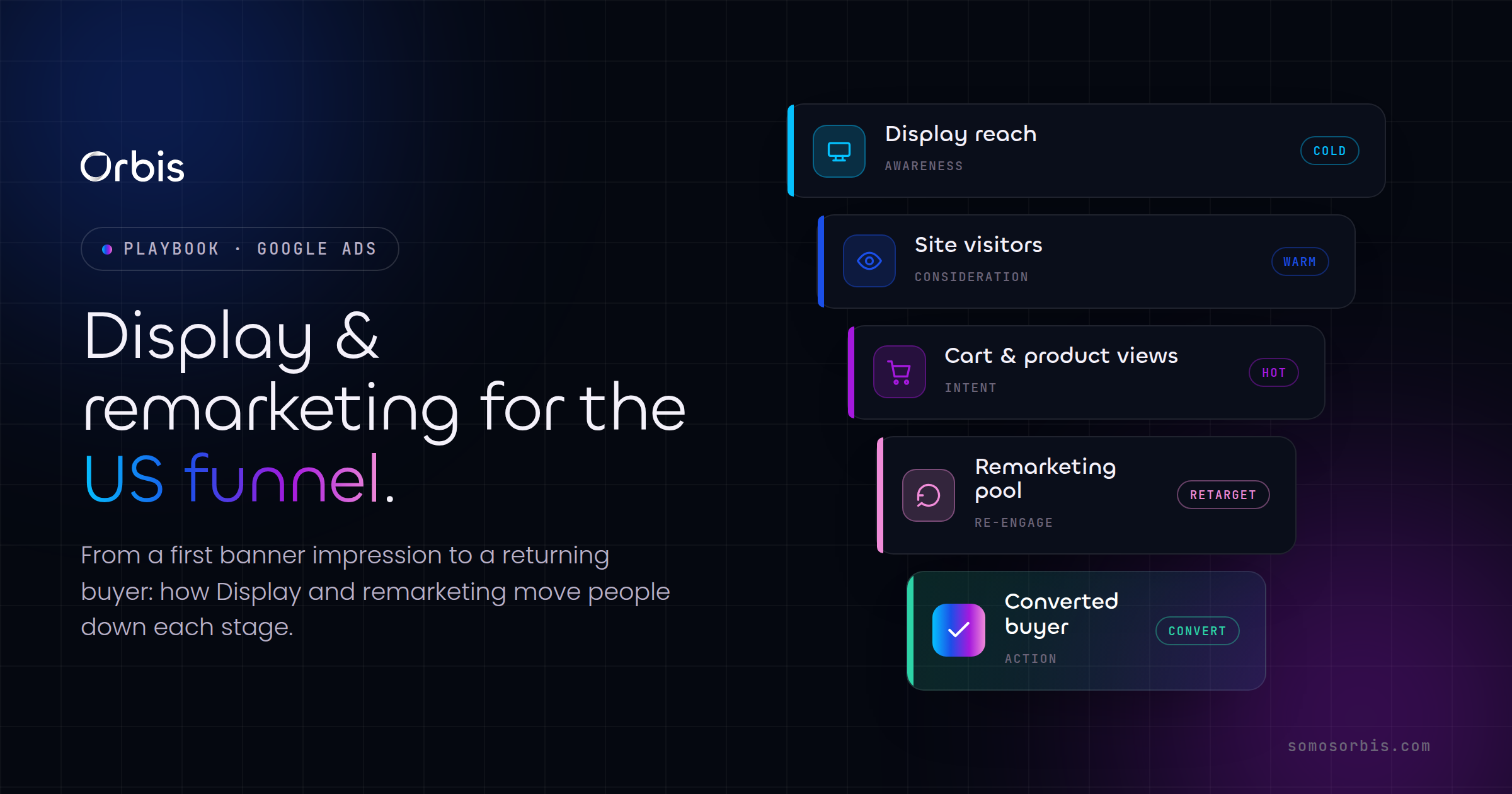
Mapping Display to the Three Stages of the US Funnel
Think of Display and remarketing as three distinct jobs, each with its own audiences, creative, and success metric. Mixing them into one campaign is the single most common reason US Display budgets leak.
Top of Funnel: Prospecting and Awareness
At the top, you are introducing your brand to people who have never heard of you. This is where Google's audience signals do the heavy lifting. The most reliable prospecting audiences for US brands are:
- In-market audiences — people Google has identified as actively researching a product category. For a US furniture brand, "Home & Garden > Home Furnishings" captures shoppers in the consideration phase right now.
- Affinity audiences — broader lifestyle signals useful for brand-building, like "Cooking Enthusiasts" for a kitchenware brand.
- Custom segments — audiences you build from keywords and URLs. Feed Google the search terms and competitor sites your ideal US customer visits, and it assembles a lookalike pool.
Measure top-of-funnel by reach, qualified site visits, and new audience growth — not by last-click sales. Holding prospecting to a direct-response ROAS target will choke it before it ever feeds your lower funnel.
Middle of Funnel: Engaged but Undecided
The middle is where remarketing begins. These are people who visited your site, viewed products, or engaged with your video content but did not act. Segment them by behavior, because a homepage bouncer and a product-page lingerer deserve different messages:
- All visitors (last 30 days) — a broad re-engagement pool.
- Product or category viewers — shoppers who looked at specific items but did not add to cart.
- Content engagers — readers of your blog or guides who are researching, not yet buying.
Middle-funnel creative should answer objections and build trust: customer reviews, your Google Partner status if you are an agency, social proof like a 4.9-star rating, or a clear explanation of what makes you different. The goal is to move the undecided one step closer, not to hard-close.
Bottom of Funnel: Cart and Checkout Recovery
The bottom is where remarketing pays for itself. These audiences are small, high-intent, and worth aggressive bidding:
- Cart abandoners — added to cart, never purchased. Your single highest-value remarketing list.
- Checkout abandoners — reached the payment step and stopped. Often a friction or trust issue you can address directly in the ad.
- Past purchasers — for cross-sell, replenishment, and seasonal returns.
Bottom-funnel creative should be specific and urgent: the exact product they viewed, free-shipping thresholds in USD, or a time-bound incentive. Dynamic remarketing, covered below, automates this at scale.
Dynamic Remarketing: Showing the Right Product to the Right Shopper
Static remarketing shows everyone the same banner. Dynamic remarketing shows each shopper the exact products they viewed, pulled live from your product feed. For US ecommerce brands with large catalogs, this is non-negotiable — it routinely outperforms static creative by a wide margin on return-on-ad-spend.
To run it well, you need three things working together:
- A clean Merchant Center product feed with accurate titles, USD pricing, availability, and high-quality images.
- Remarketing tags with custom parameters that pass product IDs and the visitor's funnel stage (viewed, added to cart, purchased) back to Google.
- Responsive display ad templates that automatically assemble product, price, and call-to-action into on-brand layouts.
The payoff is relevance at scale. A Chicago shopper who browsed running shoes sees those exact shoes, in their size category, at the price they saw — across the apps and sites they visit next. That specificity is what turns a passive impression into a return visit.
Privacy-Conscious Targeting: CCPA and CPRA Without the Guesswork
US privacy expectations have matured. Shoppers in California and beyond expect transparency about how their data is used, and the ability to opt out of the sale or sharing of their personal information. Building remarketing that respects those expectations is not just compliance hygiene — it is a trust signal that protects your brand and, increasingly, the only durable way to operate as third-party signals erode.
Here is how to build Display and remarketing that respects current US privacy norms while staying effective:
- Lead with consent. Use a consent management setup so remarketing tags fire only when a visitor has agreed. Google's Consent Mode adjusts measurement based on the consent state, preserving modeled conversions without overreaching on data you are not permitted to collect.
- Honor opt-outs end to end. When a shopper exercises their right to opt out of data sharing, that signal must propagate to your audience lists. Build the process so suppression is automatic, not manual.
- Shift toward first-party data. Audiences built from your own customer lists and on-site behavior are more durable and more privacy-aligned than rented third-party segments. They are also higher quality, because they reflect real relationships.
- Lean into Google's privacy-safe modeling. Enhanced conversions and modeled audiences let you maintain performance as cookie-based signals fade, without relying on data practices that conflict with CCPA and CPRA expectations.
- Keep frequency and recency reasonable. Following a shopper with the same ad for sixty days reads as surveillance, not service. Cap frequency and set membership durations that match a realistic buying window.
At Orbis we treat this as compliance by design: privacy controls built into the campaign structure from day one, governed by documented processes, rather than bolted on after a problem surfaces. That is how you keep performance and trust pointing in the same direction.
Sequencing Display Across US Seasonality
US retail runs on a predictable calendar, and Display rewards advertisers who plan audiences around it. The mistake is waiting until the peak to start building lists — by then the window to warm an audience has closed.
- Black Friday and Cyber Monday. Begin prospecting and list-building in October. By the time deals go live, your remarketing pools are full of warmed shoppers ready to convert at peak. The brands that win BFCM built their audiences a month before the discounts.
- Amazon Prime Day. Even off-Amazon, the mid-summer shopping surge lifts category demand. Use Display to capture comparison shoppers researching alternatives during the event.
- Back-to-school. A long July-to-September ramp. Segment audiences by category — apparel, electronics, supplies — and sequence creative as the season builds.
- Tax season. For higher-ticket considered purchases, refund season is a real demand driver. Display keeps your brand present while shoppers weigh a larger spend.
The principle across all four: build the audience early, then increase bids and frequency as the event approaches. Display is a warming channel before it is a closing channel.
Reaching the US Hispanic Market with Bilingual Display
The US Hispanic market represents enormous, often under-served buying power across exactly the cities where competition is fiercest — Los Angeles, Miami, Houston, Dallas, Chicago, New York. Display gives you a precise, cost-effective way to reach this audience in language and in context.
- Run parallel English and Spanish creative. Build separate responsive display ad sets in each language and let placement and audience signals route the right version to the right shopper, rather than translating one ad as an afterthought.
- Place in Spanish-language context. Target Spanish-language sites, apps, and YouTube content to reach Hispanic audiences where they already spend attention.
- Localize the offer, not just the words. Bilingual creative works when the message reflects real cultural context and relevant US seasonality — not a literal translation that lands flat.
Bilingual EN/ES Display is one of the clearest cases where thoughtful targeting outperforms bigger budgets. You are reaching a high-intent audience that competitors routinely overlook.
Common Display and Remarketing Mistakes US Advertisers Make
Across hundreds of US accounts, the same avoidable mistakes show up again and again:
- One campaign for the whole funnel. Prospecting and remarketing have different goals, bids, and creative. Combining them buries your best-performing audience.
- No frequency caps. Over-serving the same shopper wastes budget and erodes goodwill.
- Stale audience durations. A 540-day membership keeps long-cold visitors in your pool. Match duration to your real buying cycle.
- Ignoring placements. Display can serve on low-quality apps and made-for-ads sites. Review placement reports and exclude the junk.
- Optimizing remarketing on last-click alone. Display's value is in assist and view-through. Judge it on its real contribution to the funnel, not a narrow attribution slice.
How Display Connects to the Rest of Your Paid Stack
Display and remarketing do not work in isolation. They are one layer of a coordinated paid strategy. Video is the natural partner — the same remarketing audiences you build here can be activated on YouTube for richer storytelling and higher-impact reinforcement. If video is part of your plan, our guide to YouTube ads for US brands shows how to extend these same funnel principles into video placements.
And for the full picture — how Search, Shopping, Display, and video fit together into one US paid media engine with shared audiences and unified measurement — start with the complete paid media guide for US advertisers in 2026, the pillar this article belongs to.
The brands that win on Display are not the ones spending the most. They are the ones who structured their audiences around the funnel, respected their shoppers' privacy, and stayed present across the full consideration window.
Put Your Display and Remarketing to Work
Display and remarketing reward structure, patience, and discipline. Build distinct audiences for each funnel stage. Use dynamic remarketing to show the exact product a shopper viewed. Respect CCPA and CPRA expectations by leading with consent and first-party data. Sequence your lists around Black Friday, Prime Day, back-to-school, and tax season. And reach the US Hispanic market with genuine bilingual creative. Do those things well and Display stops being a leftover line item — it becomes one of the most efficient channels in your funnel.
If you want a partner who builds this with documented processes, real revenue engineering, and compliance built in from day one, explore our Google Display and remarketing services. We are a Google Partner with a 4.9-star rating across 58 reviews, more than 500 clients, and over 15 years moving US brands through the funnel. Let's build Display and remarketing audiences that bring your US shoppers back — and turn consideration into revenue.