
Social media is where most Canadian buying journeys now begin, continue and get decided. Whether you sell direct-to-consumer in Toronto, run a B2B services firm in Calgary, or operate a bilingual retail brand serving Montreal and Vancouver, the platforms are no longer a "nice to have" bolted onto your marketing. They are the front door to your brand, your most active customer service channel, and one of the largest sources of first-party signal you will ever collect. The problem is that most teams treat social as a stream of disconnected posts rather than a managed program with strategy, process and measurement behind it. This guide walks through how Canadian brands build a real social media management practice end to end: strategy, content, community, listening and reporting. It is written for marketing leads, founders and in-house social managers who want a system they can run all year, not a list of growth hacks that stop working by next quarter.
At Orbis we manage social programs for Canadian and North American brands every day, and the through-line is always the same. The brands that win on social are not the ones posting the most. They are the ones with documented processes, a clear content engine, disciplined community management, and reporting that ties activity back to revenue. If you want the short version: treat social like an operating system, not a hobby. If you want the long version, keep reading.
What "social media management" actually means in 2026
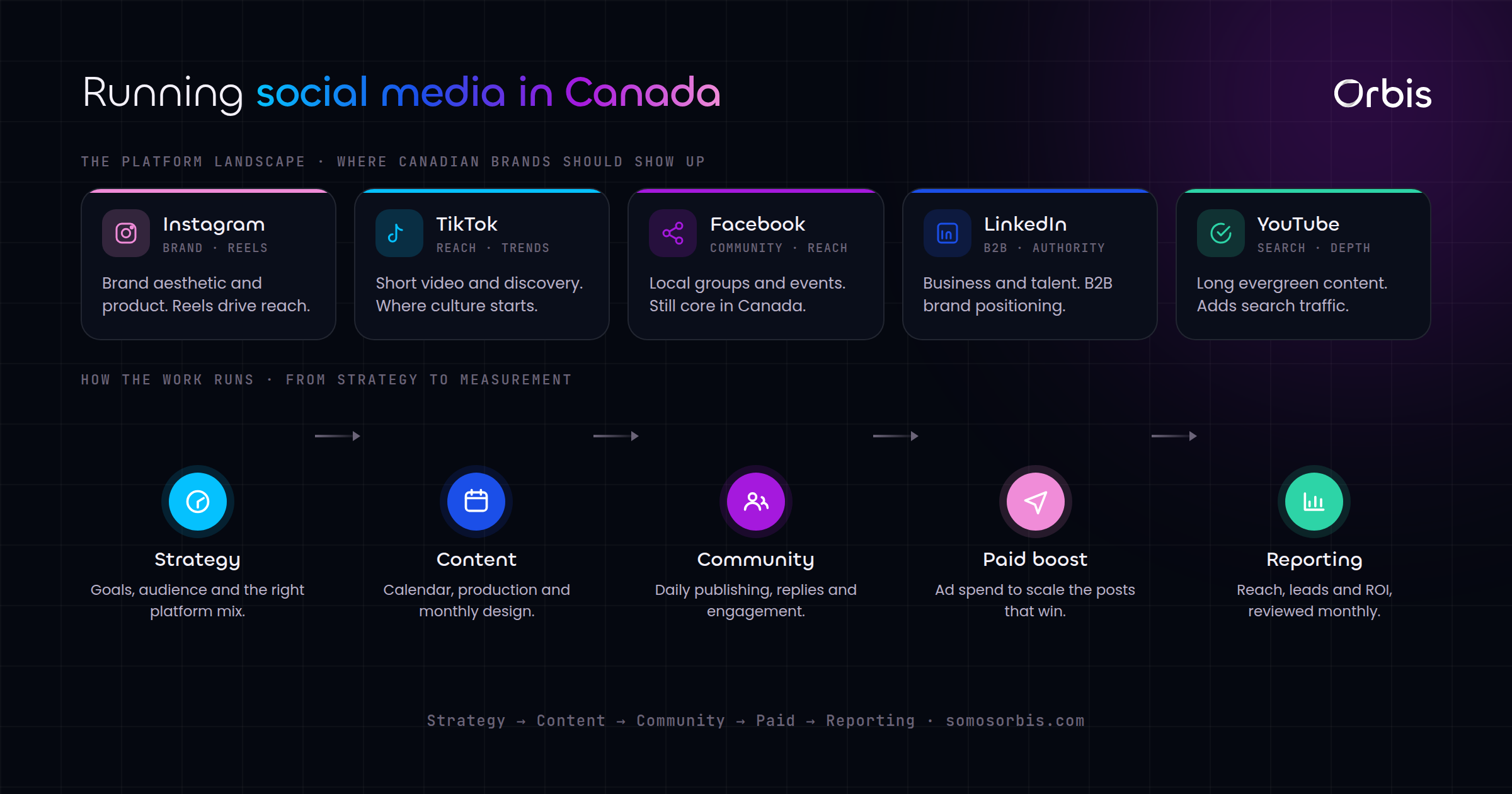
Social media management is the ongoing practice of planning, producing, publishing and optimizing branded content across social platforms, while actively managing the conversations that content generates. It sits at the intersection of marketing, customer service, brand and sales. A complete program has five working parts that feed each other:
- Strategy and governance — the goals, audience definition, platform priorities, brand voice and the rules that keep everything consistent.
- Content production and scheduling — the calendar, the creative formats, and the publishing cadence that turns strategy into a steady stream of posts.
- Community management — replies, DMs, comments, moderation and relationship-building that happen after you hit publish.
- Social listening and reputation — monitoring mentions, sentiment, competitors and the wider conversation, then feeding what you learn back into strategy.
- Measurement and reporting — the analytics, dashboards and ROI story that prove the program works and guide the next quarter.
Miss one of those and the whole thing wobbles. Great content with no community management feels like a billboard nobody can talk back to. Brilliant community management with no strategy burns out your team on conversations that do not move the business. Our full social media management service for Canadian brands is built around all five working together, because that is the only configuration that compounds over time.
Why the Canadian market needs its own playbook
It is tempting to copy an American social playbook and assume it ports across the border. It mostly does not, and the gaps are exactly where Canadian brands lose trust. A few realities shape everything:
Bilingualism is not optional
Canada is officially bilingual, and roughly a fifth of the population speaks French at home. In Quebec, French-language obligations are a legal and cultural reality, not a marketing preference. A brand that posts only in English and machine-translates the rest signals that it does not really serve the whole country. Strong Canadian social programs plan French and English as parallel tracks with native-quality copy, not afterthoughts. This is involved enough that it deserves its own workflow, which we cover in our guide to bilingual social content for Canadian audiences.
The Canadian calendar is its own thing
Canadian seasonality drives the content calendar more than most teams admit. Back-to-school lands differently across provinces. Canadian Thanksgiving is in October, not November. Boxing Day and Boxing Week are a genuine retail event, often bigger than Black Friday for domestic brands. Winter is long, weather-driven content performs, and the summer patio-and-festival season is compressed and intense. Layer in regional events — the Calgary Stampede, the Toronto International Film Festival, Vancouver's outdoor season, Montreal's festival summer — and you have a content rhythm no US calendar will hand you.
Privacy and trust expectations run high
Canadian consumers and regulators take privacy seriously, and brands are expected to handle data and advertising responsibly under current regulations. That shows up in how you run contests, collect data through social, and disclose partnerships. Building compliance into your process from the start — rather than cleaning it up after a complaint — is part of doing social properly here. It is also simply good for trust, which is the currency social runs on.
Step one: build the strategy before you build the calendar
Almost every struggling social program we audit has the same root problem: it started with "we need to post more" instead of "what are we trying to achieve and for whom." Strategy comes first. Here is the sequence that works.
Define outcomes, then channels
Start with the business outcome, not the platform. Are you driving e-commerce sales, qualified B2B leads, retail foot traffic, app installs, or brand awareness for a category most people do not know exists yet? The outcome dictates which platforms matter. A Canadian DTC apparel brand chasing Boxing Week sales lives on Instagram, TikTok and Pinterest. A Toronto B2B SaaS firm selling to enterprise buyers lives on LinkedIn, with a supporting presence elsewhere. Pick two or three platforms you can do exceptionally well rather than six you do poorly.
Know your audience at the segment level
"Canadians aged 25 to 54" is not an audience, it is a census bracket. Real targeting means understanding the jobs your customers are trying to get done, the language they use, the objections that stall them, and where they already spend attention. For bilingual brands this means mapping segments by language and region, because a French-speaking buyer in Quebec City and an English-speaking buyer in Vancouver may want the same product but respond to very different framing.
Run an honest audit first
Before you write a single new post, take stock of what you already have. A proper social media audit looks at every active profile, your historical performance, your competitors' presence, the gaps in your content mix, and whether your profiles are even set up correctly. It is the single highest-leverage thing you can do in week one, because it tells you what to stop, start and keep. We walk through the entire process in our social media audit guide, and it is worth doing before you commit a quarter's budget to a direction that may be wrong.
Document your brand voice and governance
Voice is what makes a brand recognizable when the logo is cropped out of the frame. Document it: the tone, the words you use and avoid, how you handle humour, how formal you get in French versus English, and how you respond to criticism. Pair it with governance — who can approve what, how fast you respond to complaints, what gets escalated, and what you never say. Documented processes are the difference between a program that survives a staff change and one that collapses the moment your social manager goes on vacation.
Step two: build a content engine, not a posting habit
Content is where most of the visible work happens, and where most teams quietly run out of steam by month three. The fix is to stop thinking in individual posts and start thinking in an engine: repeatable formats, a planned calendar, and a production process that does not depend on last-minute inspiration.
Plan content in pillars and formats
Define three to five content pillars — the recurring themes your brand owns. A home-services brand might run pillars like seasonal maintenance tips, behind-the-scenes crew content, customer transformations, and local community involvement. Within each pillar, standardize formats you can produce repeatedly: a weekly tip carousel, a monthly customer story reel, a recurring FAQ series. Formats are what make production sustainable, because the team is filling a known template rather than inventing from scratch every time.
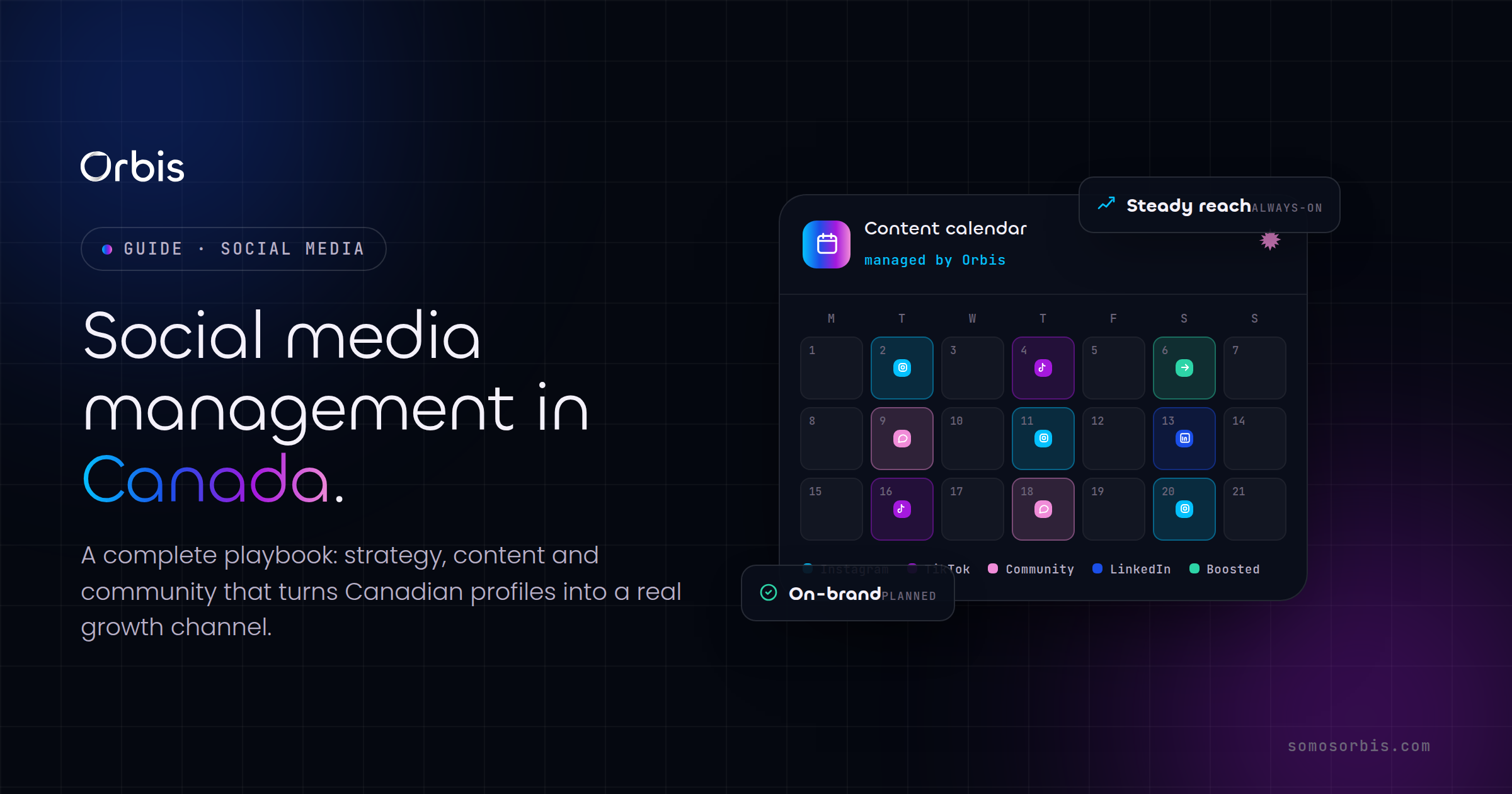
Build a real content calendar
A content calendar maps what goes out, where, when and in which language, far enough ahead that you can batch production and align with the Canadian seasonal moments that matter. It is also where bilingual planning gets real, because every English slot needs a French counterpart planned alongside it, not translated in a panic the night before. This is involved enough that we built a dedicated content strategy and calendar service around it, and a companion playbook on how to build a social content calendar for the Canadian market that covers cadence, batching and seasonal mapping in depth.
Match the format to the platform
Cross-posting identical content everywhere is a tax on your reach. Each platform rewards native behaviour:
- Instagram — Reels for reach, carousels for saves and education, Stories for daily presence and community.
- TikTok — fast, authentic, trend-aware short video; polish matters less than hook and rhythm.
- LinkedIn — for B2B, document posts and text-led storytelling outperform link-dumps; this is where Canadian professional services brands build authority.
- Pinterest — quietly powerful for Canadian retail and DTC, especially around seasonal and gift-driven moments like Boxing Week.
- Facebook — still essential for local reach, community groups and an older demographic, plus events and Marketplace in many regions.
Batch produce and stay flexible
Batch the evergreen and pillar content so the calendar is mostly filled in advance, then leave deliberate gaps for reactive content — trends, news, customer moments and the occasional well-judged real-time post. The 80/20 split of planned to reactive keeps you efficient without making the brand feel like a robot. And always produce with repurposing in mind: one customer-story shoot can become a Reel, a carousel, three Stories, a LinkedIn post and a Pinterest pin.
Step three: community management — where brands are actually built
Publishing is half the job. The other half starts the moment someone replies. Community management is the practice of responding to comments and DMs, welcoming new followers, handling complaints, moderating conversations, and proactively engaging with the people and communities your brand cares about. It is the part most likely to be neglected and the part that most directly builds loyalty.
Reactive and proactive engagement
There are two modes, and you need both. Reactive engagement is responding to what comes to you: questions, compliments, complaints, tags and mentions. Proactive engagement is going out into the conversation — commenting thoughtfully on relevant posts, engaging with local communities, supporting customers who mention you without tagging, and showing up in the spaces where your audience already gathers. The brands that feel alive on social do both, and they do them with a consistent voice. Our community management service exists precisely because this is the work that quietly compounds into reputation and retention.
Response time is a trust signal
On social, speed is service. A customer who asks a question publicly and waits two days for a reply is telling every other follower what your service is like. Set response-time targets, staff for them across the hours your audience is active, and build a library of approved responses for common situations so replies are fast without sounding canned. For bilingual brands, that means being able to respond competently in both French and English, in real time.
Handle complaints in the open, carefully
Negative comments are not a crisis, they are an opportunity to show how you treat people. Acknowledge quickly, take the detail to DMs or email, resolve it, and where appropriate close the loop publicly so others see it handled. What you never do is delete legitimate criticism or get defensive in the replies, which only amplifies the problem. A documented escalation path — what a frontline community manager handles versus what goes to a manager or to PR — keeps responses calm and consistent under pressure.
Turn customers into a community
The highest form of community management is building genuine community: recognizing repeat fans, featuring user-generated content, creating reasons for followers to talk to each other, and making people feel like insiders. For deeper, Canada-specific tactics on this, our guide to community management for Canadian brands goes well beyond the basics into moderation playbooks, UGC programs and bilingual response systems.
Step four: social listening and reputation management
Most of what is said about your brand happens without tagging you. Social listening is the practice of monitoring the wider conversation — brand mentions, relevant keywords, competitor activity, industry trends and overall sentiment — so you can respond, learn and protect your reputation. It turns social from a broadcast channel into a two-way intelligence system.
What to listen for
- Brand mentions — tagged and untagged, including misspellings and your product names.
- Sentiment — is the conversation trending positive, negative or neutral, and why.
- Competitors — what people praise and complain about with the brands you compete against, which is free product and positioning research.
- Category and trends — the conversations and questions emerging in your space before they become obvious.
- Crisis signals — early spikes in negative mentions that let you respond before something escalates.
From listening to action
Listening only pays off when it feeds back into the system. Insights from listening should reshape your content (answering the questions people actually ask), sharpen your community responses, surface product feedback for other teams, and protect your reputation before small issues grow. For a Canadian brand, that also means watching how sentiment differs by region and language, because a perception problem in Quebec can be invisible if you only monitor English. Our deeper playbook on social listening and reputation management in Canada covers tooling, sentiment tracking and crisis preparedness in detail.
Step five: measurement, analytics and proving ROI
If you cannot measure it, you cannot defend the budget — and social budgets get cut first when the value is fuzzy. Good measurement connects social activity to outcomes the business actually cares about, then reports it in a way leadership understands.
Pick metrics that map to the funnel
Vanity metrics like follower count feel good and prove little. Organize your metrics by funnel stage instead:
- Awareness — reach, impressions, video views, share of voice versus competitors.
- Engagement — saves, shares, comments and meaningful interactions, which signal content that resonates rather than just gets seen.
- Consideration — profile visits, link clicks, DMs initiated, content saves, time on landing pages from social.
- Conversion — leads, sign-ups, sales and assisted conversions attributed to social.
- Retention and advocacy — repeat engagement, UGC volume, and customers who become vocal advocates.
Build reporting that tells a story
A report is not a screenshot of platform analytics. It is a narrative: what we set out to do, what happened, what we learned, and what we will change next. Leadership wants to see the line from social activity to pipeline and revenue, not a wall of engagement rates. Set up consistent monthly reporting against the goals you defined in your strategy, and review quarterly to reset priorities. Our detailed guide to social media reporting and ROI for Canadian brands includes dashboard structures and attribution approaches you can adopt directly.
Close the loop
Measurement is not the end of the process, it is the input to the next cycle. The strongest programs run a continuous loop: strategy informs content, content generates community and listening data, that data feeds measurement, and measurement reshapes strategy. Each turn of the loop makes the program smarter. That is what "managed" social media actually means, and it is why a documented, repeatable process beats individual talent over the long run.
Organic and paid: how they work together
Organic and paid social are not rivals, they are partners. Organic builds the brand, tests what resonates, and creates the content library. Paid amplifies what already works, reaches beyond your existing audience, and drives measurable performance against specific goals. The smartest Canadian programs use organic as a continuous test lab: whatever performs best organically becomes the creative you put paid budget behind, which removes most of the guesswork from ad spend. As a Meta and Pinterest partner, we run this organic-to-paid pipeline so that media budget chases proven creative rather than hunches — and so seasonal pushes like Boxing Week or back-to-school land with content audiences have already validated.
In-house versus agency: choosing your operating model
There is no universally right answer, only the right fit for your stage and resources. Many Canadian brands run a hybrid: an in-house owner who holds brand knowledge and community relationships, supported by an agency for strategy, production capacity, bilingual content and reporting rigour. What matters most is that someone owns each of the five working parts and that the process is documented well enough to survive turnover. If you are deciding, run an audit first, be honest about your capacity to staff community management across business hours in both languages, and remember that consistency over years beats brilliance in bursts.
A 90-day plan to stand up a real social program
- Days 1 to 30 — Audit and strategy. Complete a full social audit, define outcomes and audience segments, choose your two or three priority platforms, document brand voice and governance, and set up listening.
- Days 31 to 60 — Build the engine. Define content pillars and formats, build the first quarter's bilingual content calendar around the Canadian seasonal map, batch-produce a buffer of evergreen content, and set community management response targets and templates.
- Days 61 to 90 — Run, measure, refine. Publish consistently, manage community actively, monitor listening, ship your first proper monthly report tied to business outcomes, then use what you learned to reset the next quarter.
Do this and by day 90 you will not have a posting habit — you will have a managed program with strategy, a content engine, active community management, listening and reporting all reinforcing each other.
Related guides for Canadian social teams
This pillar is the map; the guides below are the detailed routes. Read them in whatever order matches what you are working on this quarter:
- Social media audit guide — take stock before you build.
- Building a social content calendar for Canada — cadence, batching and seasonal mapping.
- Community management for Canadian brands — moderation, UGC and bilingual response.
- Social listening and reputation management in Canada — monitoring, sentiment and crisis readiness.
- Social media reporting and ROI — dashboards and attribution that prove value.
- Bilingual social content for Canadian audiences — running French and English as parallel tracks.
Make social a managed program, not a guessing game
Social media management is not about chasing every trend or posting until something sticks. It is a disciplined, documented program: strategy that starts from business outcomes, a content engine built on pillars and a bilingual calendar, community management that turns followers into advocates, listening that protects and informs your brand, and reporting that ties it all back to revenue. Built that way, social compounds — every quarter makes the next one easier and more effective. Built any other way, it stays a treadmill.
If you want a partner who runs this as a system for Canadian brands — Google Partner, Meta and Pinterest partners, with 15-plus years and 500-plus clients behind us — explore our social media management services for Canada and let's build a program that works as hard as you do. Whether you need the full engine or specialist support for your content strategy and calendar or your community management, we will meet you where you are and help you grow from there.