
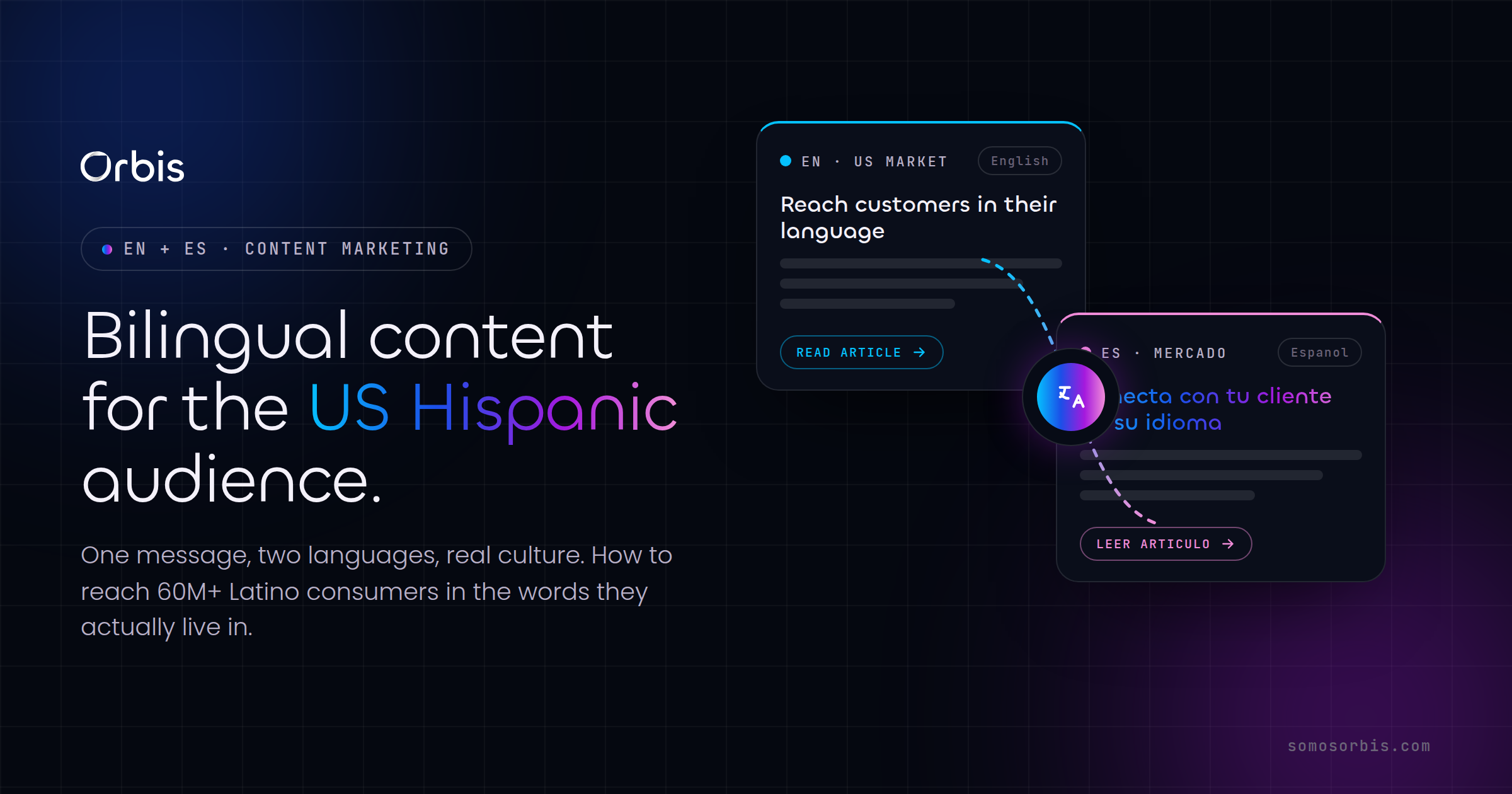
The US Hispanic market is not a niche. It is roughly one in five people in the country, with concentrated purchasing power in metros like Miami, Houston, Los Angeles, Dallas, New York, and Chicago. Yet most brands still treat bilingual content as a translation task: run the English script through a tool, swap the captions, ship it. That approach gets you words people can technically read and a message that lands flat. Authentic bilingual content for US Hispanic audiences is a production discipline, not a localization afterthought.
This guide breaks down how to plan, produce, and distribute EN/ES video, photo, and user-generated content that actually resonates across the most important US Hispanic markets. It is part of our broader content creation guide for US brands in 2026, and it pairs directly with the platform-specific tactics in our breakdown of video production for US social channels.
Why "Hispanic" Is Not One Audience
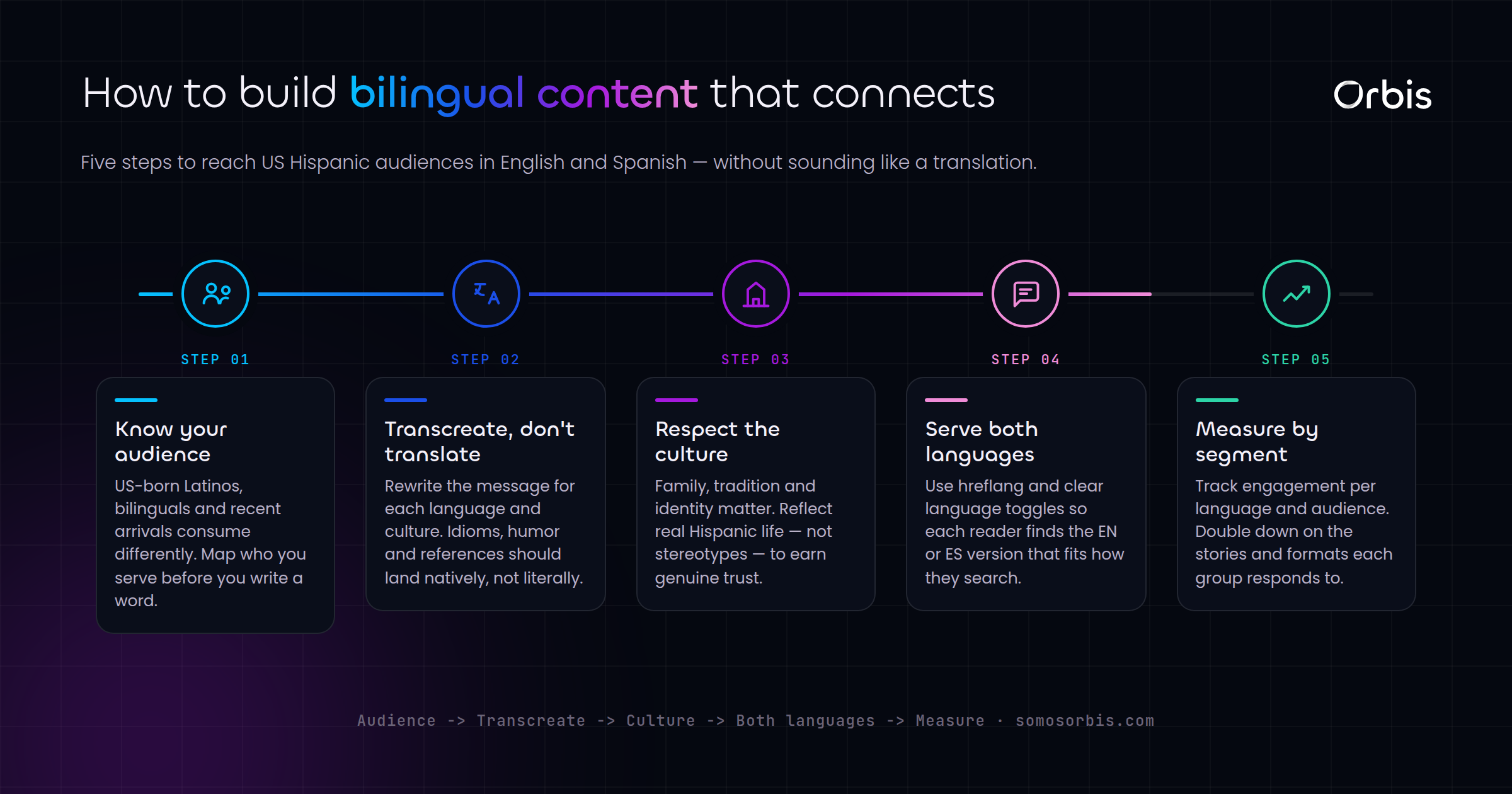
The single biggest mistake brands make is treating US Hispanic consumers as a monolith. A third-generation Mexican-American family in Houston, a recently arrived Venezuelan professional in Miami, and a bilingual Gen Z creator in Los Angeles share a language thread but almost nothing else in tone, references, or media habits. If your content assumes they are interchangeable, it will feel generic to all three.
Segment before you produce. At minimum, map your audience across these axes:
- Generation and acculturation: First-generation immigrants often consume primarily Spanish content. Second and third generations are frequently English-dominant but Spanish-resonant, the audience for whom code-switching feels native.
- Country and region of origin: Miami skews Cuban, Venezuelan, and Colombian. Houston and Dallas skew Mexican and Central American. Los Angeles is heavily Mexican with deep multigenerational roots. Vocabulary, humor, and even music cues differ.
- Language dominance: Spanish-dominant, English-dominant, and balanced bilingual viewers each want a different default. Guessing wrong on the default language is the fastest way to lose them in the first three seconds.
The practical takeaway: a Miami-targeted Reel and a Houston-targeted Reel for the same product should rarely be identical files with swapped captions. The creative brief itself should differ.
Translation Versus Transcreation
Translation moves words from one language to another. Transcreation moves meaning, emotion, and intent. For bilingual content that performs, you want transcreation almost every time.
A literal translation of a clever English tagline usually produces something that is grammatically correct and emotionally dead. Idioms break. Wordplay disappears. Calls to action that feel urgent in English become stiff and formal in Spanish. A transcreation process starts from the underlying message and rebuilds it natively in Spanish, with a native speaker who understands the target country's register.
Concrete rules we apply on bilingual productions:
- Write Spanish from the brief, not from the English copy. Let both versions express the same idea in their own most natural form.
- Decide on formality (tú vs. usted) per audience. A younger Los Angeles creator audience expects tú. A professional services pitch in Miami may warrant usted. This is a strategic choice, not a default.
- Respect Spanglish where it is authentic. Forcing pure Spanish onto an English-dominant Gen Z audience reads as corporate and out of touch. Code-switching, used naturally, signals belonging.
- Always have a native speaker from the target region review. Not just a fluent speaker, a native speaker who would actually talk this way.
Choosing Your Bilingual Video Format
There is no single right way to deliver bilingual video. The format depends on the platform, the audience's language dominance, and your budget. Here are the four models that work, with their tradeoffs.
1. Dual-version (two separate cuts)
You shoot once but produce a fully Spanish version and a fully English version, each with its own captions, voiceover, and on-screen text. This is the gold standard for authenticity because each audience gets content that feels native. It costs more in post-production and doubles your ad-set management, but for high-stakes campaigns around Black Friday, Cyber Monday, or Amazon Prime Day, the lift in relevance usually pays for itself.
2. Bilingual single cut (code-switching)
One video that moves naturally between English and Spanish, the way bilingual people actually speak. This works beautifully for English-dominant US Hispanic Gen Z and millennials. It feels real, it is efficient to produce, and it signals cultural fluency. The risk: done clumsily, it alienates both monolingual audiences. It only works when the creator is genuinely bilingual.
3. Subtitled single cut
Shoot in one language, add burned-in subtitles in the other. The cheapest option and acceptable for top-of-funnel awareness, but understand its ceiling. Around 85% of social video is watched on mute, so subtitles do real work, yet a subtitled-only approach still signals "we translated this for you" rather than "we made this for you."
4. Same-shoot, dual-talent
Bring a bilingual creator or two creators and capture both language performances in the same session. You get authentic native delivery in both languages without paying for two full productions. This is often the best cost-to-authenticity ratio, and it is a model we build into our video production workflows for US Hispanic campaigns.
Casting and Creators: The Make-or-Break Decision
Audiences detect inauthenticity instantly. The accent, the slang, the cultural references, the rhythm of speech, these either belong to the community or they do not. The single highest-leverage decision in bilingual content is who is on camera.
Guidelines for casting bilingual talent:
- Match origin to market. A Mexican-American creator for Houston and Los Angeles, a creator with Caribbean or South American roots for Miami. Regional accents and slang carry weight.
- Prioritize genuine bilinguals over translated performances. An English-speaking actor reading phonetic Spanish off a teleprompter is obvious and damaging.
- Let creators adapt the script. The people who live the language know how their community actually phrases things. Give them room to rewrite a line in their own voice.
- Build a roster, not a one-off. Consistent faces across a campaign build familiarity and trust, especially for the US Hispanic market where word-of-mouth and community recommendation drive purchase decisions.
The Power of Bilingual UGC
User-generated content is disproportionately effective with US Hispanic audiences because it carries the credibility of community. A real person in Miami or Dallas showing how they use your product, in their own language and their own slang, outperforms polished brand video on trust metrics nearly every time.
A bilingual UGC program should:
- Source creators from the target metros so the references, the backgrounds, and the accents ring true.
- Brief loosely. Give creators the product and the key message, then let them speak in whichever language and register feels natural to them. Over-scripting kills the authenticity that makes UGC work.
- Tie content to US seasonality. Back-to-school for families, tax season for financial services, Black Friday and Cyber Monday for retail, Prime Day for ecommerce. Hispanic households over-index on family-oriented seasonal spending, so align your creator briefs to those moments.
- Repurpose across the funnel. The same authentic clip can run as an organic Reel, a paid Spanish-language ad set, and a product-page testimonial.
Structuring rights, briefs, and a repeatable creator pipeline is exactly what our UGC content service is built to operationalize, so the program scales without losing its authentic edge.
Platform Nuances for the US Hispanic Market
Where your audience spends time should shape format and language. A few patterns worth designing around:
- Instagram and TikTok dominate among younger, English-dominant and balanced bilingual audiences. Vertical, fast, code-switching content thrives here.
- YouTube serves longer-form Spanish content well, including the family co-viewing that is common in Hispanic households.
- WhatsApp is central to how many US Hispanic families share content. Make assets easy to forward, with short, self-contained videos that work without context.
- Facebook retains strong reach among first-generation and older Spanish-dominant audiences, who skew toward this platform more than the general-market average.
For platform-by-platform aspect ratios, hook timing, and caption strategy, our guide on video production for US social channels covers the technical specs in depth.
Privacy and Targeting: Do It Right
Reaching US Hispanic audiences through paid social and retargeting means handling consumer data responsibly. US privacy expectations have tightened, and audiences notice when targeting feels intrusive. Build consent into your data collection, honor opt-outs cleanly, and avoid building audience segments around sensitive inferred characteristics. Treat compliance as part of the creative trust you are trying to earn, not a legal footnote. Following current privacy norms is simply part of running a credible program, and it protects the brand relationship you are working so hard to build.
Measuring What Actually Matters
Bilingual content should be measured against bilingual benchmarks, not just blended general-market numbers that hide what is happening with your Hispanic segment.
- Split reporting by language and by metro. A Miami Spanish ad set and a Los Angeles bilingual ad set will perform differently; averaging them obscures the signal.
- Watch three-second and hook retention by version. If the Spanish cut holds attention longer than the subtitled cut, that is your transcreation strategy validated in data.
- Track engagement quality, not just volume. Saves, shares, and comments in Spanish indicate genuine cultural resonance.
- A/B test language defaults. For balanced bilingual audiences, test whether Spanish-first or English-first openings drive better completion and conversion.
The goal is not to "have a Spanish version." The goal is to make each audience feel the content was made by someone who understands them, because it was.
A Practical Production Checklist
Before you greenlight your next bilingual shoot, run through this:
- Have you segmented by metro, generation, and language dominance?
- Are you transcreating rather than translating the core message?
- Is your on-camera talent genuinely bilingual and origin-matched to the market?
- Have you chosen the right format model (dual-version, code-switching, subtitled, or same-shoot dual-talent) for each platform?
- Does your UGC pipeline source creators from the actual target cities?
- Is your timing aligned to the US seasonal moments your audience cares about?
- Are your privacy and consent practices clean and audience-respecting?
- Will you measure results split by language and metro?
Check every box and you move from "we made a Spanish version" to content that genuinely belongs to the communities you want to reach.
Bring It Together With a Documented Process
Authentic bilingual content is repeatable when it runs on a documented process rather than improvisation: clear segmentation, transcreation standards, an origin-matched creator roster, format rules per platform, and disciplined measurement. That is how you turn one good campaign into a durable engine for the US Hispanic market across Miami, Houston, Los Angeles, and beyond.
If you want a partner that builds this as a system, Orbis brings 15+ years, a 4.9-star rating across 58 reviews, and 500+ clients to bilingual content programs that are engineered to perform. Start with our video production team to scope your next EN/ES campaign, and we will help you reach the audiences that matter, in the language they actually live in.