
Your CRM is the most valuable database your company owns. It is also the riskiest. Every email address, phone number, purchase history, and behavioral tag you store is a promise to a customer that you will handle their data responsibly. For US marketing teams in New York, Los Angeles, Chicago, Miami, Dallas, and Houston, that promise is no longer just good manners. It is a baseline expectation that shapes whether people trust you enough to buy.
This guide is written for marketers, not lawyers. It will not quote statutes line by line or replace the advice of qualified counsel. Instead, it gives you a practical operating model for handling customer data inside your CRM that aligns with current US privacy norms, respects consumer expectations, and keeps your revenue engine running. The goal is simple: collect what you need, protect it well, honor people's choices, and turn privacy into a competitive advantage rather than a compliance headache.
Why CRM Privacy Is a Marketing Problem, Not Just a Legal One
Marketers often treat privacy as something the legal department handles after the fact. That is backwards. The CRM is where marketing actually touches customer data every single day. You are the ones importing lead lists, building segments, syncing data to ad platforms, and triggering automated emails. If privacy is going to work, it has to work where the data lives and moves, which is your stack.
Consumers have grown sharper. A shopper in Miami who buys during Black Friday or Cyber Monday notices when a brand suddenly knows too much about them. A back-to-school parent in Dallas wonders how a retailer got their kid's age. When data handling feels invasive, people quietly opt out, mark you as spam, or simply stop opening your messages. Every one of those reactions degrades the asset you spent money to build.
Done right, privacy becomes a trust signal. Brands that ask clearly, store carefully, and honor requests fast earn permission to keep marketing. That permission is the real currency of modern CRM marketing.
The consumer rights that shape your CRM workflows
Without naming specific statutes chapter and verse, US privacy norms have converged around a handful of consumer rights that your CRM must be able to support operationally:
- The right to know. People can ask what data you hold about them and how you use it. Your CRM needs to surface a complete record of a single contact on demand.
- The right to delete. When someone asks you to erase their data, you must be able to find every copy and remove it, including in connected tools.
- The right to opt out of sale or sharing. If you pass data to ad platforms or partners in ways that count as sharing, customers can say no, and your systems must respect that signal.
- The right to correct. Customers can ask you to fix inaccurate data, so your records need to be editable and auditable.
- The right to non-discrimination. You cannot punish someone for exercising these rights by degrading their service or pricing.
Notice that every one of these is a workflow, not a policy document. A privacy policy on your website is necessary but not sufficient. The hard part is wiring your CRM so these rights can be honored quickly, consistently, and without a fire drill each time.
Map Your Data Before You Protect It
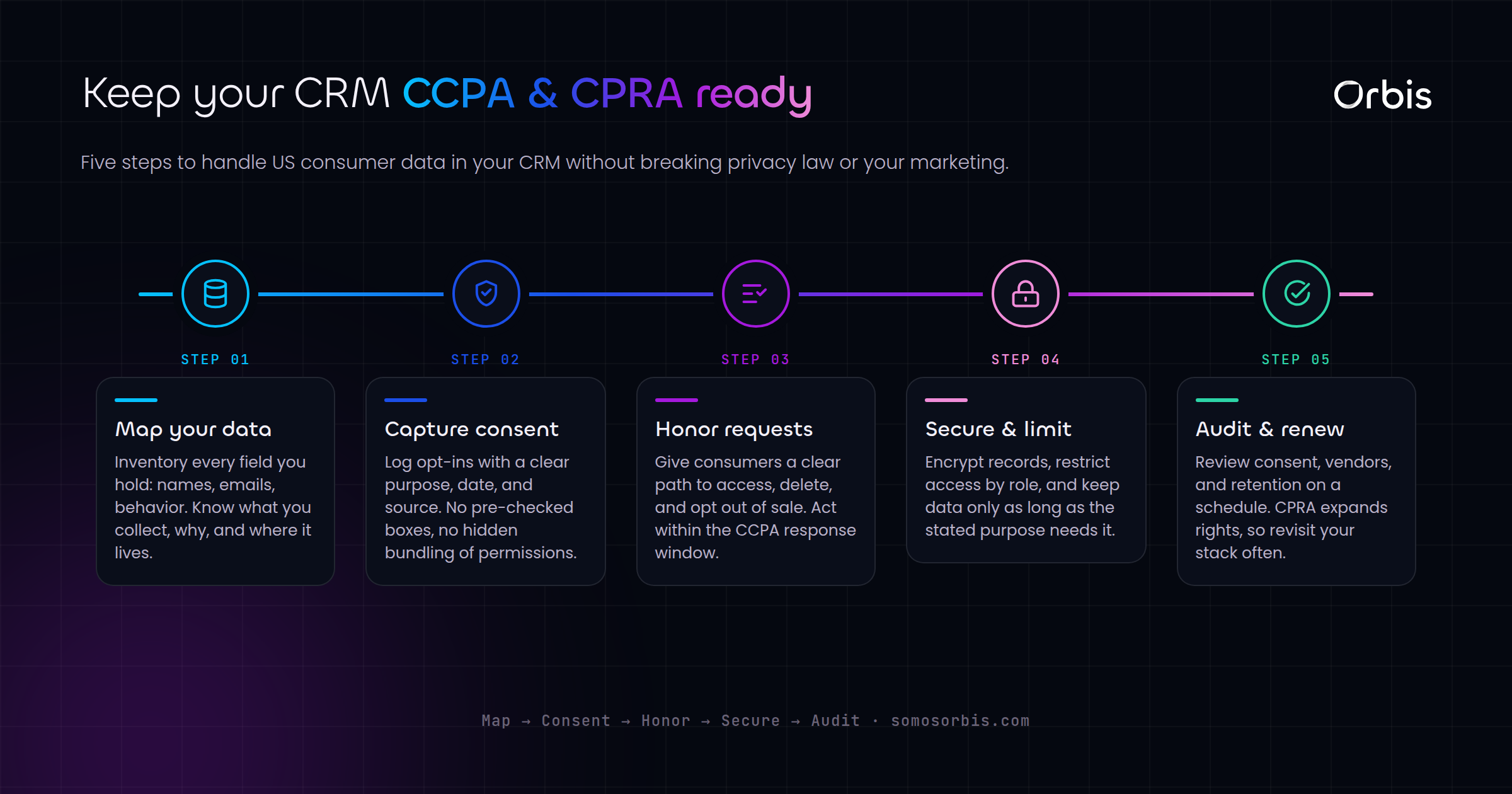
You cannot protect what you cannot see. The first practical step is a data inventory. Sit down with your marketing operations lead and answer four questions for every piece of customer data in your CRM.
- What do we collect? List every field: names, emails, phones, addresses, purchase history, browsing behavior, lead source, custom tags.
- Why do we collect it? Tie each field to a real marketing purpose. If you cannot name the purpose, that is a candidate for deletion.
- Where does it flow? Document every integration that touches the data: ad platforms, email tools, analytics, chat tools, data warehouses.
- How long do we keep it? Define a retention period. Lead data that has been cold for three years is liability, not opportunity.
This inventory is the foundation for everything else. Most teams are shocked at how much data they hoard with no purpose. A retailer running Amazon Prime Day promotions might discover dozens of abandoned custom fields from campaigns that ended years ago. Each one is risk with zero return.
Data minimization beats data hoarding
The instinct of many marketers is to collect everything, just in case. Resist it. The principle of data minimization says you should only collect what you actually use. A shorter form on your landing page often converts better and reduces your privacy exposure at the same time. If you do not need a date of birth to run a campaign, do not ask for it. Less data means less to secure, less to delete on request, and less to lose in a breach.
Build Consent and Preferences Into the CRM Itself
Consent is where marketing teams most often get into trouble. A pre-checked box, a buried opt-in, or a list purchased from a vendor can all undermine the trust your CRM depends on. The fix is to treat consent as structured data inside the CRM, not as a vague assumption.
Every contact record should carry consent fields that answer concrete questions. When did this person opt in? What did they opt in to: email, SMS, both? What was the source: a form, a checkout, a webinar? Has anything changed since? When consent is a timestamped, sourced field rather than a guess, you can prove permission and segment cleanly.
Give people a preference center
A preference center is a self-service page where customers choose what they hear from you and how often. It is one of the highest-leverage privacy tools a marketer can build because it shifts control to the customer while keeping them on your list. Instead of a binary unsubscribe, a parent in Houston managing back-to-school noise can dial down frequency rather than leaving entirely. That single feature recovers subscribers you would otherwise lose, and it signals respect.
The preference center should write directly back to the CRM so that every choice is reflected instantly in segments and automations. This is where solid plumbing matters. Connecting your forms, preference center, and downstream tools so consent flows correctly is exactly the kind of work that our systems and API integrations team handles, making sure a customer's choice in one place is honored everywhere.
Honor Data Requests Without Breaking a Sweat
When a customer asks to see or delete their data, the clock starts. US privacy norms generally expect timely responses, and a slow or sloppy process erodes the trust you are trying to protect. The teams that handle this well have turned it into a documented, repeatable workflow rather than a scramble.
Here is a practical request-handling sequence to build into your operations:
- Intake. Provide a clear channel for requests, such as a dedicated email or a form, and log every request the moment it arrives.
- Verify identity. Confirm the requester is who they claim to be before acting, so you never expose data to the wrong person.
- Locate every copy. Search your CRM and all connected systems. This is why your data inventory matters: you know where to look.
- Act and confirm. Fulfill the request, then tell the customer it is done. A clean confirmation closes the loop and builds confidence.
- Document. Keep a record of what was requested, when, and how you responded.
The hardest part is usually the "locate every copy" step. If a contact's data lives in your CRM, your email tool, your ad platform audiences, your warehouse, and a spreadsheet on someone's laptop, a deletion request becomes a manual hunt. Centralizing data flows and automating propagation of requests across tools turns a half-day chore into a few clicks. This is the backbone of well-designed marketing and sales automation, where a single action triggers the right downstream effects across your stack.
Secure the Data You Keep
Privacy and security are siblings. You can have perfect consent and still betray your customers if their data leaks. Marketers do not need to become security engineers, but you do need to insist on a few non-negotiables and make sure your operations partner enforces them.
- Limit access. Not everyone on the team needs to export the full database. Role-based permissions mean an intern running a campaign cannot download every customer record.
- Encrypt in transit and at rest. Customer data should be encrypted as it moves between tools and while it sits in storage.
- Audit your integrations. Every connected app is a potential door. Review which tools have access to your CRM and revoke the ones you no longer use.
- Plan for the worst. Have a documented response plan for a data incident so you are not improvising under pressure.
These are quality processes, not bureaucracy. They are the difference between a brand that recovers quickly from a problem and one that loses its customer base overnight.
Privacy Across the US Seasonal Calendar
US marketing runs on a seasonal rhythm, and each peak brings a flood of new data. The volume is exactly when privacy discipline matters most, because that is when shortcuts are most tempting.
- Black Friday and Cyber Monday. You will capture a huge wave of new leads and buyers. Make sure consent is captured cleanly at the point of sale, not assumed because someone bought once.
- Amazon Prime Day and other retail surges. High-velocity promotions tempt teams to import lists fast. Resist buying or scraping data; build your list with permission.
- Back-to-school season. Family-oriented campaigns can touch sensitive data about children. Be especially conservative about what you collect.
- Tax season. Financial services and adjacent verticals handle sensitive financial details. Tighten access controls and minimize what you store.
A privacy-by-design mindset means you build these guardrails before the rush, not during it. When your consent capture, retention rules, and request workflows are already wired into the CRM, a 10x spike in volume does not create a 10x spike in risk.
Serving the US Hispanic Market Respectfully
The US Hispanic market is large, fast-growing, and often underserved by bilingual experiences. Reaching it well is a real opportunity, and privacy is part of getting it right. If you offer forms, preference centers, and privacy notices in both English and Spanish, you give bilingual customers a genuine choice and a clearer understanding of what they are agreeing to.
Consent given in a language someone fully understands is stronger consent. A preference center available in Spanish for a customer in Los Angeles or Houston is not just a nicety; it is a trust-builder that improves both compliance and conversion. Treat bilingual privacy communication as a feature of your CRM, with language preference stored as a field that drives which version of every message and notice a contact receives.
Turn Privacy Into a Marketing Advantage
The brands winning right now are not the ones that collect the most data. They are the ones customers trust enough to share data willingly. When you ask clearly, explain plainly, store responsibly, and honor choices fast, you earn a kind of permission that no amount of ad spend can buy.
Practical privacy also makes your marketing better. Clean, consented, well-segmented data outperforms a bloated list of strangers. Deliverability improves when you mail people who actually want to hear from you. Personalization lands when it is based on data customers knowingly provided. Privacy and performance pull in the same direction once your CRM is built correctly.
Related guides for US teams
This article is part of a larger body of work on building a modern marketing stack. For the full picture, start with our pillar resource, The Complete Guide to Marketing Tech Implementations for US Teams in 2026, which ties privacy together with the rest of your tooling decisions. And because so much customer data now enters through conversational channels, it is worth reading how to handle it responsibly there too in our guide to chatbots for US customer service and lead capture.
Your Next Step
Privacy is not a one-time project. It is an operating standard baked into how your CRM collects, stores, and moves customer data every day. The teams that treat it that way spend less time firefighting and more time growing, because their data is clean, their customers trust them, and their systems do the heavy lifting.
If your consent capture is inconsistent, your data lives in too many disconnected tools, or honoring a deletion request still means a manual hunt, that is a plumbing problem with a clear fix. Our team can connect your stack so privacy is enforced automatically across every system. Start by exploring how our systems and API integrations work can give you a single, well-governed source of truth for customer data, and let your marketing run on a foundation your customers can trust.